The ice gleamed under the harsh lights of the Milano Ice Skating Arena as 21-year-old Ilia Malinin stepped onto the surface that had defined his entire life. For two years he had been untouchable—the Quad God, the only man to land a quadruple Axel in competition, the two-time world champion who had rewritten the rules of men’s figure skating with every explosive rotation. On Friday night, February 13, 2026, the Olympic free skate was supposed to be his coronation. Instead, it became the most jaw-dropping collapse in modern Olympic figure skating history.
Malinin began with the same quiet intensity that had carried him through 14 straight victories. The first quad toe loop was clean, the crowd roaring in relief. But then came the moment that cracked the myth. On the second element—an attempted quadruple Axel, the jump that had made him immortal—he flinched mid-air, rotated only three and a half times, and popped it into a shaky single. The gasp from 12,000 spectators echoed like a thunderclap. Seconds later, his quadruple Salchow downgraded to a double. By the time he launched into a quadruple Lutz, the wheels had come off completely: he fell hard, skidding across the ice on his hip. A second fall followed on a triple Axel combination. When the music finally stopped, Malinin stood in the center of the rink, chest heaving, eyes wide with disbelief. His free-skate score flashed: 156.33—15th place in the segment. Combined with his short-program lead of 108.16, his total of 264.49 dropped him to an unthinkable eighth overall.
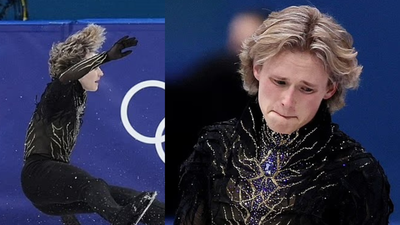
In the kiss-and-cry area, the American star could barely speak. “I blew it,” he told NBC’s Johnny Weir moments later, voice cracking. “Honestly, that was the first thing that came to my mind. I have no words.” For a skater who had never lost a senior international competition since 2023, the words carried the weight of shattered invincibility.
What made the night electric, however, was not just Malinin’s fall from grace. It was the man who rose in his place.
Mikhail Shaidorov, also 21, had skated earlier in the final group. The Kazakhstani entered the free skate in fifth place after a solid but unspectacular short program of 92.94. No one—not even his closest friends—expected what happened next. To the pulsing beats of “The Diva Dance” from The Fifth Element, Shaidorov unleashed a masterclass: five clean quadruple jumps, including a flawless quad toe-triple toe combination and a soaring quad Lutz. His edges were razor-sharp, his spins centered, his step sequences intricate and musical. When he struck his final pose, the arena erupted. Shaidorov dropped to his knees, hands clasped over his face in pure disbelief. As Malinin’s disastrous score was announced, the realization hit: 198.64 in the free skate, 291.58 overall. Olympic gold.
Kazakhstan had its first-ever figure skating Olympic champion—and only its second Winter Games gold medal since independence in 1991. Shaidorov, who had trained in a shopping-mall rink in Almaty before moving to Sochi to work with 1994 Olympic champion Alexei Urmanov, stood on the top step of the podium with tears streaming down his cheeks, braces glinting under the lights. Silver went to Japan’s Yuma Kagiyama (280.06), bronze to his teammate Shun Sato (274.90). France’s Adam Siao Him Fa, another pre-event favorite, also crumbled under pressure and finished outside the medals.
The drama unfolded in layers that night. After the short program on February 12, Malinin had led by more than five points—the largest margin in Olympic men’s skating in years. Analysts, coaches, and even rival skaters openly called the gold a foregone conclusion. “Ilia is in a league of his own,” Shaidorov himself had said earlier in the week, smiling at his American friend. The two had trained together at times, bonded over the brutal demands of quad-heavy programs. Now that friendship was tested in the most public way imaginable.

Malinin’s meltdown began subtly. Observers noted his usual swagger was missing from the first warm-up. His coach, Tatiana Malinina, later revealed he had felt “off” during the morning practice but insisted on pushing through. The Olympic pressure—something the Quad God had never truly faced in his meteoric rise—proved heavier than any jump. He had arrived in Milan as the face of U.S. figure skating, the heir to Nathan Chen, the athlete Sports Illustrated had already dubbed “the future of the sport.” Sponsors, media, and a nation expected gold. The ice, unforgiving as always, delivered a brutal lesson in humility.
Shaidorov’s performance, by contrast, was a masterclass in composure. The 21-year-old from Almaty had spent the season quietly building toward this moment. In 2025 he won Four Continents gold, took silver at Worlds behind Malinin, and landed history-making jump combinations that few others could match. Yet he remained an afterthought in Olympic previews, overshadowed by the American supernova and the deep Japanese contingent. Skating last among the top contenders, he knew exactly what he needed to do. “I just skated for myself,” he said afterward through a translator, still shaking. “I didn’t think about medals. I thought about the music, about the jumps. When I finished, I didn’t even know I had won until I saw Ilia’s score.”
The numbers tell only part of the story. Shaidorov’s technical element score of 114.68 led the entire field. His program components—83.96—reflected a maturity that had blossomed in the past year. He landed four quads cleanly and turned a planned triple Axel into a quad for good measure. The only skater to go clean in the final flight, he capitalized on mistakes from nearly everyone else. Malinin popped three jumps and fell twice. Kagiyama and Sato, while strong, each had one major error. The field, expected to be a quad arms race, instead became a survival test.
Figure skating has seen upsets before—Sarah Hughes in 2002, the “Battle of the Brians” in 1988—but few carried the shock value of this one. Malinin had not lost a free skate since he was 16. His personal-best total score stood at 333.81; on Olympic ice he scored 69 points less. The last time an Olympic favorite in men’s singles finished outside the medals was… no one could immediately recall. Christine Brennan, the veteran skating journalist, called it on live television “as big an upset in sports as we’ve probably ever seen.”
For Kazakhstan, the moment was seismic. The country of 20 million had never won Olympic figure skating gold. Its only previous Winter medal came from cross-country skier Vladimir Smirnov in 1994. Shaidorov’s victory instantly made him a national hero. President Kassym-Jomart Tokayev phoned him minutes after the podium. Back in Almaty, fans flooded the streets waving blue-and-yellow flags. In a nation still building its winter-sports infrastructure, this was more than a medal—it was proof that talent from the steppes could conquer the world.
Malinin, to his credit, handled the aftermath with grace. He hugged Shaidorov warmly in the mixed zone, congratulating his friend with genuine warmth. “He deserved it,” Malinin said later. “I’m happy for him. This is figure skating. One night can change everything.” He spoke of learning from the experience, of returning stronger. At 21, he still has another Olympic cycle ahead. The Quad God may have fallen, but the fire that made him legendary still burns.
Behind the drama lies the brutal reality of the sport. Men’s figure skating has become a quad-or-bust discipline. Malinin popularized the quadruple Axel; Shaidorov and others followed. Programs now demand six or seven quads across short and free skates, pushing bodies to the limit. Training hours stretch into the double digits. Mental preparation is as critical as physical. Coaches whisper about the “Olympic curse”—the invisible weight that turns champions into mortals under the five-ring spotlight.
Shaidorov’s coach Alexei Urmanov, himself an Olympic champion, had prepared his pupil for exactly this scenario. “We trained under pressure every day,” Urmanov said. “Misha knows how to stay calm when others panic.” That preparation paid off in the most spectacular way.
In the days following the event, social media exploded. #QuadGod trended alongside #ShaidorovGold. Memes flooded timelines: Malinin’s falls juxtaposed with Shaidorov’s joyful collapse to the ice. Analysts dissected every takeoff, every landing edge. Some blamed Malinin’s coach for an overly ambitious layout; others pointed to the absence of a sports psychologist in his inner circle. Most simply marveled at the poetry of sport—how the surest thing in skating became the greatest upset.
For American figure skating, the result stings. The U.S. had hoped for its first men’s Olympic gold since Evan Lysacek in 2010. Instead, it watched its brightest star finish eighth. Yet the program’s depth remains impressive: several young Americans are already landing quads and eyeing 2030. Malinin’s story will become part of the sport’s lore—the champion who learned on the biggest stage that invincibility is an illusion.
Shaidorov, meanwhile, returns home a legend. He has already been offered endorsement deals, a parade in Almaty, and a meeting with the national hockey team. At 21, with braces still on his teeth and a shy smile that lights up every interview, he represents the new face of figure skating: global, diverse, hungry.
As the arena lights dimmed in Milan that night, two young men walked out together— one carrying the weight of disappointment, the other the weight of history. Ilia Malinin and Mikhail Shaidorov embraced once more at the exit. “See you at Worlds,” Shaidorov said. Malinin nodded, eyes determined. “Count on it.”
The Quad God had fallen. A new champion had risen. And figure skating, in all its heartbreaking, breathtaking glory, reminded the world why we can never look away.