He Saved the Maid’s Dying Daughter—Then She Saved His Empty Heart
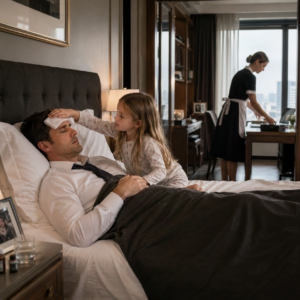
My mansion was not a home; it was a museum of solitude. Spanning over eight hundred square meters, with cold marble walls and endless, haunting corridors, this villa was a fortress where Julian Thorne sequestered himself after every grueling day of corporate warfare. To the outside world, I was the city’s most formidable CEO, the bachelor every socialite wanted. But they never saw the man dining alone in a cavernous hall, where the clink of silverware against porcelain echoed like a death knell for my emptiness.
I hired Elena Vance on a rainy afternoon. She wasn’t like the professional help I usually interviewed. She was fragile, her face etched with a quiet sorrow, and she held the hand of a small child—Sophie, a four-year-old with eyes as round and bright as marbles.
“I need a housekeeper, not a daycare,” I had said, my voice cold, the steel of a man who had forgotten how to be kind.
Elena didn’t argue. She simply bowed her head, her fingers tightening around her daughter’s small hand. “Mr. Thorne, she is very well-behaved. She won’t disturb you. We just need a place to shelter until the winter passes.”
I don’t know why I nodded. Perhaps it was Sophie’s eyes. She looked at me without the fear that my business partners wore every day. She looked at me as if she were seeing… a human being, not a balance sheet.
I relegated them to the basement. It was originally an old storage room, but I had it cleaned, fitted with a heater, and carpeted. To me, it was just a convenient arrangement. To them, it was a lifeline.
The following days continued as a blur of numbers and conference calls, but the absolute silence of the house began to develop small cracks. Cracks named Sophie.
One evening, returning from a meeting so intense it felt like my head might explode, I found Sophie sitting at the foot of the stairs. She was holding a toy she had fashioned out of paper.
“Mr. Julian?” she chirped.
I stopped, my brow furrowed. “I told you not to disturb me.”
She didn’t flinch. She held the toy up. “Look. It’s a bird. It had a broken wing like the one in the garden, but I fixed it with tape. Now it can fly again.”
I looked at the crude, crooked paper bird. The sheer sincerity in her childlike eyes made a strange ache bloom in my chest. I didn’t answer; I just brushed past her. But that night, in my dark study, I didn’t open my laptop to review reports. I couldn’t stop thinking about the paper bird.
The bond began to form through the smallest of gestures.
Elena was reserved, working diligently and quietly like a shadow. But Sophie was different. She was a ray of light spilling into the dark basement of my life. Sometimes, she would sneak a piece of candy onto my desk with a drawing of a man with a grumpy face.
“Why do you always frown?” she asked one day when I came downstairs to tell Elena to bring me some tea.
“Because work is exhausting,” I replied.
The child ran over and hugged my leg. A warm, spontaneous hug, devoid of calculation or self-interest. “You don’t need to work so hard. Mom says if I finish my rice, I’ll grow up strong. You should eat Mom’s cooking, too, and then you won’t frown anymore.”
In that moment, the steel armor of a cold CEO began to melt. I had forgotten what it felt like to be cared for. I had lived in a state of defense, in a world of power struggles where people only approached me for money or status. But Sophie—she only saw me.
I began to change. I stopped coming home and locking myself in my office. I started sitting in the living room, occasionally listening to Sophie’s giggles as she played. I began to ask Elena about her struggles. I learned that Elena had been abandoned by her ex-husband and had worked countless odd jobs to raise her child.
My initial pity slowly transformed into genuine respect. Elena was a brave mother. And Sophie—she was the most precious gift life had ever thrown into my empty house.
One winter night, a fever struck Sophie. The sound of her weak crying from the basement made it impossible for me to sleep. I ran down and found Elena panicked, trying to cool her daughter down but feeling helpless.
Without a second thought, I scooped Sophie up and ran straight to the car. “To the hospital!” I commanded the driver.
I sat outside the hospital room all night, my tie loosened, my shirt wrinkled. Elena sat beside me, trembling. I realized I was worried—a pure, human anxiety that had nothing to do with dividends or stock prices. When the doctor announced that Sophie’s fever had broken, I felt a thousand-pound weight lift from my chest.
Sophie woke up and offered a weak smile when she saw me. “Mr. Julian… you’re a superhero.”
I laughed. For the first time in years, I laughed out loud.
After that day, my house was no longer just a “place to stay.” It had truly become a home. I no longer viewed Elena as just a housekeeper, and Sophie was no longer just the maid’s daughter.
I had a spacious room upstairs, filled with sunlight, renovated for them. I encouraged Elena to pursue further education, and Sophie was enrolled in the best school. I wasn’t her father, but I realized I had found a new role: the protector of their happiness.
On weekends, there were no more meetings. We cooked together, and I read stories to Sophie before bed. I taught her how to draw a real bird, replacing the crooked paper ones.
One afternoon, as golden sunlight bathed the lawn in front of the villa, Sophie ran around me. Elena stood nearby, offering a gentle, grateful smile. I looked at them, then reflected on my own image in the mirror. The cold CEO I once was had learned how to love, how to be patient, and above all, how to be happy.
It turned out that the most valuable things in life aren’t hidden in safes or millions of dollars in contracts. They are found in a small hand held in yours, in a warm meal, and in the laughter of a child.
I had saved Elena and Sophie’s lives, but in truth, they had saved my soul.
The villa was no longer empty. It was filled with warmth, laughter, and a sense of belonging I once thought I would never touch. This wasn’t just a happy ending for a mother and daughter; it was the beginning of a new chapter of true happiness for me—the life of a man who found a family amidst the cold walls.
As I watched Sophie playing and Elena standing there, bathed in happiness, I silently thanked the lonely years that had passed. If not for that void, I would never have known how to cherish the warmth that now rested in my hands.