Grease and Grace: The Single Woman’s Bold Bet That Melted the Mechanic’s Rough Exterior
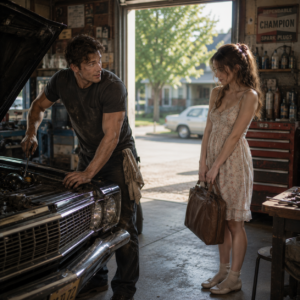
The bell above the door of “Miller’s Auto & Repair” let out a rusty, wheezing protest as I stepped inside. The air was thick with the scent of motor oil, old coffee, and a kind of chaos that made my pulse quicken. I wasn’t here because I loved engines; I was here because the stack of medical bills for my mother’s physical therapy was threatening to bury us alive.
I’m Sharon. I’ve always been good at fixing things—logistics, schedules, broken budgets—but I had never walked into a place like this.
Behind the front desk sat Jesus. He looked like he’d been wrestling a transmission for six hours straight. He didn’t look up as I approached. “We’re booked out for three weeks, lady. And if you’re looking for a bathroom, it’s out back. Don’t clog it.”
I stood my ground, my resume clutched in my hand like a shield. “I’m not a customer. I’m an applicant. I saw the sign in the window.”
Jesus finally looked up. His eyes were dark, tired, and deeply guarded. He leaned back, his chair creaking. He gave me a slow, mocking once-over that made my skin crawl. “A job? Honey, this is a garage. We don’t have desk jobs, and we certainly don’t have room for someone who looks like they’ve never touched a wrench.”
I felt the heat rising in my cheeks, but I refused to let it show. I had spent months being told ‘no’ by people who didn’t know what I was capable of.
He smirked, clearly trying to make me the punchline of his own miserable day. “Tell you what. I’m tired of dealing with people. I don’t want an employee to manage my chaos; I want a wife who can handle my mess. You interested in that?”
The room went silent, save for the hum of a distant compressor. My grip on the resume tightened until the paper crinkled. I didn’t cry, and I didn’t run. I took a step closer, placing the resume firmly on his greasy desk.
“I’m here to save your business, Jesus, not your social life,” I said, my voice steady despite the tremor in my knees. “Your books are a disaster, your scheduling is non-existent, and you’re losing money because you’re too busy trying to be a clown instead of a business owner. Take the resume. If I’m not running this shop better than you are by Friday, I’ll leave for free. If I am, you pay me double the hourly rate.”
He stared at me, his smirk faltering. For a second, he looked genuinely stunned. Then, he let out a short, sharp laugh and tossed the paper aside. “Fine. Start now. Don’t touch the cars.”
The first week was a war of attrition. I spent eighteen hours a day cleaning, organizing, and digitizing records that were essentially scrap paper. Jesus spent the first two days watching me like a hawk, waiting for me to quit or mess up.
But I didn’t. I noticed the way he worked—with a terrifying, beautiful precision when it came to engines, but with a blind, panicked incompetence when it came to everything else.
The drama hit on Thursday. A major supplier, the one Jesus had been neglecting for months, showed up to repo our diagnostic equipment. Jesus was ready to scream, to fight, to make a scene. He was running on pure, masculine pride.
I stepped in. I didn’t shout. I pulled out the payment schedule I had negotiated with the regional manager the night before—a schedule that gave us the breathing room we desperately needed. The supplier walked away, confused but satisfied.
When the door closed, Jesus looked at me. The bravado was gone. “Why?” he asked. “Why didn’t you let me blow up?”
“Because blowing up doesn’t keep the lights on,” I said, wiping oil off my hands. “You think being tough is the only way to survive. You’re wrong. It’s just the easiest way to end up alone.”
The twist came two weeks later. I was looking through a file cabinet in the back when I found a folder marked ‘Legal.’ Inside were papers detailing a lawsuit against the shop—a claim that Jesus had purposely damaged a high-end luxury vehicle. The claimant was a wealthy local developer who had been trying to buy the garage’s land for years.
Jesus had been hiding it because he was terrified that if he told anyone, he’d lose the shop anyway. He was drowning in his own silence.
I didn’t confront him in the shop. I waited until closing time. When he finally locked the heavy iron doors, he sat on the curb, his head in his hands.
“I’m going to lose it, Sharon,” he whispered. “The land, the legacy… everything. I’m a joke.”
I sat down next to him. I didn’t offer a platitude. I offered a strategy. “You’re not losing anything. That developer is a shark, but sharks have weaknesses. I know the auditor who handled that vehicle claim. If we show them the original logs I digitized last week—the ones that prove the damage happened after the car left our lot—that lawsuit collapses.”
He looked at me, and for the first time, there was no awkwardness, no sarcasm. Just a raw, vulnerable respect. “You didn’t have to do this,” he said. “You could have walked away when you saw the mess.”
“I told you,” I replied, my heart beating a little too fast. “I don’t walk away from things that need fixing.”
The resolution wasn’t overnight. The lawsuit took months to dismantle, but we did it. The shop didn’t just survive; it started to thrive. The paperwork was clean, the customers were happy, and Jesus started actually talking to me—about his past, his fear of failure, and his realization that he had been pushing people away to avoid getting hurt.
But then, the boundaries started to blur.
He started bringing me flowers, not as a joke, but as a genuine thank you. He started asking about my mother, checking in on her health. And I started realizing that the man who had asked for a ‘wife’ as a joke was slowly becoming the partner I hadn’t realized I was looking for.
One evening, after we had finished a late-shift inventory, he walked over to me. The air was different—no longer heavy with tension, but charged with something gentle.
“I meant what I said that first day,” he started, his voice rough.
I tensed, ready to walk away if he was about to make another joke. “Jesus, if you’re going to make a crack about hiring a spouse—”
“I’m not,” he interrupted, stepping into my space. “I said I wanted a wife because I was too scared to admit I wanted a partner. I wanted someone who could handle my mess, but I didn’t realize I needed someone who could stand with me, not just for me. I’m sorry I was a jerk. I’m sorry I made you fight for a seat at the table. Will you stay? Not as an employee, and not because you’re obligated by kindness. But because… because I’ve finally learned how to be the man you deserve?”
I looked at him—really looked at him. I saw the callouses, the tired eyes, and the genuine, unvarnished effort he had made to earn my trust.
“I don’t need a savior, Jesus,” I said, feeling the weight of the last few months lift off my chest.
“I know,” he smiled, reaching out to take my hand, his touch warm and steady. “I’m not looking for a savior. I’m looking for an equal.”
He didn’t try to kiss me then. He just held my hand, a silent promise of a future where we didn’t have to be ‘tough’ to be happy.
We eventually opened a second location. My mother’s medical bills were paid, not just by my salary, but by the profit-sharing plan we built together. It wasn’t the fairy-tale life I had imagined, and the garage was still greasy, but for the first time in my life, I felt like I was exactly where I was meant to be.
We learned that trust isn’t a gift you get on day one—it’s something you build, bolt by bolt, just like a car engine. And sometimes, the most painful first impressions are just the rough surface of something much deeper and much more precious waiting to be discovered underneath.