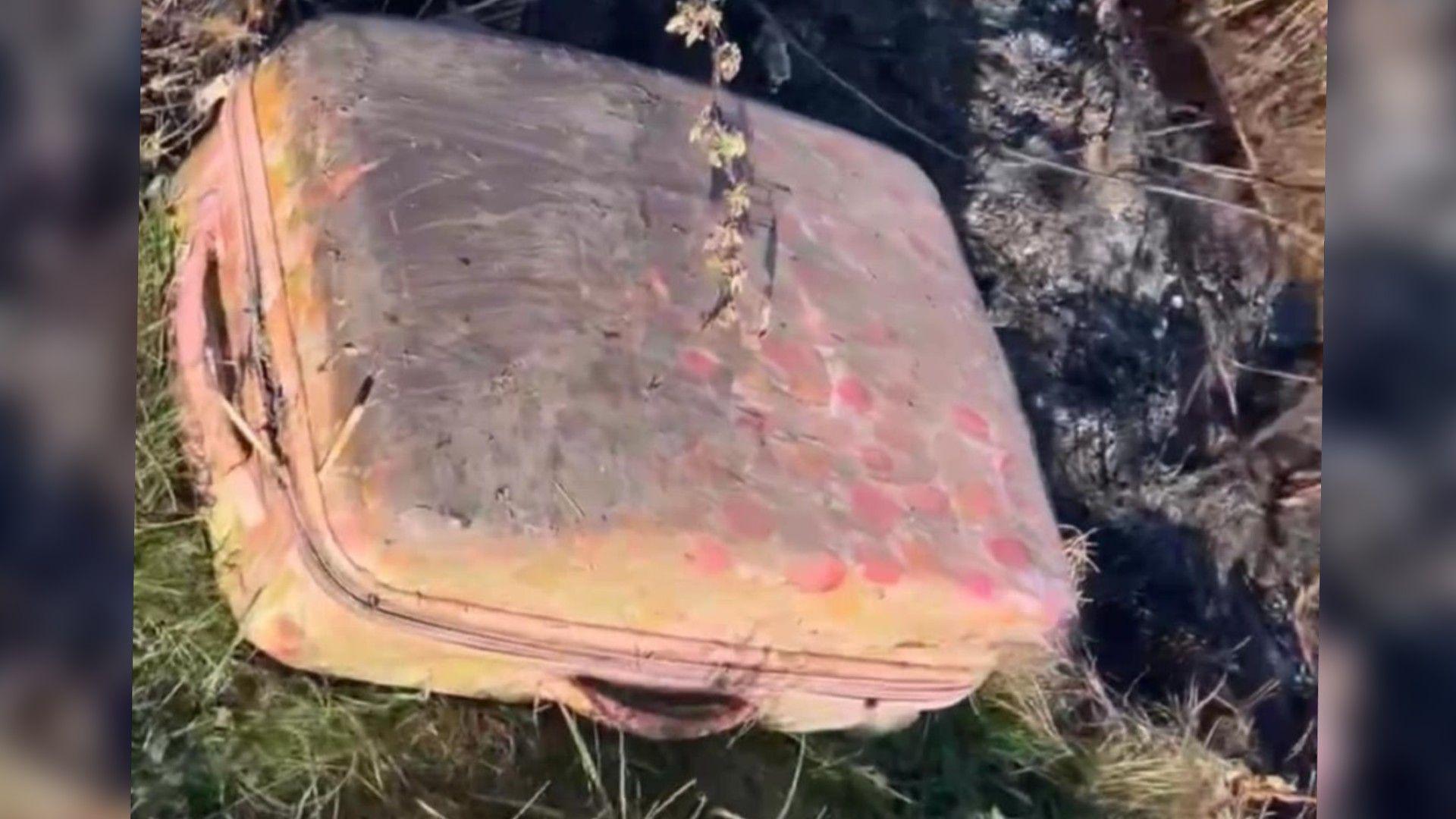
A man out for an ordinary evening walk with his dog never imagined he would stumble upon the kind of horror that haunts a city for generations. It was Monday, March 2, 2026, around dusk in Cleveland’s South Collinwood neighborhood. Phillip Donaldson followed his dog along the familiar path near Saranac Playground, just off East 162nd Street and Midland Avenue, close to the sprawling field behind Ginn Academy. The dog suddenly froze, sniffing intently at a suspicious pile of dirt along a fence line. Something felt wrong. Donaldson stepped closer, noticed the edge of a suitcase half-buried in the shallow grave, and—driven by a mix of curiosity and dread—unzipped it.
What he saw stopped his heart: the face of a child. A young girl’s head. He didn’t touch anything else. Hands shaking, he dialed 911 immediately. “It was like a pile of dirt, and she stopped to sniff,” Donaldson later told FOX 8, his voice still raw. “I usually just walk, and she catch up with me and she was taking too long. So I went back and looked, and it was a suitcase that was half buried… I pulled it up and looked in it, and it was a head. Somebody’s head in it.” He added that he had walked past that same mound of dirt for at least a week without realizing what lay beneath. “I had been walking past that for at least a week… and I check it. Was it buried? Yeah, it was buried pretty much, you could see just the very top of it.”
Within minutes, Cleveland police swarmed the isolated stretch of overgrown field—an area locals know too well as a dumping ground for old mattresses, broken appliances, and forgotten trash. Officers secured the first suitcase, confirmed the grim contents, and began a frantic search of the surrounding ground. Just yards away, hidden in another shallow grave, they found a second suitcase. Inside was another child. Two young Black girls. Both dead. Both unidentified. Both discarded like unwanted luggage in the cold Ohio dirt.
The discovery sent shockwaves through Cleveland and beyond. By Tuesday afternoon, March 3, Cleveland Police Chief Dorothy Todd stood before cameras at a hastily called press conference, her face etched with the weight of what her officers had uncovered. “This is a traumatic event for our officers, for the community,” she said. “This is just such a tragic incident, but we are trying to develop any leads we can. That’s why we are also asking for the community’s help.” She described the scene as “a terrible, horrific situation.” Todd emphasized that the girls’ bodies were found intact—not dismembered—and that preliminary estimates placed one victim between 8½ and 13 years old, the other between 10½ and 14. Both were Black. No names. No families stepping forward. And, most chilling of all, no active missing persons reports in Cleveland or the immediate region that matched their descriptions.
Investigators with the Cleveland Division of Police Homicide Unit immediately launched a 24-hour tip line—216-623-5463—and urged anyone with information to call or contact Cuyahoga County Crime Stoppers at 216-252-7463. The bodies were transported to the Cuyahoga County Medical Examiner’s Office, where autopsies would begin the agonizing process of determining how these children died and how long they had been buried. Early indications suggested they had been there “for some time.” Recent heavy snowfall, the kind that blankets Cleveland in late winter, may have hidden the shallow graves beneath fresh powder, turning a visible horror into something the community walked past unknowingly for days or even longer.
The location itself adds layers of heartbreak and outrage. Ginn Academy, an all-boys public school, sits just across the field. Parents who dropped their sons off that Tuesday morning learned the news with dawning terror. One mother, Erica Allen, told local reporters her son called her in tears. “My son called me this morning, telling me what was going on… I wish it wasn’t happening at all. I just want to keep them in a bubble. But you can’t do that. I’m praying for the families… hoping that they get justice and peace.” Nearby businesses and homes line the streets, yet the field is isolated enough that foot traffic is minimal—an ideal spot, some feared, for someone who wanted the bodies to disappear.
Ward 10 Councilman Mike Polensek, who chairs the public safety committee and rushed to the scene the night of the discovery, did not mince words. “Extremely devastating,” he said. “I was there last night when they found the first one, and then I was there when they found the second one… To say the least, I’m very upset about the lack of respect not only to myself as the councilman but also as chairman of public safety.” Polensek grilled investigators on camera checks—neighborhood homes, businesses, and especially the school’s security system. He pointed out the area’s long-standing problem with illegal dumping. “It’s a very low crime area in that area but it’s an area where we’ve experienced illegal dumping and maybe that was the attraction… thinking that if I’m going to dump somebody or remains that with all the other illegal dumping… they thought maybe this would never be discovered.”
Cleveland Mayor Justin Bibb released a blistering statement the same day: “This heinous crime, in which the bodies of two young children were abandoned, is deeply disturbing. These were children who had their entire lives ahead of them. Whoever is responsible for depriving them of their futures should be held fully accountable under the law. Our Division of Police is pursuing every lead, carefully reviewing all available evidence, and deploying all necessary resources. They will not stop working until those responsible for this tragic and inhumane act are identified and brought to justice.”
As the investigation intensified, detectives fanned out across the neighborhood, knocking on doors and canvassing for security camera footage. Chief Todd specifically asked residents to review their own home videos for anyone “lingering in the area or who doesn’t belong.” The suitcases themselves—ordinary pieces of luggage—could become crucial evidence once examined for fingerprints, DNA, purchase history, or manufacturer markings. Forensic teams are also scouring the graves for trace evidence: fibers, footprints, tire tracks, anything the snow and time might have spared.
The absence of matching missing persons reports is what troubles authorities most. In an age of Amber Alerts, social media, and instant national databases, two girls this age vanishing without a trace anywhere in Ohio—or beyond—defies easy explanation. Investigators have expanded their search statewide and nationwide. Could the children have come from another state? Were they hidden from the system by abusive guardians who never reported them missing? Or worse—were they never reported because the very people responsible for their deaths controlled the narrative? These are the questions keeping homicide detectives awake at night.
Community activist Antoine Tolbert, known locally as Chairman Fahiem with New Era Cleveland, stood among the growing crowd of onlookers and spoke of deeper systemic pain. “It just further pushes me in the direction of empowering community,” he said. “We’re waiting on systems to change, to come save us, but look at what’s happened… When I see repetitive cycles, I start to realize that there’s something that I have to do to change.” Tolbert’s message carried a broader call to action: “If we look at a thing from a holistic perspective in the Black and brown community, our women are unprotected, our children are unprotected… The frustration, the sadness, the fear, the lack of safety is like foundational in our communities, and so my message to all people is that we all have an active role to play.”
M-PAC Cleveland, a local advocacy group, echoed that sentiment and announced an emergency community meeting for March 10 at 5:30 p.m. at 12403 Superior Avenue. Organizers promised space for prayer, healing, conversation about safety, and collective care. “This impact the emotional safety of an entire neighborhood,” their statement read. “When tragedies occur, the ripple effects show up as fear, grief, and uncertainty for families who simply want to feel safe where they live.”
The discovery has already changed daily life in South Collinwood. Parents are keeping closer watch on their children. Residents who once left doors unlocked are double-checking them. One longtime neighbor, Cheryl Young, who has lived across the street for 26 years, told reporters she now feels afraid in her own home. “It’s shocking and frightening… I still live over here, and I got to live here. I don’t want anything happen to me.” Another resident, James Buchanan, summed up the collective frustration: “Right around the corner from me, yeah, very much concerning. It’s just crime everywhere. I don’t know what we’re going to do to do better, but we’ve got to do something soon… I would hope that the police find who did that and justice is restored back to the people and their families.”
Business owner Allen Harrison, whose shop sits nearby, spoke for many when he said, “I feel kind of messed up because it’s two young kids… There’s a lot of cameras, so hopefully something like that can help… You hope police are able to piece this together and bring some closure to the families? Yes. I hope so. I hope so.”
The suitcases have already invited grim comparisons in true-crime circles. Fox News itself linked the story to its coverage of the infamous “Suitcase Killer,” Melanie McGuire, who dismembered her husband and packed his remains into luggage before dumping them in the Chesapeake Bay. While the Cleveland case involves no dismemberment and entirely different victims, the imagery of children zipped inside ordinary travel bags and buried like garbage has struck a nerve nationwide. Social media exploded with theories, prayers, and demands for answers. Some users posted photos of the scene—police tape fluttering against a chain-link fence, evidence markers dotting the snow-dusted field—while others shared the tip line number with pleas for information.
For now, the investigation remains in its earliest, most delicate phase. The medical examiner’s report could take days or weeks. DNA profiling, dental records, and possible clothing or jewelry analysis will be critical in identifying the girls so their families—if any are still alive—can be notified and the children given proper burials. Until then, two small bodies lie in a morgue, their stories silenced but not forgotten.
Cleveland has seen its share of heartbreak. From the 2012 Ariel Castro kidnappings to countless unsolved homicides, the city has learned how to mourn while demanding better. But the image of two little girls stuffed into suitcases and left in a field near a school playground feels different—more intimate, more unforgivable. It forces every parent to confront the unthinkable: children who should have been protected, loved, and safe, instead discarded in the most dehumanizing way possible.
Chief Todd and her team insist there is “no indication this is a clear threat to safety” for the broader public, yet the message carries an unspoken caveat: whoever did this walked among us, chose this spot, dug these graves, and vanished. The heavy snow that may have concealed the crime for days or weeks also bought the perpetrator precious time. Every hour that passes without identification or arrest deepens the mystery.
Police are now combing through every possible lead: surveillance from nearby homes and businesses, traffic cameras on East 162nd, even doorbell footage from blocks away. They are cross-referencing the suitcases’ make, model, and any serial numbers against sales records. Canvassers are knocking on every door within a widening radius, asking the same questions: Did you see anyone carrying luggage? Did you notice fresh dirt piles before the snow? Did anything seem out of place near the playground?
Phillip Donaldson, the man whose dog refused to walk past that fateful mound, has not slept since Monday night. “I was completely shocked and disturbed,” he said, “especially since there is a school, the Ginn Academy, nearby. It’s really sad to see something like this.” His simple act of investigation—going back to check on his dog—may have saved the second suitcase from remaining hidden forever. In a cruel twist of fate, one man’s ordinary walk became the catalyst that brought two murdered children into the light.
As Cleveland wakes up each morning under gray March skies, the city carries a new burden. Two girls with no names yet, no known families, no recorded disappearances. Two lives reduced to evidence tags and headlines. But the community refuses to let them remain anonymous. Tips are already pouring in. Cameras are being reviewed. Neighbors who once nodded politely now stop to talk, to share what they saw or what they fear.
The shallow graves have been excavated and documented. The field near Saranac Playground stands cordoned off, a temporary scar on the landscape. Soon the tape will come down, but the questions will linger: Who were these girls? How did they die? Who carried those suitcases under cover of night or storm? And most haunting of all—who could do such a thing to children and then walk away?
Cleveland Police have made one thing crystal clear: they will not rest. The homicide unit is working around the clock. State and federal databases are being searched. Every resource is on the table. And the public—parents, grandparents, teachers, strangers across the country—are being asked to do their part. Check your cameras. Search your memory. If you saw anything unusual near East 162nd and Midland in the weeks before March 2, speak up.
Because somewhere out there, perhaps still in the city or hundreds of miles away, someone knows these girls’ names. Someone knows what happened in the days or weeks before those suitcases were buried. And someone, somewhere, is carrying the unbearable weight of that knowledge.
The two young victims deserve more than a field for a grave and headlines for a legacy. They deserve justice. They deserve to be remembered not just as “the girls in the suitcases” but as daughters, sisters, friends whose lives were stolen too soon. Until their names are known and their killer is caught, Cleveland—and anyone who reads this story—carries a shared responsibility: to keep looking, keep asking, keep demanding answers.
The tip line is open 24 hours a day. The city is watching. The nation is watching. And two small souls, zipped inside ordinary luggage and left in the dirt, are finally being heard.