Chilling Irony Revealed 🌊 She Spent Free Time Kayaking The Same Lake Where Fatal Dive Training Took Her LifeShocking Loss Shakes South Carolina 🚨
Master Deputy Jillian Olson never returned from the depths of Lake Murray. The 29-year-old Lexington County sheriff’s deputy died during a routine dive team training exercise on the sprawling South Carolina reservoir, cutting short a career defined by quiet dedication and a willingness to take on the most demanding assignments. What began as a standard underwater session on Thursday ended in tragedy, leaving colleagues, family, and a tight-knit community searching for answers while mourning a young officer who had already logged more than 100 hours beneath the surface.
Olson had joined the Lexington County Sheriff’s Department dive team in 2024. In the relatively short time since, she had distinguished herself as a reliable and skilled member of the unit, logging extensive time in the water that far exceeded the minimum expectations. Officials confirmed she brought the same intensity to dive training that she applied to every other part of her job. The Lexington County Coroner’s Office is investigating the exact cause and manner of her death. Recovery efforts were led by the South Carolina Department of Natural Resources Investigations Unit and its Aquatics Investigation and Recovery team, with assistance from the South Carolina Law Enforcement Division.
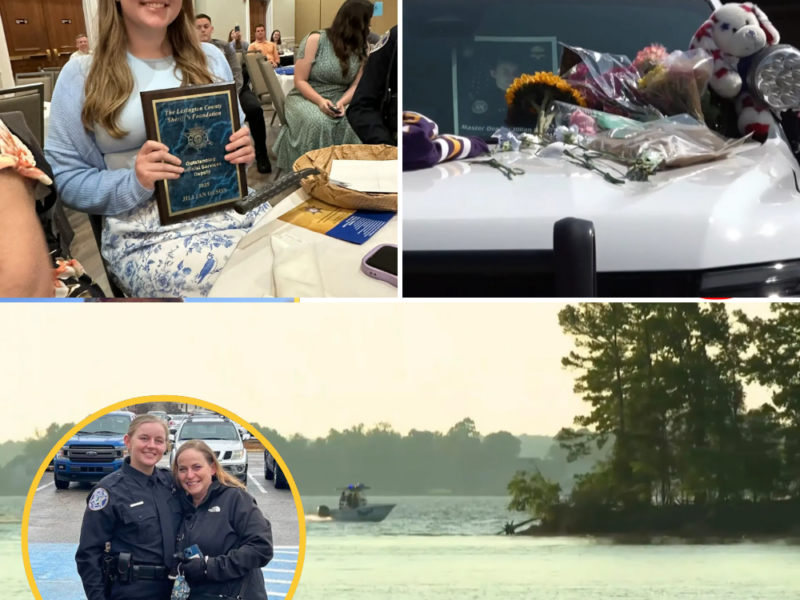
Sheriff Jay Koon released a statement expressing gratitude to the many agencies that responded without hesitation. “I would like to express my thanks to the countless public safety agencies that responded without hesitation from across the whole state to help us in our time of need,” he said. The loss was felt immediately across the department. Olson’s patrol cruiser became an informal memorial site outside the sheriff’s office, where colleagues, friends, and members of the public left flowers and teddy bears in her honor.
Her path into law enforcement began far from the Carolina lakes. A native of Illinois, Olson graduated from Western Illinois University in 2019 with a bachelor’s degree in law enforcement and justice administration. She later earned a master’s degree in student personnel services. Those academic foundations prepared her for a career she approached with clear purpose. She joined the Lexington County Sheriff’s Department in 2021 and rose steadily through the ranks. By 2025 she had been promoted to master deputy in the warrants division. Along the way she collected notable recognition, including the Sheriff’s Tactical Operations Support Award in 2023 and the Outstanding Judicial Services Deputy of the Year honor. She was scheduled to receive a five-year honorable service award the following month—an acknowledgment of consistent performance that she would never collect.
Those who knew her well describe a woman driven by something deeper than professional ambition. Pastor Frank Anderson of St. Michael Lutheran Church had known Olson and her family for decades. He baptized her himself and watched her grow into an adult whose faith shaped her choices. “She had a deep faith and I think that deep faith was the motivation for her to want to be a helper and serve other people,” Anderson said. “She had an altruistic heart.” That sense of service, he explained, explained both her decision to become a deputy and her later choice to join the dive team—an assignment that demands physical endurance, technical skill, and a willingness to operate in environments most officers never experience.
Lake Murray itself is no ordinary body of water. Constructed in the 1920s to generate hydroelectric power, the man-made reservoir covers roughly 48,000 to 50,000 acres and features more than 650 miles of shoreline. Average depth sits around 41 feet, but certain areas plunge nearly 200 feet. The lake is both a recreational destination and a working landscape, and for Olson it had become something more personal. Her family had recently purchased a house on its shores. In her limited free time she kayaked, paddle-boarded, and jet-skied across its surface, seeking the quiet that stood in contrast to the demands of her job. “She enjoyed the serenity and the quiet of the lake in the midst of her busy career as a sheriff’s deputy,” Anderson recalled. The same waters that offered her peace ultimately claimed her life during a training exercise intended to prepare her for the very emergencies she might one day face on duty.
The dive team’s work is inherently hazardous. Underwater operations involve limited visibility, equipment management, physical stress, and the constant possibility of equipment failure or environmental complications. Training is designed to reduce those risks through repetition and discipline. Olson had embraced that preparation. Colleagues and supervisors repeatedly noted her willingness to go beyond standard requirements. Sheriff Koon described her decision to join the dive team as “just one example of her going above and beyond.” That characterization matches the portrait painted by those who knew her longest: a deputy who sought out the harder assignments rather than avoiding them.
News of her death spread quickly through the law-enforcement community in South Carolina and beyond. Fellow officers from surrounding counties and state agencies responded to the scene and later offered support to the Lexington County department. The outpouring reflected both professional solidarity and genuine personal regard for a young deputy who had already made an impression in a relatively short career. The informal memorial that formed around her cruiser—flowers, stuffed animals, handwritten notes—served as a visible expression of that respect.
As the coroner’s investigation continues, many questions remain unanswered. What specifically went wrong during the underwater session? Was there an equipment malfunction, a medical event, or another factor still to be determined? Officials have released few operational details while the inquiry proceeds. What is already clear is the human cost. A 29-year-old officer with a strong service record, a deep personal faith, and a demonstrated willingness to take on difficult work is gone. Her family has lost a daughter. The department has lost a colleague. The dive team has lost a member who had already invested more than 100 hours in the water.
Olson’s funeral is scheduled for Wednesday. In the days leading up to it, the department and the community continue to process the suddenness of the loss. Training accidents are rare, yet when they occur they strike with particular force because they happen during the very preparation meant to prevent line-of-duty deaths. The irony is not lost on those who knew her. The lake she loved for recreation became the site of her final training session. The skills she was refining in order to help others ultimately could not save her.
Those closest to Olson emphasize the consistency of her character. From her academic choices to her decision to enter law enforcement, from her steady promotions to her voluntary service on the dive team, the same themes appear: service, competence, and a quiet determination to be useful. Pastor Anderson’s description of an “altruistic heart” seems to capture the consensus. In a profession that regularly asks officers to place themselves in harm’s way, Olson had chosen one of the more specialized and physically demanding paths available to her.
Lake Murray will continue to host recreational boaters, anglers, and the occasional emergency response. For the Lexington County Sheriff’s Department, however, the reservoir now carries an additional weight. A young master deputy who once trained in its waters will not return to the surface. Her colleagues will remember the hours she spent preparing, the awards she earned, and the faith that colleagues and her pastor say guided her work. The investigation will eventually provide a technical explanation for what happened on Thursday. The fuller story of Jillian Olson’s short career will be told in the memories of those who served alongside her and in the quiet example she set by repeatedly choosing the harder assignment.