The ad titled “American Icons” by Budweiser, released for Super Bowl LX in 2026, is a 60-second masterpiece that has captivated audiences worldwide. Dropped two weeks early on January 26, 2026, it quickly went viral, amassing millions of views on YouTube and social media platforms. Critics and fans alike have dubbed it a frontrunner for “Ad of the Year,” with outlets like Forbes predicting it would dominate viewer polls and emotional responses. While other brands leaned into celebrity cameos, humor, or high-concept gags, Budweiser chose a timeless, heartfelt narrative that blends nostalgia, patriotism, and raw emotion—proving once again why the Clydesdales remain one of advertising’s most enduring icons.
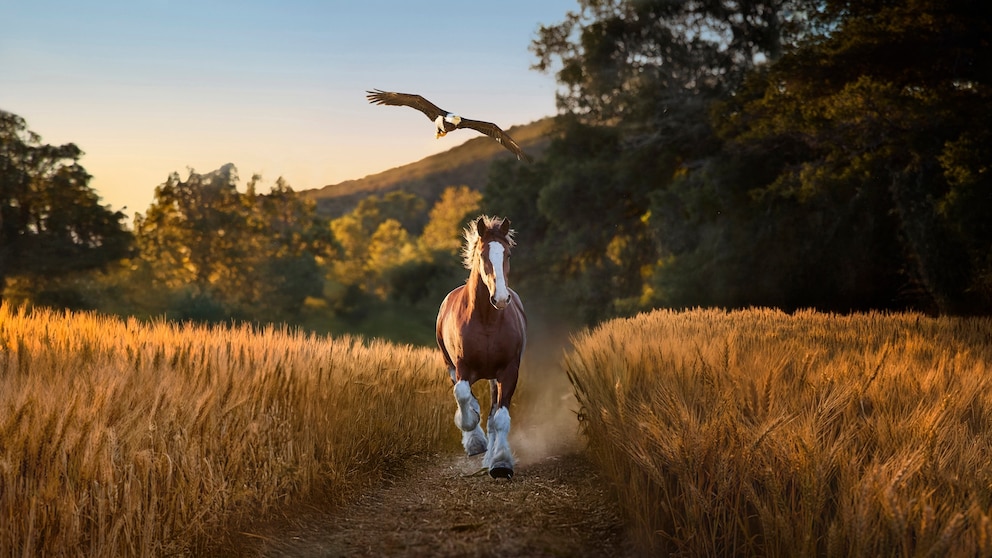
At its core, the spot tells an improbable yet profoundly moving story: the bond between a young Clydesdale foal and a fallen eaglet. Set against sweeping American landscapes—rolling farmlands, stormy skies, and golden sunsets—the ad unfolds like a short film rather than a mere commercial. Lynyrd Skynyrd’s legendary rock anthem “Free Bird” provides the soundtrack, its iconic guitar solo building to a cathartic crescendo that mirrors the animals’ growth and eventual triumph. The choice of music is no accident; “Free Bird,” with its themes of freedom, longing, and soaring independence, perfectly complements the visual metaphor of an eagle learning to fly.
The ad opens quietly in a stable on a Budweiser-affiliated farm. A curious Clydesdale foal, with its signature white blaze and massive, endearing proportions even as a baby, steps out into the world. It frolics playfully, full of youthful energy, when it spots something unusual: a tiny, tousled eaglet—barely feathered, chirping weakly—nestled beside an overturned tree, apparently fallen from its nest. The foal approaches cautiously, sniffs, then turns away at first, as if unsure. But the bird’s lonely gaze lingers, and the foal returns. In that simple moment of hesitation and return, the foundation of an unbreakable friendship is laid.
As Lynyrd Skynyrd’s gentle opening chords begin—”If I leave here tomorrow…”—the seasons shift in a montage of breathtaking cinematography. The foal shields the eaglet from a pounding rainstorm, using its broad body as a living umbrella. Days turn to weeks; the young horse carries the bird on its back through meadows, giving the fledgling a safe vantage point to practice flapping its wings. The eaglet grows stronger, its feathers filling in, while the Clydesdale matures into a powerful, majestic adult—its chestnut coat gleaming, muscles rippling under the harness-free freedom of the fields.
The narrative avoids overt product placement until the very end. There’s no forced pour of beer, no logo slapped awkwardly on screen. Instead, the focus remains on the animals’ journey, symbolizing resilience, mutual support, and the American spirit of rising together. A real Budweiser barley farmer makes a subtle appearance in one shot, nodding approvingly at the duo—a quiet nod to the brand’s agricultural roots without stealing the spotlight.
The emotional peak arrives in the final frames. The now-grown Clydesdale charges forward across open land, galloping with purpose toward a fallen log. As it leaps—graceful, powerful, airborne for a heartbeat—a breathtaking wingspan unfurls behind it. The camera reveals the majestic bald eagle, fully mature and regal, launching from the horse’s back into the sky. For a split second, the eagle’s wings spread wide across the Clydesdale’s form, creating the illusion of a mythical Pegasus: earthbound strength fused with aerial freedom. The eagle soars upward as “Free Bird”‘s guitar solo explodes, the notes soaring just as high. The screen fades to the simple text: “MADE OF AMERICA,” followed by a crisp pour of Budweiser beer, golden and refreshing.
That final visual—the eagle taking flight as the Clydesdale leaps—has been called the most “chilling” moment in Super Bowl ad history. Viewers report goosebumps, tears, and an inexplicable swell of pride. It’s not just cute animals; it’s a metaphor layered with meaning. The Clydesdale, a symbol of Budweiser’s 150-year legacy since 1876, represents steadfast American heritage: hardworking, reliable, rooted in the land. The bald eagle, America’s national emblem, embodies freedom, aspiration, and the promise of the future. Their impossible friendship suggests that true strength comes from lifting each other up—protecting the vulnerable until they can fly on their own.
The timing amplifies the impact. 2026 marks not only Budweiser’s 150th anniversary but also America’s 250th birthday (the semiquincentennial). The ad subtly ties the brand’s history to the nation’s, celebrating shared values without overt political messaging. In a divided era, it offers unity through shared symbols: the farm, the horse, the eagle, the open sky. As one viewer commented on YouTube, “This isn’t selling beer—it’s selling hope.”
The eagle featured is no CGI creation. Named Lincoln, he is a real rescued bald eagle from the American Eagle Foundation in Tennessee, permitted by the U.S. Fish and Wildlife Service. Lincoln, trained to fly in stadiums (including as a mascot for the Philadelphia Eagles), brings authenticity to every wingbeat. His backstory—rescued and rehabilitated—mirrors the ad’s theme of second chances and soaring beyond adversity.
Directed by Henry-Alex Rubin (who helmed Budweiser spots for three consecutive years), the ad was crafted by BBDO New York in collaboration with Anheuser-Busch’s internal agency, draftLine. The production avoided shortcuts; real animals, real locations, and meticulous training ensured the bond felt genuine. The result is a tearjerker that transcends advertising. Social media erupted with reactions: “Crying at a beer commercial again—thanks, Budweiser,” one user posted. Another wrote, “This is what America should feel like—strong together, free to fly.”
Compared to competitors, “American Icons” stands apart. While many 2026 spots relied on star power—think celebrity pairings or comedic skits—Budweiser bet on emotion and heritage. It paid off. Early buzz positioned it as a top contender on USA TODAY’s Ad Meter, with fans predicting another win following the previous year’s baby Clydesdale favorite. The ad’s release two weeks ahead of schedule (a bold move) allowed organic sharing to build momentum, turning it into a cultural moment before the game even kicked off.
Beyond the tears and chills lies a deeper message. In celebrating 150 years of brewing in America, Budweiser reminds us that icons endure not by chasing trends, but by staying true to their roots. The Clydesdale and eagle aren’t just mascots; they’re emblems of what binds us—loyalty, growth, and the courage to let others soar. As the guitar fades and the eagle disappears into the horizon, viewers are left with a quiet question: What legacies will we carry forward?
In an age of fleeting content, this 60-second film lingers. It’s more than an ad—it’s a reminder that some stories, like great beer and great nations, are made to last. Watch it, feel it, and share it. Because in 2026, Budweiser didn’t just remind the world how it’s done—they redefined it.