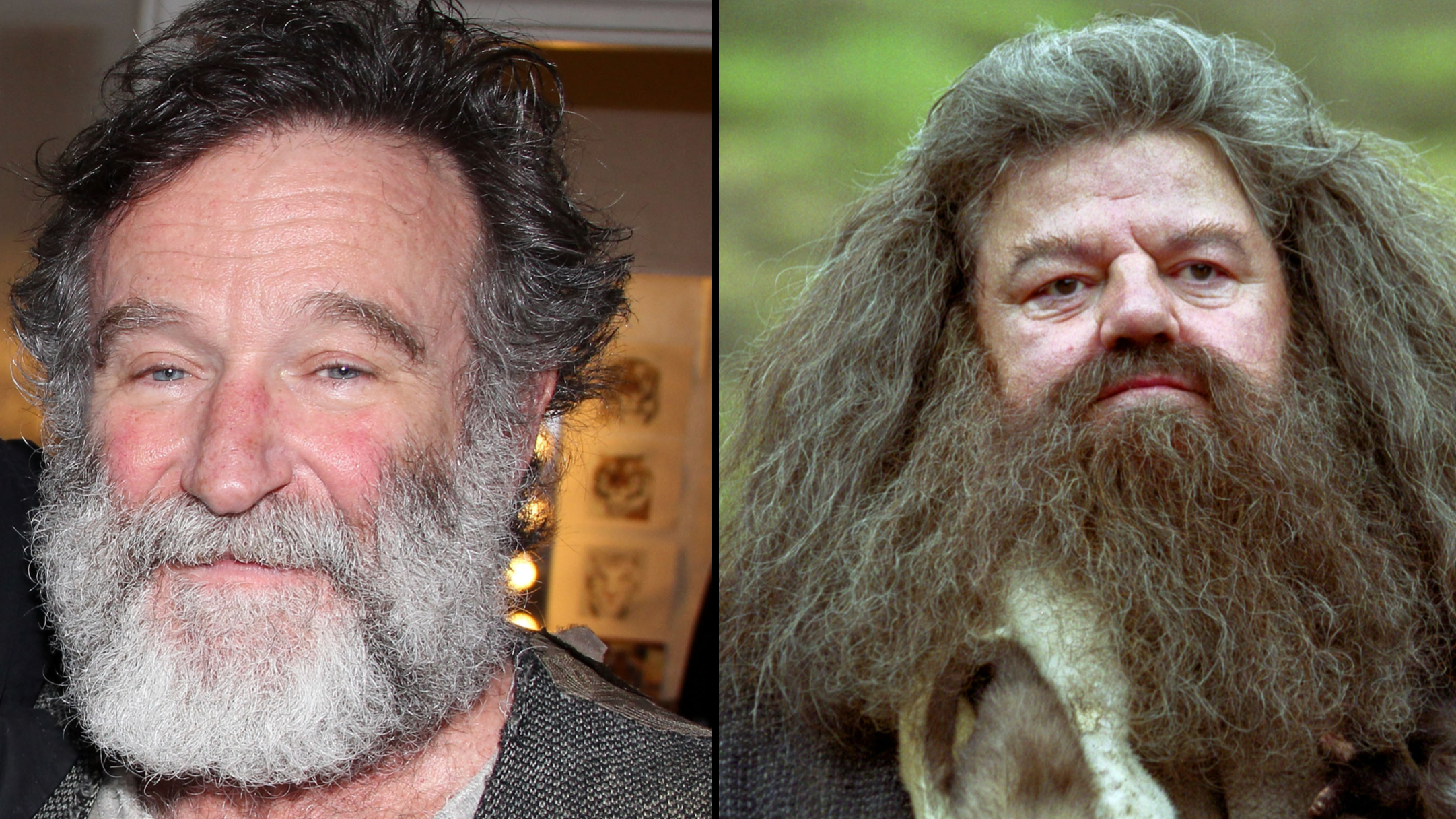
Robin Williams, the man who could make the world laugh and cry in the same breath, once set his heart on stepping into the massive boots of Rubeus Hagrid. It wasn’t just a passing whim or a casual audition request. The Oscar-winning comedian, known for his boundless energy and heartfelt performances, reached out personally to director Chris Columbus — the same man who had directed him to iconic roles in Mrs. Doubtfire and Hook — because he genuinely wanted to become part of the wizarding world that had captivated millions of readers.
Williams was a devoted Harry Potter fan from the moment the books landed in his hands. He devoured J.K. Rowling’s stories, falling in love with the richly imagined universe of Hogwarts, its quirky characters, and the unbreakable bonds of friendship at its core. As production on the first film, Harry Potter and the Sorcerer’s Stone, began ramping up in the late 1990s, Williams saw an opportunity. He picked up the phone and made the call. “I really wanted to be in the movie,” he later recounted in interviews, his voice carrying that familiar mix of excitement and mischief. He wasn’t asking for the lead — he wanted Hagrid, the gentle giant who served as Hogwarts’ keeper of keys and grounds, the half-human, half-giant with a heart as big as his frame and a love for dangerous creatures that mirrored Williams’ own affection for underdogs and misfits.
Columbus, who had already forged a deep creative partnership with Williams on family-friendly hits that blended humor with genuine emotion, was torn. He knew exactly what Williams could bring to the role: that explosive improvisation, those lightning-fast comedic riffs, and the underlying tenderness that made audiences root for his characters even when they were flawed. But there was a problem — a non-negotiable rule that had been etched into the project from day one by Rowling herself and the producers determined to honor the books’ British soul.
The “British and Irish only” casting edict was ironclad. Rowling, protective of the cultural DNA of her stories set in a distinctly English landscape of misty moors, ancient castles, and proper British boarding-school traditions, insisted that every speaking role go to actors from the United Kingdom or Ireland. It wasn’t about nationalism or exclusion for its own sake; it was about authenticity. The accents, the rhythms of speech, the subtle cultural nuances that British actors could deliver without forcing an imitation — these were meant to keep the films feeling like a natural extension of the novels rather than a Hollywood transplant. Columbus himself later described the rule as sacred: “We want this cast to be 100 percent British.” Even his own daughter, cast in a tiny background role, wasn’t allowed to speak a single line because her American accent would break the spell.
When Williams’ name came up, the answer had to be no. Casting director Janet Hirshenson confirmed the rejection years later in a candid interview: “Robin had called because he really wanted to be in the movie, but it was a British-only edict, and once he said no to Robin, he wasn’t going to say yes to anybody else.” Williams understood, but the disappointment lingered. He even floated the idea for another role later — Remus Lupin, the haunted Defense Against the Dark Arts professor introduced in Prisoner of Azkaban — only to face the same immovable barrier. In a 2001 chat with The New York Post, he reflected with his trademark self-deprecating humor: “There were a couple of parts I would have wanted to play, but there was a ban on American actors.”
The part of Hagrid ultimately went to Robbie Coltrane, a Scottish actor whose gravelly voice, imposing yet warm presence, and dry wit made him Rowling’s dream choice from the very beginning. Coltrane didn’t just play Hagrid — he embodied him. Standing at six feet tall but enhanced with prosthetics and clever camera work to appear larger-than-life, he brought a rugged Scottish charm that felt utterly authentic to the character’s half-giant heritage. His Hagrid was protective without being overbearing, clumsy yet capable, and fiercely loyal in a way that made every young wizard and witch in the audience wish they had such a friend. Coltrane’s performance anchored the early films, providing comic relief in the right doses while delivering quiet emotional depth during moments of vulnerability, like when he revealed his own painful backstory or stood up for Harry against authority figures.
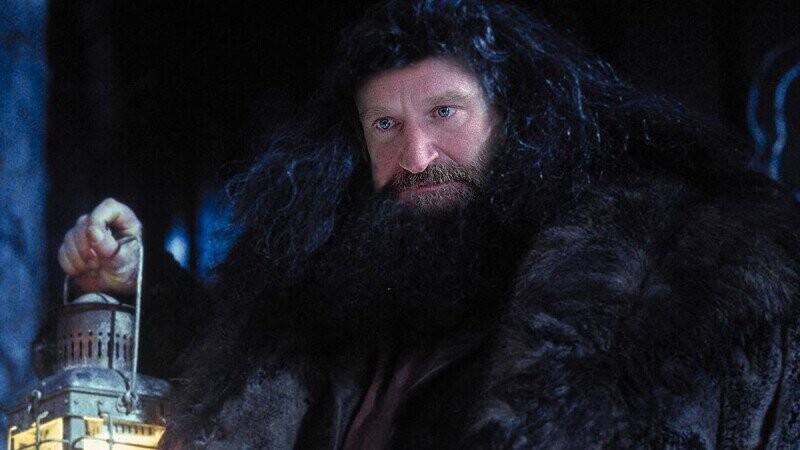
Fans have debated the “what if” for years. What if the producers had bent the rule just once? What if Robin Williams had donned the oversized coat, the wild beard, and the pink umbrella that doubled as a wand? The version of Hagrid we might have seen would have been electric in an entirely different way. Williams’ genius lay in improvisation — those off-the-cuff monologues that turned ordinary scenes into unforgettable spectacles. Imagine Hagrid not just muttering about “blasted Blast-Ended Skrewts” but launching into a full-blown, manic rant about magical creatures while juggling a baby dragon, his eyes lighting up with that signature Williams sparkle. His Hagrid could have injected even more slapstick humor into the Forbidden Forest sequences or turned the flying motorcycle ride with baby Harry into a whirlwind of physical comedy. Yet beneath the laughs, Williams excelled at quiet pathos. Think of his work in Dead Poets Society or Good Will Hunting — that ability to convey profound sadness through a single glance or a cracked voice. A Williams Hagrid might have made the character’s loneliness after losing his giant mother or his ostracism from wizarding society hit even harder, blending belly laughs with genuine tears in the same scene.
The decision to stick rigidly to the British casting rule, however, proved pivotal to the franchise’s success. Harry Potter and the Sorcerer’s Stone premiered in 2001 to massive acclaim precisely because it felt British to its bones. The misty Scottish Highlands doubled for Hogwarts grounds, the young cast of unknowns like Daniel Radcliffe, Emma Watson, and Rupert Grint spoke with natural accents that grounded the fantasy in reality, and supporting players like Maggie Smith as McGonagall, Alan Rickman as Snape, and Richard Harris as Dumbledore brought decades of Shakespearean gravitas to the screen. Rowling’s insistence preserved an intangible magic: the films didn’t feel like an American studio’s glossy remake; they felt like the books had stepped off the page. Global audiences — including millions of American kids who grew up quoting lines in perfect Received Pronunciation — embraced that authenticity. The series grossed nearly $8 billion worldwide across eight films, proving that sometimes restraint creates the most enduring spell.
Still, the near-miss with Williams adds a fascinating layer to the Harry Potter lore. It humanizes the casting process, showing that even the most meticulously planned blockbuster had its moments of temptation and tough choices. Columbus has spoken openly about how difficult it was to deliver the news to his friend. “It was very difficult for me to say ‘It’s all British. There’s nothing I can do,’” he told Total Film in 2021. Williams, ever the professional, respected the boundary and moved on, continuing to deliver legendary performances in films like Insomnia and the animated Happy Feet. But the anecdote has lived on in fan forums, Reddit threads, and late-night “what if” conversations, fueling endless speculation about alternate universes where the Genie from Aladdin also guarded the keys to Hogwarts.
This story also opens a broader conversation about authenticity versus star power in literary adaptations. Hollywood has a long history of bending rules for bankable names — think of the occasional American accent slipping into British period pieces or big-name imports in franchises like The Lord of the Rings. Yet Rowling’s team drew a line in the sand, and the result was a cast that felt organically tied to the source material’s cultural roots. Irish actors like Evanna Lynch (Luna Lovegood) and Domhnall Gleeson (Bill Weasley) were welcomed under the umbrella, but the core remained steadfastly from the British Isles. The rule even extended to minor roles; no exceptions were made, not even for Williams’ star wattage or his proven track record in family entertainment.
Robbie Coltrane’s Hagrid, meanwhile, became one of the most beloved characters in cinematic history. He passed away in 2022 at age 72, and tributes poured in from castmates and fans alike. Emma Watson called him a “gentle giant” in real life as much as on screen. Daniel Radcliffe praised how Coltrane filled every frame with warmth and humor. Coltrane himself once joked that playing Hagrid made him realize “I’ll not be here, sadly. But Hagrid will” — a line that now feels prophetic, cementing the character’s immortality. His portrayal wasn’t flashy or improvisational in the Williams style; it was steady, grounded, and deeply Scottish, which made the giant feel real rather than cartoonish.
For Williams, the rejection was just one chapter in a career full of near-misses and triumphs. He had already conquered Disney with Aladdin’s Genie, terrified audiences in One Hour Photo, and earned Oscars for his dramatic turns. Losing Hagrid didn’t diminish his legacy; if anything, it added to the mythos of a man who loved stories so much he wanted to inhabit even the supporting roles in someone else’s universe. Fans today still share photoshopped images of a bearded, larger-than-life Williams as Hagrid, complete with captions imagining his delivery of lines like “Yer a wizard, Harry” in that unmistakable rapid-fire cadence.
The Harry Potter films endured and thrived without him, but the “what could have been” lingers as a tantalizing footnote. It reminds us that even in a franchise built on destiny and chosen ones, some paths are closed not by fate but by deliberate creative choices. Rowling’s rule wasn’t about shutting doors on talent — it was about opening them to the right kind of magic. And in the end, that choice helped create a cinematic world that felt timeless, immersive, and true to its origins.
Yet the tale of Robin Williams and Hagrid also speaks to something universal: the power of fandom. Here was one of the world’s biggest stars, at the height of his fame, willing to shrink himself into a supporting role simply because the story moved him. That kind of passion is rare, and it underscores why Harry Potter continues to cast such a long shadow more than two decades later. New generations discover the books and films every year, and many of them learn this very anecdote, sparking fresh debates over dinner tables and comment sections.
In retrospect, the casting of Coltrane feels inevitable, almost as if the character had been waiting for him all along. But the road not taken — the one where Williams’ improvisational brilliance collided with Hagrid’s gentle giant persona — invites us to dream. Would the films have been funnier? Perhaps. More emotionally layered in unexpected ways? Almost certainly. Different enough to alter the franchise’s trajectory? Maybe not. Because at its heart, Harry Potter was always about the kids, the friendships, and the fight against darkness, not the star power of any single adult performer.
The legacy of that phone call endures as a charming reminder of the human side of blockbuster filmmaking. Behind the millions of dollars, the special effects, and the global marketing machine sat a simple truth: even legends like Robin Williams sometimes heard “no” for the greater good of the story. And in honoring that boundary, the Harry Potter team gave us something irreplaceable — a Hagrid who wasn’t just funny or warm, but who felt like he had stepped straight out of a Scottish pub and into the pages of a British fairy tale.
Today, as the wizarding world expands into new television series and theme parks, fans still pause to wonder about the roads not taken. Would Williams have stolen every scene? Undoubtedly. Would he have made Hagrid’s love for Norbert the dragon even more hilariously chaotic? Without question. But the version we received — sturdy, loyal, and perfectly pitched — proved that sometimes the right actor isn’t the most famous one. It’s the one who fits the world so seamlessly that you forget he’s acting at all.
Robin Williams left us far too soon in 2014, but his spirit of boundless curiosity and love for great storytelling lives on. He never got to walk the halls of Hogwarts or roar “I should not have said that” in that booming voice. Yet the fact that he tried — that he cared enough to call and ask — speaks volumes about the universal appeal of Rowling’s creation. It crossed oceans, bridged cultures, and even tempted one of Hollywood’s brightest lights to trade his California sunshine for the misty grounds of a Scottish castle.
In the grand tapestry of Harry Potter, the story of the almost-cast Hagrid adds a thread of bittersweet magic. It reminds us that great art often comes from saying no to the obvious choice and yes to the authentic one. Robbie Coltrane gave us the Hagrid we needed. Robin Williams showed us the Hagrid we can still imagine — wild, wonderful, and forever what if.
And perhaps that’s the most potent spell of all: the ability of a beloved story to live not just on screen, but in the hearts and daydreams of those who wished they could have been part of it. Williams may not have played Hagrid, but in the minds of countless fans, he still does — every time we picture a half-giant cracking jokes with that irrepressible grin. The wizarding world is richer for both versions: the one we saw and the one we’ll always wonder about.
News

🩸 “Just a Few Drinks” – The Shocking Confession That Has an Entire Town Furious After Teen Rico Montes Was Found Dead 😡
A single text message, innocent and full of teenage optimism, became the final words Rodrigo “Rico” Montes ever sent to his mother — and it continues to echo through the…
😭🙏 “He Was Here The Whole Time”: Family Demands Answers After Eric Valencia Found Dead in Azusa Police Car 3 Days After Release – Video Shows Everything 😢
DEAD IN A POLICE CAR: Family Demands Answers After Eric Valencia Found Lifeless in Unlocked Azusa Patrol SUV Three Days After Release – Chilling Surveillance Video Raises Disturbing Questions The…
🙏💔 Glenview Dad’s Emotional Plea After Losing Daughter Lilly to Gun Violence: “She’s an Instant Angel” – A Bright Future Stolen Too Soon 😭
A FATHER’S SHATTERED WORLD: Glenview Dad Anthony Bova’s Raw Heartbreak After 16-Year-Old Daughter Lilly Shot and Killed at Home – “She’s an Instant Angel” The sound of gunfire ripped through…
🔥😭 SHOCKING: Man Shot Multiple Times by His Own Brother in Pittsburgh’s Brighton Heights – “He Was Standing Outside Mom’s Home” 😢
GUNFIRE ERUPTS IN THE NIGHT: Man Shot Multiple Times in Pittsburgh’s Brighton Heights – A Community Once Again Confronts the Brutal Reality of Street Violence Just before 10:30 p.m. on…
😱💔 American Idol SHOCK: Carrie Underwood & Luke Bryan Reportedly Ready to QUIT After Season 24 – “Their Hearts Just Aren’t In It” Anymore! 🔥🙏
AMERICAN IDOL ON THE BRINK: Carrie Underwood and Luke Bryan Reportedly Ready to Walk as Hearts “Just Aren’t In It” for Season 25 Shake-Up The whispers have been growing louder…
💔✨ The Most Emotional Performance of 2026? Chris Tungseth Delivered Cody Johnson’s “By Your Grace” and America Can’t Stop Crying! 😭🙌
Chris Tungseth brought pure emotion to the American Idol 2026 stage with “By Your Grace” by Cody Johnson and people can’t stop talking about it. There was something different in…
End of content
No more pages to load