A flight attendant’s reinforced jump seat became her lifeline when Air Canada Express Flight 8646 from Montreal slammed into a speeding Port Authority fire truck on LaGuardia Airport’s Runway 4 late Sunday night, March 22, 2026. Solange Tremblay was hurled more than 300 feet through the darkness, still strapped securely into her seat, while the two young pilots in the cockpit ahead of her were killed instantly. The violent collision left 41 people injured, yet Tremblay walked away with only a fractured leg — a near-miracle that safety experts are now crediting to the very design of the crew jump seat itself. What unfolded in those terrifying seconds has become the most talked-about survival story in recent aviation history, raising urgent questions about why the pilots never stood a chance while one crew member defied physics and fate.
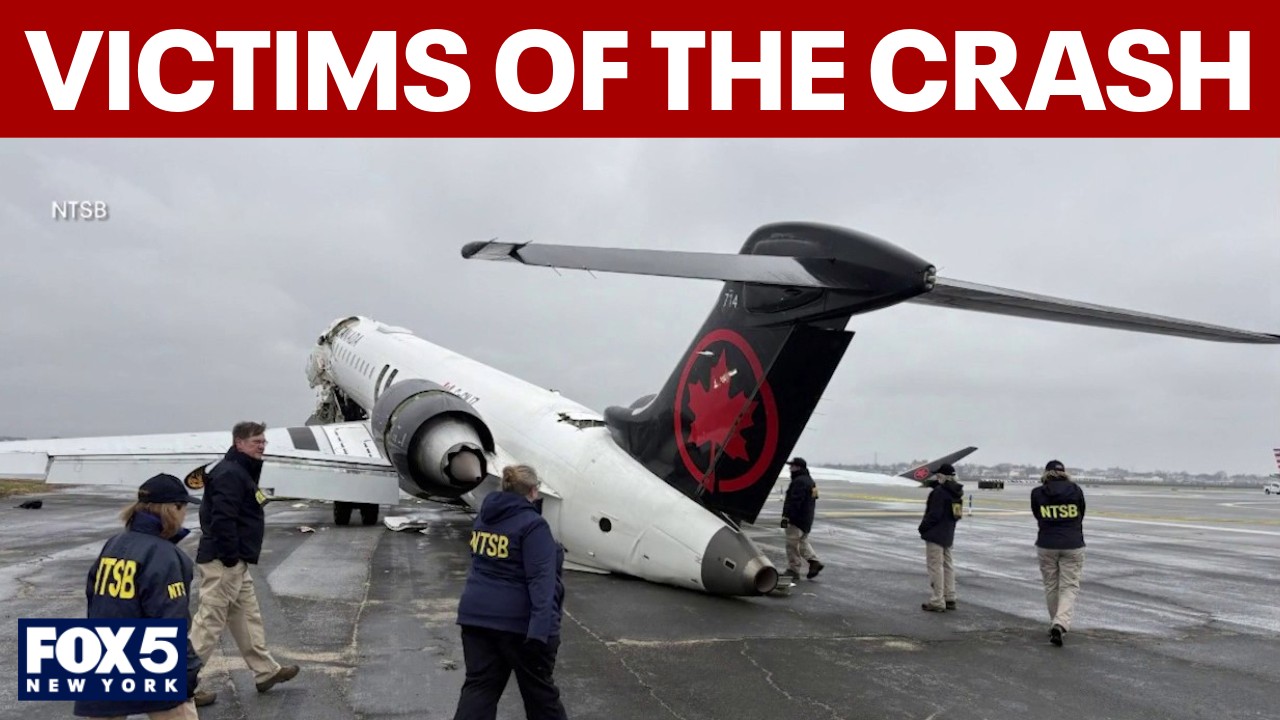
The Bombardier CRJ-900 regional jet was on final approach after a routine 90-minute flight when disaster struck around 11:40 p.m. Air traffic controllers had cleared the aircraft to land while simultaneously authorizing a fire truck to cross the same active runway to respond to a separate emergency on another plane that had aborted takeoff. In the critical seconds that followed, communication collapsed. Tower recordings captured desperate shouts of “Truck One, stop, stop, stop!” but the jet was already committed. The nose of the aircraft rammed the emergency vehicle at high speed, mangling the front section and obliterating the cockpit. Captain Antoine Forest, 30, and First Officer Mackenzie Gunther, 22, never had a chance. Their deaths were instantaneous, the full force of the impact concentrated on the forward fuselage where they sat.
Behind them, however, Solange Tremblay was seated in the jump seat directly behind the cockpit bulkhead. As the jet struck the truck, the cabin floor buckled and the reinforced crew seat — specially engineered to withstand far higher crash loads than standard passenger seats — tore free from its mounting. Tremblay remained strapped in by the four-point harness as the entire assembly was catapulted more than 100 meters (328 feet) across the tarmac. When rescuers reached her, she was still buckled into the seat, conscious and alive. Her daughter, Sarah Lépine, later told TVA Nouvelles in an emotional interview that the family is still trying to process the miracle. “I’m still trying to understand how all this happened, but she definitely has a guardian angel watching over her,” Lépine said. “At the moment of impact, her seat was ejected more than 100 meters from the plane. They found her and she was still strapped into her seat.”
Aviation safety expert Jeff Guzzetti, a former federal crash investigator, explained exactly why the jump seat likely saved Tremblay’s life. “The flight attendant’s seat is kind of a jump seat that folds down and is bolted to the wall, the same wall that the cockpit utilizes,” he told the New York Post. “It’s a very robust seat. It’s designed to withstand probably more crash loads than passenger seats because you need the flight attendant to help passengers get out of an airplane after a crash.” The seat’s reinforced construction, combined with the four-point restraint system, acted like a protective capsule, absorbing and distributing forces that would have been fatal in a standard passenger chair. While the pilots were crushed in the forward section, Tremblay’s seat became an improvised escape pod that carried her clear of the worst destruction.
The contrast between survival and tragedy could not be starker. Forest and Gunther represented the best of Canadian aviation — dedicated professionals at the start of promising careers. Forest, from Coteau-du-Lac, Quebec, had been flying since he was 16. His great-aunt Jeannette Gagnier, who helped raise him during summers in Hawkesbury, Ontario, remembered a boy who lived for the skies. “He flew his first plane when he was 16 years old. He was always taking courses and flying. He never stopped,” she said, her voice breaking. “It’s a very bad day for me.” Gunther, a recent Seneca Polytechnic graduate, was just beginning his airline journey but already earning praise for his skill and professionalism. Seneca lowered its flags to half-mast in his honor, calling him a bright talent who will be deeply missed.
For the 76 passengers and crew on board, the moments after impact were pure chaos. Harrowing video captured the jet barreling into the truck, debris scattering across the runway as emergency lights flashed in the darkness. Passengers described the sudden violent jolt, the screech of metal on metal, and the rapid evacuation as surviving crew members guided them to safety amid the smell of jet fuel and burning debris. Forty-one people were hospitalized, most with minor injuries, though some required overnight observation. Many later credited the pilots and crew with saving their lives right up to the final seconds. One passenger told reporters the landing felt normal until the bone-jarring collision threw everyone forward. Flight attendants, including Tremblay before her ejection, acted with calm professionalism under extreme pressure.
The National Transportation Safety Board (NTSB) launched an immediate investigation, and Chair Jennifer Homendy addressed the media on Tuesday with sobering clarity. “We have found in all of our investigations that it is not a single error that led to a terrible tragedy,” she said on Fox & Friends. “It’s multiple failures.” Early findings point to a cascade of problems: the airport’s ground radar system failed to alert controllers to the conflict, the fire truck lacked a transponder that would have made it visible to the system, and the control tower was operating in a high-workload environment with possible staffing strains. An air traffic controller reportedly admitted to “messing up” after the incident, but Homendy stressed it was too early to assign sole blame. Investigators are poring over cockpit voice recordings, black-box data, tower communications, and physical evidence from the wreckage.
The crash has reignited urgent debates about runway safety at congested urban airports like LaGuardia. Squeezed into a dense area with limited space, the airport has long been known for challenging operations. Runway incursions — situations where aircraft or vehicles enter an active runway without authorization — remain a persistent concern for the FAA and the International Civil Aviation Organization. This incident, experts say, highlights vulnerabilities in ground operations, outdated technology, and the human pressures on controllers during concurrent emergencies. Calls are already growing for mandatory transponders on all airfield vehicles, enhanced ground surveillance systems, revised protocols for handling simultaneous incidents, and increased staffing during peak hours.
FAA Administrator Bran Bedford captured the collective sorrow when he addressed reporters. “These were two young men at the start of their careers, so it’s an absolute tragedy that we’re sitting here with their loss.” Jazz Aviation, the operator of the flight, expressed profound grief and extended full support to the families and injured passengers. The Air Line Pilots Association called the loss of the two crew members a profound tragedy, emphasizing the quiet heroism required in commercial aviation.
In Quebec and Ontario, communities are mourning two dedicated pilots whose lives were cut short. Forest’s family and friends remember a man who chased his dream with relentless passion, from bush planes over Quebec forests to regional jets connecting cities. Gunther’s instructors and classmates at Seneca Polytechnic recall a bright, professional student eager to prove himself in the cockpit. Flags flew at half-mast, and messages of support poured in from fellow pilots and aviation enthusiasts across North America. For Tremblay’s family, the relief is tempered by grief for the two pilots who did not survive. Sarah Lépine’s words echo the sentiment shared by many: her mother has a guardian angel, but the pilots’ families now face unimaginable loss.
Passengers have begun sharing their stories in the days since the crash. Many describe the sudden impact, the smoke, the shouts, and the swift evacuation that prevented even greater loss of life. One survivor called the crew’s actions heroic, noting that flight attendants remained calm even as the cabin filled with chaos. The survival of Tremblay and the quick response of the remaining crew have become symbols of resilience amid tragedy. Her ejection, while terrifying, may ultimately provide investigators with critical data about how the jump seat performed under extreme forces — information that could lead to even stronger safety standards in the future.
As the NTSB continues its methodical work, the human stories remain front and center. Antoine Forest’s lifelong passion for flight ended on a New York runway he had traversed many times before. Mackenzie Gunther’s promising career was cut short just as it was gaining altitude. Solange Tremblay’s miraculous ride in her reinforced jump seat offers a rare glimmer of hope — proof that even in the most violent moments, modern safety engineering can sometimes defy the odds. Her daughter’s description of a guardian angel resonates deeply with a public searching for meaning in the face of sudden loss.
The incident has also prompted broader reflection on aviation safety in 2026. While commercial jet accidents remain statistically rare thanks to rigorous standards, runway incursions continue to pose risks, especially at busy, space-limited airports. Pilot and controller shortages, lingering effects from the pandemic, and aging infrastructure have been cited as contributing pressures. Experts predict the final NTSB report will recommend sweeping technological and procedural changes, including better integration of emergency response with landing operations and next-generation runway monitoring that eliminates blind spots.
LaGuardia resumed limited operations within hours, but the affected runway remained closed for days as investigators sifted through wreckage and data. The Port Authority of New York and New Jersey faces scrutiny over emergency vehicle protocols and coordination with air traffic control. For the families of the pilots, the coming weeks will be filled with grief and memorial services. For Tremblay, recovery will include physical therapy for her fractured leg and the emotional processing of a trauma few can imagine. Yet her survival stands as a testament to the quiet engineering marvels that protect those who protect us in the air.
In the end, the LaGuardia crash of March 22, 2026, will be remembered for its heartbreaking toll and its extraordinary survival story. Two young pilots who lived for the skies gave their lives in service to passengers they would never meet again. A flight attendant’s reinforced jump seat became the difference between life and death, turning a potential catastrophe into a miracle that experts are already studying for lessons that could save lives in the future. As the investigation unfolds and reforms are debated, one image lingers — Solange Tremblay found still strapped into her seat far from the wreckage, a symbol of resilience, engineering ingenuity, and the thin line between tragedy and triumph in the unforgiving world of modern aviation.
The runway lights at LaGuardia have since returned to normal operations, and flights continue to depart and arrive under the bright New York sky. But for those touched by this crash — the families, the survivors, the aviation community — the events of that Sunday night will serve as a lasting reminder that safety is never guaranteed, yet every small design choice, every reinforced seat, and every dedicated professional can make the difference between despair and deliverance. Solange Tremblay’s story, against the sorrow of two lost pilots, offers a powerful message: even in the darkest moments on the runway, hope and human ingenuity can sometimes carry someone home.
News
🚨 Two Young Canadian Pilots Dead After Plane Crashes Into Fire Truck at LaGuardia — Antoine Forest Flew Since Age 16, Co-Pilot Just Graduated… The Terrifying Final Moments No One Saw Coming 😢
Two young Canadian pilots with everything to live for were killed in a heartbeat when their Air Canada Express regional jet slammed into a speeding fire truck on the runway…

🚨 Masked Killer Was Hiding Behind the Lighthouse on the Pier Before Executing 18-Year-Old Loyola Student Sheridan Gorman at Point-Blank Range – The Chilling Motive Still Remains a Complete Mystery 😱💔
An 18-year-old freshman at Loyola University Chicago stepped out with friends for a late-night walk along the scenic lakefront, hoping to catch a glimpse of the northern lights dancing over…
Family Mourns Quebec Pilot Antoine Forest Who Died at 30 When Air Canada Plane Hit Fire Truck at LaGuardia Airport… He Started Flying at 16 🔥 “He Never Stopped”
The runway at New York’s LaGuardia Airport was bathed in artificial light late on Sunday night, March 22, 2026, when Air Canada Express Flight 8646 — a Bombardier CRJ-900 regional…
😱💔 Air Canada Pilot Antoine Forest, 30, Killed When His Plane SLAMMED Into Fire Truck on LaGuardia Runway — “He Never Stopped Flying” Since Age 16, Says Heartbroken Family 🔥 Two Young Pilots Gone in Tragic Crash
The runway at New York’s LaGuardia Airport glowed under the late-night lights on Sunday, March 22, 2026, as Air Canada Express Flight 8646 made its final approach. The CRJ-900 regional…

💔 Heartbreaking Tribute: University of Alabama Student Jimmy Gracey’s Girlfriend Kenna Breaks Silence After He Died on Spring Break in Barcelona – “I Wish I Could Rewind Time” 😢
She was waiting for him to come home. Instead, she had to write a goodbye. Kenna Cohen sat in her Tuscaloosa apartment, phone in hand, staring at the screen as…

😭 First Harry Potter TV Trailer is HERE & It’s Giving Chills! Dominic McLaughlin as Harry, Nick Frost as Hagrid & Surprise Christmas 2026 Premiere – Potterheads Are LOSING IT! 🔥🧙♂️
Magic is erupting back into the cultural bloodstream with a ferocious new energy, and the first official trailer for HBO’s long-awaited Harry Potter TV series has just sent Potterheads into…
End of content
No more pages to load