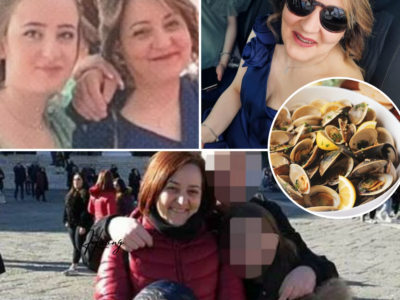
A seemingly ordinary pre-Christmas family lunch in the quiet Italian hill town of Pietracatella was supposed to usher in the festive season with warmth and togetherness. Instead, it set in motion a medical nightmare that has since unravelled into one of the most disturbing suspected poisoning cases in recent Italian history – a double murder investigation centring on ricin, the deadly, odourless toxin once favoured by Cold War assassins.
On December 23 last year, 50-year-old Antonella Di Ielsi and her 15-year-old daughter Sara Di Vita sat down for a meal at their home in the small Molise region community, home to around 1,200 residents. The lunch included fish and a variety of seafood such as clams, mussels, cuttlefish and cod, along with flour-based dishes and jars of mushrooms preserved in oil. Also present was Sara’s father, Gianni Di Vita, a local accountant who had served twice as mayor of Pietracatella and currently acts as treasurer for the centre-left Democratic Party in the area. The couple’s eldest daughter, Alice, was not at the meal that day.
Within hours, Antonella and Sara began experiencing severe nausea, vomiting and intense abdominal pain. The following day, December 24, they sought medical help at the local hospital, where doctors initially diagnosed a straightforward case of gastroenteritis – commonly known as stomach flu or food poisoning – and sent them home with advice to rest and hydrate.

But their condition did not improve. In the days that followed, both mother and daughter deteriorated rapidly, prompting readmission to Cardarelli Hospital in nearby Campobasso. What unfolded next shocked even seasoned medical professionals. Dr Vincenzo Cuzzone, head of the intensive care unit, later described the progression as extraordinary in its speed and brutality.
“There was liver failure, followed by a cascade of events, one after another, at extraordinary speed, ultimately leading to multiple organ failure,” he said. “I had the impression some external factor stopped their heart.”
Sara Di Vita, a 15-year-old classical high school student described by friends as full of life and optimism, died on December 27. Her mother, Antonella, passed away the very next day on December 28. The rapid decline left hospital staff reeling and the tight-knit town of Pietracatella in mourning.
At first, investigators treated the deaths as a tragic case of accidental food contamination. Police seized leftovers from the family home, focusing on possible culprits such as contaminated mushrooms – perhaps the deadly death cap variety (Amanita phalloides) – botulism, listeria, or even rat poison from the family’s granary. Extensive testing ruled out these common threats one by one. Then came the bombshell results from laboratory analyses conducted in Italy and Switzerland.
Post-mortem examinations detected traces of ricin in the blood of both victims. In Antonella’s case, the toxin was also found in her hair, suggesting possible prolonged or repeated exposure. Ricin, a highly potent poison derived from castor beans, is odourless and tasteless when prepared correctly. Experts warn that as little as 14 milligrams – roughly the weight of a few grains of salt – can be fatal for an average adult. It works by inhibiting protein synthesis in cells, triggering catastrophic organ failure, particularly in the liver, kidneys and spleen. Death typically occurs within three to five days of ingestion, often mimicking severe food poisoning in the early stages.
The revelation transformed the inquiry overnight. Italian prosecutors in Larino have now opened a formal investigation into premeditated double homicide, currently against unknown persons. The case has shifted from suspected accidental poisoning to deliberate murder, with detectives exploring every possible angle of how such a rare and dangerous substance entered the family’s Christmas Eve meal.
Ricin carries a sinister reputation. It gained notoriety during the Cold War, most famously in the 1978 assassination of Bulgarian dissident Georgi Markov in London, where he was jabbed in the leg with a ricin-laced pellet fired from a modified umbrella on a busy bridge. Another Bulgarian defector survived a similar attack in Paris. The toxin’s appeal to assassins lies in its potency, its delayed symptoms and the difficulty of immediate detection.
In a rural town like Pietracatella, nestled in the mountainous Molise region some 260 kilometres southeast of Rome, ricin is not something that appears by accident. Police believe the poison could only realistically have been obtained through illicit channels, possibly the dark web, where instructions for extraction from castor beans and even ready-made supplies sometimes circulate in hidden marketplaces. Forensic teams are now preparing a fresh, more detailed search of the family home, examining plates, utensils, kitchen surfaces and any containers that might retain microscopic traces.
Computers and mobile phones seized from the household are being scrutinised for any internet searches related to ricin, castor beans, poisons or toxicology. Detectives are also interviewing extended family members, friends and anyone who might have had access to the home or knowledge of the meal preparations. Alice Di Vita, who was absent from the fatal lunch and showed no symptoms, has already been questioned and is expected to be interviewed again.
The survival of Gianni Di Vita adds another layer of intrigue to the mystery. He too developed similar gastrointestinal symptoms after the meal and was admitted to Rome’s Spallanzani Hospital, a facility specialising in infectious diseases. He spent time in intensive care before being moved to a general ward and was discharged after about ten days. Extensive tests at Spallanzani found no traces of ricin in his system. This has prompted questions: did he receive a much smaller, sub-lethal dose? Was his illness coincidental or caused by something else entirely? Or could the poison have been targeted specifically at Antonella and Sara?
Gianni himself has spoken briefly to the media. “I’m feeling better, but I still can’t understand what happened,” he said, capturing the bewilderment shared by many in the community.
Friends of Sara recalled speaking to her on Boxing Day, when she still sounded hopeful that hospital treatment would help her recover. “We last spoke to Sara on Boxing Day, over the phone,” one friend told local reporters. “She believed the heavy treatment at the hospital would be sufficient and didn’t expect her condition to deteriorate.”
The small size of Pietracatella has amplified the shock. Mayor Antonio Tommasone expressed the collective disbelief felt by residents. “We are a small community and everyone has always got on with each other, there has never been any tension. We are like family,” he said. “We trust the investigators, but we are struggling to believe this was anything but an accidental death.”
Yet the scientific evidence pointing to deliberate poisoning is now hard to dismiss. Ricin’s presence, especially in Antonella’s hair, raises the possibility of more than a one-time contamination. Pharmacology experts, including Professor Gianni Sava, have emphasised the toxin’s extreme lethality and the tiny quantities required to kill.
As the investigation deepens, five doctors who initially treated Antonella and Sara at Cardarelli Hospital are themselves under scrutiny for possible manslaughter and negligence. Prosecutors describe this as standard procedure whenever an initial diagnosis is later contradicted by forensic findings, particularly given the two occasions when the pair were assessed and sent home before their conditions worsened dramatically. The misdiagnosis, while understandable given ricin’s rarity, has sparked questions about whether faster toxicology screening in regional hospitals could have altered the outcome.
For the people of Pietracatella, the tragedy has shattered the sense of safety that comes with living in a close-knit rural town. Christmas lights and decorations that once brightened the streets now feel painfully out of place. Flowers have appeared outside the family home as residents quietly pay their respects. Sara, at 15, was a typical teenager with school, friends and the usual dreams of youth ahead of her. Antonella was remembered as a devoted homemaker at the heart of her family.
The case has drawn national and international attention, with headlines comparing it to spy-novel plots. Yet for those closest to the victims, it remains a deeply personal devastation. The family must now mourn while living under the shadow of an active murder probe that could eventually point toward someone they knew – or, conceivably, an outsider with a grudge or motive yet to surface.
Detectives face significant challenges. Ricin is difficult to handle safely and requires specific knowledge to extract and administer without self-contamination. Its delayed action gave the perpetrator time to distance themselves from the crime scene. Full autopsy results, including more precise details on the exact timing, dosage and method of delivery, are expected by the end of April, potentially providing crucial breakthroughs.

In the meantime, lines of inquiry include possible family tensions – however hidden they may have been in a town where everyone appears to get along – financial disputes, personal grudges, or even external connections that could explain access to such an exotic poison. The dark web angle broadens the search beyond Italy’s borders, though rural Molise seems an unlikely setting for sophisticated international intrigue.
The contrast between the festive occasion and the horror that followed could hardly be starker. A simple family lunch, prepared with everyday ingredients, somehow became the vehicle for one of the world’s most notorious toxins. The fact that ricin can mimic common food poisoning so effectively explains why the true cause remained undetected until after the deaths.
As spring advances across the Italian countryside, Pietracatella remains subdued. Residents gather in small groups, speaking in hushed tones about the unimaginable. Some whisper about possible motives or overlooked signs of strain within the prominent local family, though the mayor and others insist no such tensions were apparent.
The investigation continues at pace. Forensic experts are analysing every seized item with renewed urgency. Digital forensics teams hunt for any electronic footprint that might betray the poisoner’s preparations. Interview after interview seeks to reconstruct the days and weeks leading up to December 23.
For now, the people of this small town are left grappling with a question that challenges their very sense of community: how could such a cold, calculated act have occurred in a place where everyone is “like family”?
Antonella Di Ielsi and her daughter Sara Di Vita deserved a long, ordinary life filled with the simple joys of small-town Italy – school achievements, family celebrations and quiet days in the hills. Instead, their story has become a cautionary tale about hidden dangers that can lurk even in the most familiar settings.
The pink and white flowers placed in remembrance may eventually fade, but the questions surrounding their deaths are likely to linger for years. As prosecutors and police press forward with what promises to be a complex and painstaking inquiry, the residents of Pietracatella – and observers further afield – wait with a mixture of grief, disbelief and growing unease for answers that may finally explain how a Christmas meal turned fatal in the most extraordinary way.
The full truth may emerge when the detailed autopsy and forensic reports land by the end of April. Until then, a quiet Italian town holds its breath, confronting the possibility that behind the facade of everyday life, someone chose to introduce a lethal spy poison into a family gathering with devastating consequences.
News

🔥 Behind The “Perfect” Family Photos: The Dark Secret That Ended In Triple Murder-Suicide In Quiet Plainville 😭 Neighbors Reveal What They Saw
A suburban home on Milford Street in Plainville, Connecticut, became the scene of a shocking murder-suicide that has left a tight-knit New England community reeling and searching for answers that…
😭 Heartbreaking Loss: Murphy Brown Actress & Beloved Playwright Jessie Jones Passes Away at 75 – Her Laughter Touched Millions 💔
Jessie Jones, the sharp-witted actress who lit up television screens in the 1980s and ’90s and later became America’s most-produced female playwright, passed away on March 20 at the age…

💥 They Listened! Paapa Essiedu OUT, Benedict Cumberbatch IN as Snape – Fans Are Already at War! 😤
Warner Bros. has made a bombshell decision that is already sending shockwaves through the Harry Potter fandom worldwide. After weeks of intense online fury, death threats, and heated debates over…

😱 “I Didn’t Know He Was Famous” – Neighbor Explains Brutal Fight With Alan Ritchson That Left Him Bloodied and Bruised
A peaceful Nashville suburb turned into a battlefield of bruised egos and flying fists when Reacher star Alan Ritchson allegedly pummeled his neighbor Ronnie Taylor in front of his own…

💥 Did Robert Pattinson Just Shade His Ex Kristen Stewart on the Red Carpet? The Viral Moment Everyone Is Talking About
Robert Pattinson’s casual laugh and offhand comment during a red-carpet interview at the Rome premiere of his new film The Drama has once again thrust the Twilight saga back into…

😲 “We Had a Few Drinks” – Friends Reveal Alcohol Was Flowing at Cookout Hours Before 18-Year-Old Rico Montes Died After Truck Flipped into River
A single text message filled with teenage innocence became the last words Rodrigo “Rico” Montes ever sent his mother — and it still haunts the quiet streets of Lake Station,…
End of content
No more pages to load