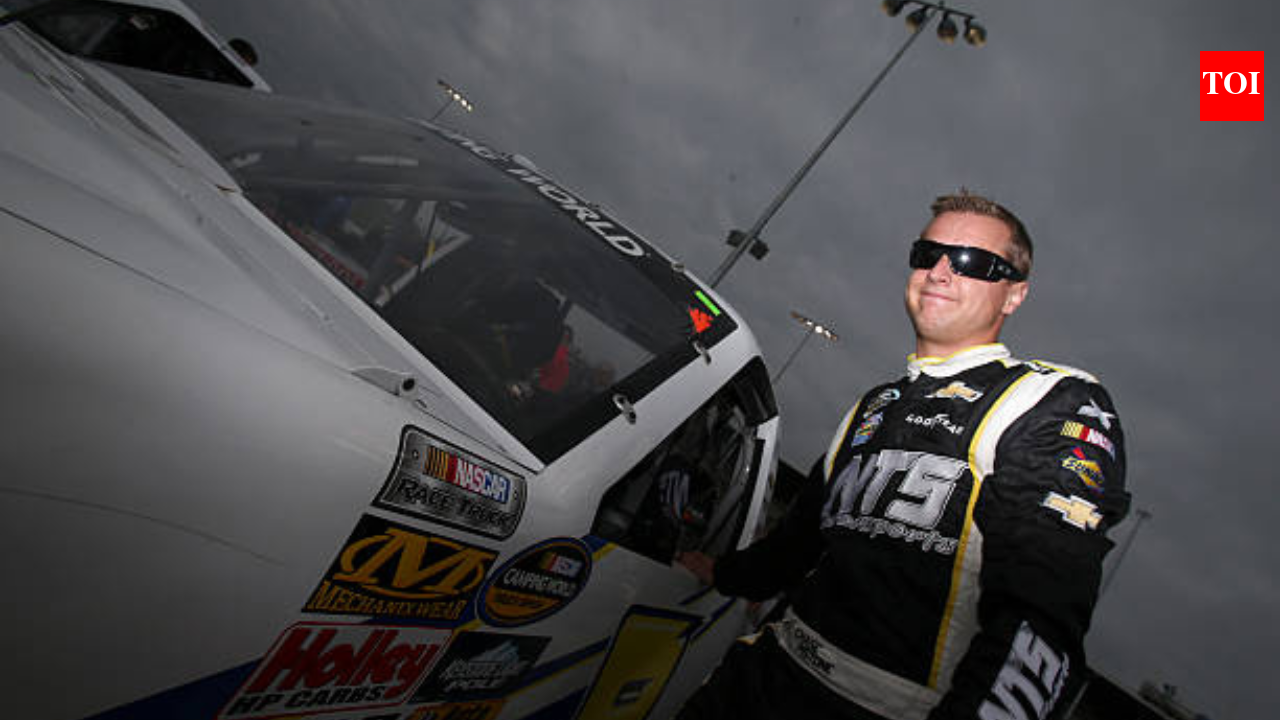
Chase Pistone, the former NASCAR driver and multi-time Legends Car champion, was taken from the racing world far too soon at the age of 42. His sudden passing, confirmed by family on March 2, 2026, has left an aching void in the tight-knit motorsports community that once cheered his fearless style behind the wheel and admired his quiet dedication off it.
The announcement came not through a formal press release but in the most personal and heartbreaking way possible: a raw, emotional post from his older brother Nick Pistone on social media. “Well my young brother and best friend is gone,” Nick wrote. “I’m broken hearted and don’t know if I’ll ever get over this. I miss you Chase already and I hope you are in a better place. I love you and I miss you so much already!!!!!!!” The message ended with a simple but powerful request from Nick and their brother Tom: include the national Suicide & Crisis Lifeline number—988—in any remembrance of Chase. That small detail spoke volumes about the invisible battles that may have contributed to his death, battles that too often remain hidden behind the helmet and the roar of engines.
Born August 20, 1983, in Charlotte, North Carolina—the undisputed capital of American stock-car racing—Chase grew up surrounded by the smell of racing fuel and the sound of V8s being tuned to perfection. Charlotte is more than a hometown for NASCAR families; it is the epicenter where legends are built, teams are headquartered, and dreams either ignite or quietly fade. For Chase, the dream ignited early. By age six he was already strapped into go-karts, learning throttle control and apex lines on the same quarter-mile layouts where future Cup Series stars cut their teeth.
What set Chase apart from many of his peers was lineage. He was the grandson of Thomas “Tiger Tom” Pistone, one of NASCAR’s true pioneers from its rough-and-tumble early decades. Tiger Tom, born in Chicago in 1929, earned his nickname with an aggressive, never-back-down driving style that thrilled crowds at Soldier Field, O’Hare, and the beach-road course at Daytona. He scored two Grand National (now Cup Series) victories in 1959—at Trenton and Atlanta—and compiled 130 starts across a career that bridged NASCAR’s barnstorming roots and its move toward superspeedways. Even into his nineties, Tiger Tom remained a revered figure at Charlotte-area tracks, often seen sharing stories with wide-eyed kids who had no idea they were talking to a man who once raced against Lee Petty and Fireball Roberts.
That heritage weighed on Chase—not as pressure, but as inspiration. He frequently spoke of sitting in his grandfather’s garage as a boy, listening to tales of blown tires at 140 mph, last-lap duels, and the sheer will it took to finish races when everything mechanical was screaming to quit. Those stories shaped Chase’s own philosophy: respect the machine, but never fear it.
His competitive résumé began in the Legends Car division, the affordable, high-energy class that uses fiberglass replicas of 1930s and 1940s coupes powered by Yamaha motorcycle engines. Legends racing is unforgiving—close-quarters contact is common, setups are critical, and talent separates winners from also-rans in a hurry. Chase proved he belonged among the elite almost immediately. Between 1999 and 2005 he captured the prestigious Summer Shootout Championship at Charlotte Motor Speedway’s Legends oval four times: twice in Semi-Pro and twice in Pro. Those mid-summer Wednesday-night showdowns under the lights became his personal proving ground, where he developed the smooth, precise style that later carried him into national series.
By the mid-2000s Chase was ready for bigger stages. He made his NASCAR Craftsman Truck Series debut in 2005 at Martinsville Speedway driving for Green Light Racing, then returned the following season with Braun Racing. Short tracks suited him; he could read the surface changes lap after lap and adjust his line accordingly. In 2006 he stepped up to the NASCAR Nationwide Series (now Xfinity), piloting the No. 50 Dodge for Bobby Jones Racing. His highlight came at Iowa Speedway, where he drove to a top-10 finish on the tricky 7/8-mile oval—a result that proved he could run competitively against drivers with far deeper funding and factory support.
Across his career Chase amassed more than 80 feature wins in Legends, Late Models, and USAR Pro Cup events. Numbers like that do not happen by luck. They come from obsessive preparation, mechanical intuition, and the ability to stay calm when the field is four-wide and the leaders are nose-to-tail.

In 2014 Chase made a pivotal decision: he stepped away from full-time driving and launched Chase Pistone Inc., a team focused on building and fielding competitive Legends and Late Model stock cars. The move allowed him to leverage years of seat time into something larger—helping the next wave of drivers reach their potential. His shop in the Charlotte area quickly earned a reputation for clean, well-sorted race cars that handled beautifully and rarely broke. Competitors joked that showing up to race against a Chase Pistone entry meant you were already fighting for second place. Owners, crew chiefs, and young drivers alike sought his advice because he spoke their language: he had lived every heartbreak of a broken part or a missed setup, and he had also tasted the euphoria of crossing the stripe first.
Those who worked closest with him describe a man who was generous with knowledge yet humble about his own accomplishments. He would spend hours explaining shock valving or tire stagger to a rookie, then quietly disappear to the corner of the shop to fine-tune his own project car. He loved the craft as much as the competition.
The racing world learned of his passing in the first days of March 2026, and the response was immediate and overwhelming. Legends Nation, one of the sport’s most respected voices, wrote: “Chase was not only a wheelman in Legends and Late Models, but his Chase Pistone Inc. team was a force to be reckoned with every time they showed up at a track, and they usually walked away with the winner’s trophy.” Tributes flooded social platforms from drivers he had raced against, crew members he had mentored, and fans who remembered his bright red Legends car slicing through traffic on summer nights.
The decision by his brothers to highlight the 988 lifeline alongside their grief has ignited wider discussion about mental health in motorsports. Drivers live under extraordinary pressure: sponsors demand results, equipment failures can end seasons, crashes can end careers, and the public sees only the highlight reels. Behind closed garage doors, many wrestle with anxiety, depression, and the fear of being “done” before they are ready. Chase’s story—however incomplete the public details remain—has become another reminder that strength on the track does not always translate to strength in silence.
At 42, Chase still had so much left to give. He could have continued building winning cars for another decade, mentoring dozens more young talents, perhaps even returning to competition in a masters or exhibition event. Instead the sport must now carry on without one of its most genuine voices.
Yet legacies like his do not vanish. Every time a Legends Car driver threads the needle in turn three at Charlotte, every time a crew chief makes a bold call on tire pressure that wins the night, every time a grandfather tells his grandson about racing in the old days, a piece of Chase Pistone lives on. He was a link in an unbroken chain that stretches from Tiger Tom’s dirt-track battles in the 1950s to whatever future awaits NASCAR and short-track America.
To those who knew him best, he was more than a driver, more than a team owner. He was a brother, a friend, a mentor who answered late-night phone calls about setups and never made anyone feel small for asking “dumb” questions. The racing community will honor him the only way it knows how: by keeping the engines running, by teaching the next kid how to hit an apex just right, and by reminding one another that it is okay to reach out when the weight becomes too heavy.
Rest easy, Chase. The checkered flag may have fallen one last time, but the stories—and the speed—will never stop.