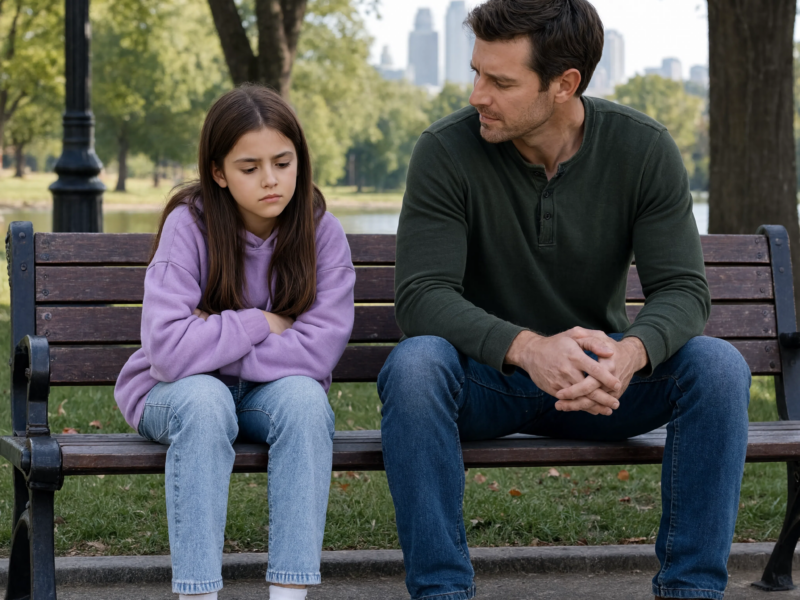
🍂 I fell to my knees in despair, then a stranger handed me my birthright
“Would you like some warm tea?”
A deep, gentle voice broke through my quiet sobbing.
I startled, looking up quickly. Standing beside the bench was a man in his early fifties, wearing a simple, elegant grey overcoat. He had a kind, weathered face, silver hair at his temples, and eyes—warm, brown eyes—that were filled with an overwhelming sense of gentleness and worry. He was holding two steaming paper cups.
Instinctively, I shrank back, shaking my head as I wiped the tears from my cheeks. “No… no, thank you. I’m fine.”
The man didn’t leave. He offered a soft, reassuring smile—the kind of smile that felt like a warm blanket on a freezing winter night—and sat down on the opposite end of the long bench, keeping a polite, respectful distance so as his presence wouldn’t frighten me. He gently placed one of the cups, smelling faintly of sweet chamomile and honey, on the stone bench near my hand.
“Don’t worry, I’m not a stranger with bad intentions,” he said quietly, looking out over the still waters of the park pond. “I’m just an old man who likes to walk here in the afternoons. I saw you crying… and I know how incredibly lonely it feels to cry by yourself in a place like this.”
His gentleness was like a cool balm on an open wound. I stared at the steaming cup, then looked back at him. There was something undefinable about him, a strange, comforting familiarity that I couldn’t quite explain.
“I… I just had a really terrible day,” I whispered, my voice cracked and raw.
“Would you like to talk about it? If you don’t mind sharing your troubles with a quiet listener,” he said, turning his head to look at me, his eyes entirely patient.
And then, like a dam bursting under the weight of a flood, sixteen years of loneliness, neglect, and pain came pouring out of me. I told him everything. I told him about being left behind at three years old, about the coldness of Aunt Susan’s house, about having to sew my own clothes and save coins to buy my own schoolbooks. And finally, I told him about the horrific shouting match I had just fled, where my mother and my aunt treated me like a prize in a twisted, greedy game of tug-of-war.
“They don’t want me,” I sobbed, burying my face in my hands. “Nobody wants me. I’m just a mistake. I’m just a burden to everyone. I wish… I wish I had never been born.”
A large, warm, and slightly trembling hand gently rested on my shaking shoulder.
“Don’t ever say that, Maya. You are not a mistake. You are the most beautiful, brave, and resilient girl I have ever known.”
I froze. The breath caught in my throat. I slowly lifted my head, staring at the man beside me. How did he know my name? I hadn’t introduced myself.
As I looked closer at his face, I realized his own eyes were red and filled with tears. His hands shook as he reached into his coat pocket and pulled out an old, worn leather wallet.
With trembling fingers, he opened it. Inside, protected behind a clear plastic sleeve, was not money, but a faded, yellowed photograph.
The picture showed a much younger man cradling a baby girl, perhaps two years old, who had wide, curious eyes and a bright, toothless smile. The baby in the photo had a distinct, tiny leaf-shaped birthmark right below her left collarbone—the exact same birthmark I saw in the mirror every single morning. And the young man holding her in the photo… was a younger version of the man sitting right next to me.
“You… you are…” My head spun, my heart hammering against my ribs so hard I thought it would burst.
“For thirteen years, Maya… not a single day went by where I didn’t look for you,” he whispered, his voice cracking as the tears finally spilled down his cheeks.
He slid off the bench, kneeling on the cold, damp ground right in front of me. He took my rough, calloused hands into his own, pressing them gently against his face.
“All those years ago, when I was deployed overseas with the military, your mother sent me a letter. She told me you had passed away from a sudden illness. She even sent me a photo of a fake grave to make me believe you were gone. She hated me for leaving to serve, and she wanted to hurt me in the worst way possible. It wasn’t until three years ago, when I ran into an old friend of hers, that I learned the truth… that you were alive, and that she had left you here.”
I stared at him, my tears falling onto our joined hands. “But… but if you knew, why didn’t you come for me? Why did you leave me there to live like that?”
“I did come, Maya. I have been here,” he wept, his eyes filled with a profound, aching regret. “I have stood by the bus stop every afternoon watching you walk home from school. I have stood outside your classroom window. I bought the pastries you liked from the bakery and asked the neighbor to leave them on your porch. But I was trapped, my sweet girl. The law was on their side; your aunt had legal guardianship papers signed by your mother. I knew if I rushed in and tried to take you, they would hide you away, and I would lose you forever. So, I spent the last three years saving every penny of my pension, hiring the best family lawyers, and building an airtight custody case.”
He squeezed my hands, his tear-filled eyes suddenly burning with a fierce, protective light. “This morning, when I saw your mother and Susan fighting, I delivered all the evidence of child neglect, abuse, and extortion I had gathered over the years straight to the police station. They were both arrested an hour ago, Maya. You are free. You never have to go back to that house again.”
In that single, breathtaking moment, the dark, cold world of neglect and shame that had haunted my entire life was torn apart by a brilliant, blinding light.
I wasn’t an unwanted orphan. I wasn’t a burden to be traded for cash. I had a father—a father who had spent a decade searching for me, who had watched over me from the shadows of the trees, and who wept for the callouses on my hands.
I lunged forward, throwing my arms around his broad, sturdy shoulders, burying my face in his neck. The scent of pine wood and warm tea from his coat enveloped me, bringing a profound sense of safety and belonging that I had craved for sixteen long years.
“Dad…” I whispered, the word feeling sacred and brand new as it echoed in the quiet autumn air.
He held me tight, kissing the top of my head, his voice shaking as he held me close. “I’ve got you, my beautiful girl. Let’s go home. I’m taking you home.”
As we walked out of the park hand in hand, the evening sun dipped below the horizon, painting the sky in brilliant shades of gold and amber. I knew the road ahead of us wouldn’t be easy, but the cold winter winds would never frighten me again. I had finally found my harbor—in the warm embrace and the quiet, unbreakable love of my father.