In the shadowed annals of HBO’s ever-expanding Game of Thrones universe, where dragons once roared and thrones dripped with blood, a quieter revolution has begun. “A Knight of the Seven Kingdoms,” the latest spin-off, premiered on January 18, 2026, with an episode that swaps epic battles for earthy humor, fire-breathing beasts for fleeting shooting stars, and royal intrigue for the raw ambitions of a commoner. Set roughly a century after the dragon-riddled chaos of “House of the Dragon” and nearly two centuries before the Stark-Lannister wars of the original series, this adaptation of George R.R. Martin’s “Dunk and Egg” novellas introduces us to Ser Duncan the Tall – or “Dunk,” as he’s humbly known – and his pint-sized companion, Egg. Directed by Owen Harris and penned by Ira Parker, the premiere episode is a masterclass in subtle world-building, blending heartfelt pathos with laugh-out-loud absurdity. It’s a Westeros we’ve glimpsed before, but never quite like this: stripped of grandeur, laced with levity, and pulsing with the underdog spirit that made Martin’s tales timeless. As social media erupts with memes of Dunk’s unfortunate “throne” moment and debates over Egg’s cheeky wisdom, one thing is clear – this knight’s errant journey has already captured hearts. But does it live up to the Iron Throne’s legacy? Let’s dive deep into the recap, analysis, and cultural ripple of this promising debut, spoiler-laden and all.
Setting the Stage: A Post-Dragon Westeros on the Brink
To appreciate the premiere’s charm, we must first contextualize its place in the sprawling Song of Ice and Fire lore. It’s the year 209 AC (After Conquest), a time when the Targaryen dynasty clings to power under King Daeron II, but the scars of the Blackfyre Rebellion – a civil war over illegitimate heirs – still fester. Dragons are extinct, their absence a ghostly void that makes the world feel smaller, more human. No longer do we soar on scaly backs; instead, we’re trudging through mud and meadows with hedge knights, those wandering warriors who scrape by on tournaments and oaths. This era’s Westeros is a land of fragile peace, where nobility jousts for glory while commoners like Dunk dream of rising above their station.

The episode opens not with a bang, but with a shovel’s thud. We meet Dunk (Peter Claffey), a towering, broad-shouldered youth with a face etched in quiet determination, digging a grave under a somber sky. His mentor, Ser Arlan of Pennytree (Danny Webb), lies cold beside him – a hedge knight felled not by valorous combat, but by a mundane chill caught in the rain. Dunk’s eulogy is raw and touching: “You were a true knight, Ser Arlan. You taught me everything I know.” Tears stream down his face as he buries the man who shaped him, a poignant reminder that in Martin’s world, death is often unglamorous. But amid the grief, opportunity glimmers. Dunk eyes Ser Arlan’s sword, testing its weight in his massive hands. It fits perfectly, as if destiny itself forged the grip. “Why not?” he mutters, a spark igniting in his eyes. He saddles Arlan’s horses – Charger and Thunder – and sets off for the grand tournament at Ashford Meadow, vowing to compete as a knight in his own right.
Yet, the premiere wastes no time puncturing this heroic bubble. As Dunk rides forth, the iconic Game of Thrones theme swells… only to accompany him crouching behind a tree, stricken with explosive diarrhea. It’s a hilariously humanizing moment, one that sets the tone for the series: This isn’t about gods and monsters; it’s about knights who shit in the woods. Social media lit up instantly – X users posted GIFs captioned “When the Iron Throne calls unexpectedly,” while TikTok recreations went viral with over 500,000 views in the first 24 hours. This blend of aspiration and absurdity is the episode’s secret weapon, drawing viewers in with relatable vulnerability.
The Road to Ashford: Encounters and Early Bonds
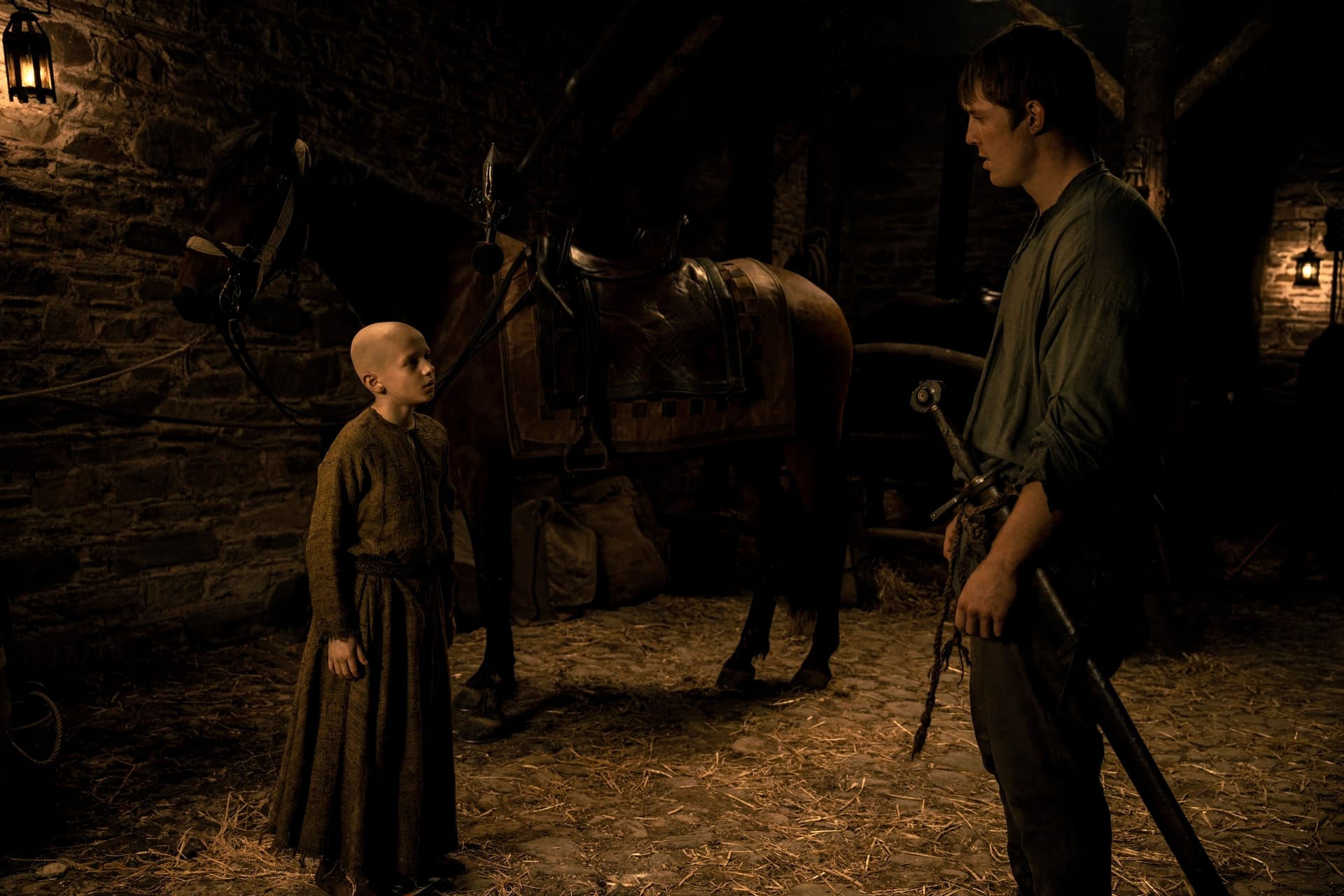
En route to the tournament, Dunk stops at a dingy tavern, a hub of rowdy patrons and flickering hearths. Here, he boasts of his impending knighthood to a skeptical crowd, including a drunken noble who mocks his commoner roots. But it’s a precocious boy with a shaved head – Egg (Dexter Sol Ansell) – who steals the scene. Egg, with his wide eyes and sharp tongue, questions Dunk’s claims: “You don’t look like a knight. Knights have armor and banners.” Undeterred, Dunk spins tales of his “exploits,” but Egg sees through the bluster, offering to squire for him at the tourney. Dunk declines, brushing off the kid as a Flea Bottom urchin, and rides on alone. Little does he know, this encounter plants the seeds of an unbreakable partnership.
Ashford Meadow unfolds like a medieval fairground on steroids: tents billow in the wind, heralds trumpet arrivals, and armored knights parade their sigils. Dunk arrives wide-eyed, his patched cloak a stark contrast to the opulent displays of houses like Baratheon and Fossoway. But reality crashes down swiftly. To enter the jousting lists, one must prove nobility or knighthood – and Dunk has neither. Ser Arlan never formally dubbed him, a detail that gnaws at Dunk’s conscience. “I’m no knight,” he confesses inwardly, but desperation pushes him to forge ahead. He seeks vouching from fellow hedge knights, but no one remembers Arlan, dismissing him as “some old fool from Pennytree.”
Enter Raymun Fossoway (Shaun Thomas), a timid, apple-cheeked squire tending to his cousin Ser Steffon. Raymun, sensing Dunk’s plight, leads him to the boisterous tent of Ser Lyonel Baratheon (Daniel Ings), a devil-may-care ancestor of the infamous King Robert. Lyonel, with his roaring laugh and tankard in hand, embodies the Baratheon fury in its rawest form – a whirlwind of mead, merriment, and mild menace. He regales Dunk with tales of past glories, offering a hearty meal of roasted meats and ale-soaked bread. The scene crackles with energy: minstrels strum lutes, dancers whirl, and Lyonel’s unhinged charisma shines as he arm-wrestles challengers. Yet, for all the hospitality, Lyonel provides no real aid – no vouch, no armor. It’s a subtle critique of nobility’s superficiality: They feast while commoners starve for opportunity.
Dejected, Dunk slinks back to his makeshift camp by the river, where his horses graze under the stars. Shock awaits: Egg has followed him, miles on foot, and has built a crackling fire with fresh-caught fish sizzling on sticks. “I told you no,” Dunk grumbles, but Egg’s resourcefulness – and his innocent plea for adventure – wins him over. “Fine, you can stay for the tourney,” Dunk concedes, clouting Egg lightly on the ear in a gesture that’s equal parts affection and authority. As they share the meal, Egg reveals he’s from King’s Landing proper, not the slums Dunk assumed, hinting at deeper secrets (book readers know Egg’s royal Targaryen lineage, but the show plays it coy for now).
The episode’s emotional apex arrives under the night sky. As Dunk and Egg lie on the cold ground – far from the silk-draped tents of lords – a shooting star streaks across the heavens. Egg, ever the optimist, declares it a sign of good luck. “The knights in their tents can’t see it,” he whispers. Dunk pauses, then smiles: “So the luck is ours alone?” Egg nods, rolling over with a grin. It’s a beautiful, understated moment, symbolizing the duo’s outsider status as their greatest strength. In a world rigged for the elite, serendipity favors the overlooked.
Character Deep Dive: From Hulking Hero to Cheeky Squire
 Peter Claffey’s Dunk is a revelation – a gentle giant whose physicality (Claffey stands at 6’6″) conveys both intimidation and innocence. His portrayal captures Dunk’s internal conflict: the burning desire for honor clashing with the fraudulence of his unearned title. Claffey’s subtle expressions – a furrowed brow during rejections, a soft smile at Egg’s antics – make Dunk instantly rootable. He’s no Jon Snow or Daemon Targaryen; he’s the everyman knight, flawed and fumbling toward greatness.
Dexter Sol Ansell’s Egg is the perfect foil: a bundle of precocious energy with a shaved head that screams “mystery.” Ansell’s delivery is pitch-perfect, blending childlike wonder with sly intelligence. Egg’s persistence – tracking Dunk, providing for him – foreshadows his role as the moral compass and comic relief. Their dynamic evokes classic buddy tales like “The Princess Bride” or “Shrek,” but grounded in Martin’s gritty realism.
Supporting players shine too. Danny Webb’s brief Ser Arlan sets a mentor archetype, his death a catalyst for Dunk’s arc. Daniel Ings’ Ser Lyonel is a riot – boisterous yet layered, hinting at the Baratheon lineage’s wild streak. Shaun Thomas’ Raymun adds timid charm, a potential ally in future episodes.
Thematic Resonance: Luck, Legitimacy, and Lighter Tones
At its core, the premiere explores legitimacy in a stratified society. Dunk’s quest mirrors broader Westerosi themes: Who deserves power? Can a commoner rise without blood ties? The tournament’s barriers – noble vouching, forgotten reputations – underscore class divides, a timely allegory for modern meritocracies riddled with nepotism.
Humor tempers the heaviness. Unlike “Game of Thrones'” grimdark tone or “House of the Dragon’s” incestuous intrigue, this series embraces comedy. The diarrhea gag, Egg’s sass, and Lyonel’s antics inject levity, making Westeros feel lived-in and fun. Yet, it’s not frivolous; subtle nods to Targaryen politics (Egg’s origins) promise deeper stakes.
Visually, the episode stuns. Cinematographer Catherine Goldschmidt captures Ashford’s vibrancy – colorful banners fluttering, crowds cheering – contrasting Dunk’s muted palette. Ramin Djawadi’s score weaves familiar motifs with folksy strings, evoking a folksier era.
Social Media Buzz and Fan Reactions
The premiere ignited online fervor. On X, #AKnightOfTheSevenKingdoms trended globally, with fans praising the “refreshing lightness” post-“House of the Dragon’s” intensity. “Finally, a GoT show that’s fun again!” tweeted @WesterosFanatic, garnering 10K likes. TikTok exploded with Egg cosplays and Dunk memes, one video of a fan recreating the shooting star scene hitting 1M views. Reddit’s r/asoiaf dissected lore accuracies, debating Egg’s hints, while Facebook groups shared polls: 78% graded it A/B.
Critics echo the hype. TVLine’s Kimberly Roots called it “smaller, gentler, more comedic,” awarding high marks. Yet, some gripe about the slow pace, yearning for dragons. Overall, it’s a win – viewership topped 8 million, per HBO metrics.
Looking Ahead: Promises of Peril and Partnership
As the credits roll, we’re left hungry for more. Future episodes, drawn from “The Hedge Knight” novella, promise jousts, betrayals, and revelations about Egg’s identity. With a six-episode season, the series could redefine GoT spin-offs: intimate, character-driven epics.
In a franchise bloated with spectacle, “A Knight of the Seven Kingdoms” reminds us why we fell for Westeros – not the thrones, but the people chasing them. Dunk and Egg’s journey is just beginning, but it’s already a knight to remember. Grade: A-. What’s yours? Sound off below.