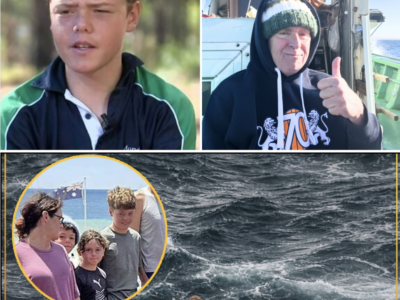
A true West Aussie hero emerged from the wild waves off Dunsborough when 13-year-old Austin Appelbee turned a family holiday disaster into an unforgettable tale of raw courage and unbreakable will.
The Appelbee family had planned nothing more than a relaxed final day on the water before heading home to Gidgegannup near Perth. Mother Joanne, 47, along with Austin, his 12-year-old brother Beau, and 8-year-old sister Grace, rented an inflatable kayak and paddleboards near Quindalup in Geographe Bay. The turquoise expanse looked inviting under the late January sun on Friday, January 30, 2026. Everyone expected laughter, gentle paddling, and maybe a few splashes before the long drive back.
Conditions changed with brutal speed around 11 a.m. Offshore winds strengthened into fierce gusts, the swell rose sharply, and the family suddenly found themselves fighting for control. Paddles slipped from their grasp and vanished into the chop. Water poured into the inflatable kayak, turning the once-fun craft into a sinking liability. Currents dragged them farther from shore with every passing minute. Life jackets kept them afloat, but the relentless push outward left no room for error.
Joanne faced a heart-stopping decision as panic crept in. One child clung to the paddleboard while the others struggled beside her. She looked at her eldest son and made the call no parent ever wants to make. She told Austin to swim for shore and raise the alarm because the situation could turn deadly fast. The boy nodded, determination replacing fear, and set off alone into the chaos.
The kayak quickly became useless, waterlogged and cumbersome. Austin abandoned it. His bulky life jacket hindered his strokes in the pounding waves, so he shed that too, exposing himself to the full force of the ocean—and to the very real danger of sharks that patrol those waters. What followed was a four-kilometer swim through massive breaking waves that tested every ounce of his strength. He later described the ordeal with chilling simplicity: massive walls of water crashing over him, no life jacket for buoyancy, pure adrenaline keeping exhaustion at bay. His longest previous swim had been only 350 meters. This was something else entirely.

He focused on one thought to block out the terror—keep swimming, just keep swimming. Four grueling hours later, Austin hauled himself onto the sand near Toby’s Inlet, roughly two kilometers up the beach from where they had started. His body screamed for rest, but his family was still out there drifting. Barefoot and drained, he ran another two kilometers along the shore to reach the spot where his mother had left her phone with their gear earlier that day. Shaking from cold, shock, and hunger—he had eaten nothing since breakfast—he dialed emergency services around 6 p.m. His voice cracked as he pleaded for help: helicopters, planes, boats, anything. My family is out at sea.
Meanwhile, Joanne, Beau, and Grace held on to a single paddleboard as the current carried them an astonishing 14 kilometers offshore—nearly nine miles into the open ocean. Darkness fell. The water grew colder. They sang songs to stay calm, cracked weak jokes to fight despair, and prayed Austin had made it. For more than eight hours—some accounts say closer to ten—they endured the unknown, hypothermia setting in, hope fading with the light.
A massive rescue effort had already mobilized. South West Police, Water Police Coordination Centre, Naturaliste Volunteer Marine Rescue, and the RAC rescue helicopter worked together under tight coordination. Commander Paul Bresland later called Austin’s swim superhuman, crediting the boy’s relentless push with giving rescuers the critical window they needed. Just before 8:40 p.m., the helicopter’s thermal imaging picked up three small heat signatures clinging to the paddleboard far out in Geographe Bay. A vessel raced to the position, and within moments the family was pulled aboard—shivering, exhausted, but miraculously alive.
Medics treated them for hypothermia and shock at the scene. No life-threatening injuries. The contrast could not have been starker: hours earlier, death seemed close; now safety wrapped around them like a blanket.
Austin’s humility shone through in every interview that followed. He brushed off the hero label, insisting he simply did what needed doing. Yet the world saw something different. Western Australian Premier Roger Cook publicly celebrated the teenager as a true West Aussie hero. Headlines raced across Australia and beyond—BBC, Sky News, Fox News, ABC, The Washington Post—each one marveling at a 13-year-old who swam through hell to save the people he loves most.
Geographe Bay can deceive with its postcard beauty. On calm days the water glows inviting blue. When the wind switches, the same bay becomes a relentless machine of current and swell. Inflatables offer almost no resistance against such forces. Experts now remind everyone checking forecasts is non-negotiable, proper flotation gear must stay on, and no one should underestimate how quickly paradise can turn perilous.
The ordeal welded the Appelbee family tighter than ever. Joanne still grapples with the memory of sending her son into the waves alone. Austin admits he feared the worst during his swim, convinced he might never see his mum, brother, or sister again. Beau and Grace talk about the songs they sang to keep spirits alive. Through it all runs one unbreakable thread: Austin refused to quit.
Stories like this cut through the noise of everyday life. They force a pause. What does real bravery look like? It looks like a skinny Year 9 kid from Gidgegannup fighting four kilometers of angry ocean because his family needed him. It looks like refusing to collapse on the beach even after your body begs for mercy. It looks like dialing for help when every muscle trembles and your voice shakes.
Austin Appelbee did not ask to become a symbol. He simply acted when the moment demanded it. In doing so, he reminded everyone that courage rarely waits for permission or comes wrapped in an adult’s frame. Sometimes it arrives in the body of a 13-year-old boy who loves his family enough to swim through hell and run through fire to bring them home.
Western Australia has every right to stand tall. This is what a true West Aussie hero looks like—quiet, determined, and fiercely loyal when the stakes are life itself.