“They Lost the Only Way Out” — Broken Guide Rope Theory Now at Center of Maldives Cave Disaster Investigation
The deadly underwater cave disaster in the Maldives has taken a deeply unsettling turn after technical diving experts reportedly identified what may be one of the most critical clues yet in understanding why five experienced Italian divers never resurfaced from the pitch-black abyss beneath Vaavu Atoll.
For days, speculation surrounding the tragedy focused heavily on dangerous underwater currents, severe weather, and the possibility of a powerful “Venturi effect” inside the cave system.
But investigators and technical specialists are now increasingly examining a far more terrifying possibility: the divers may have lost the only thing capable of guiding them back to safety.
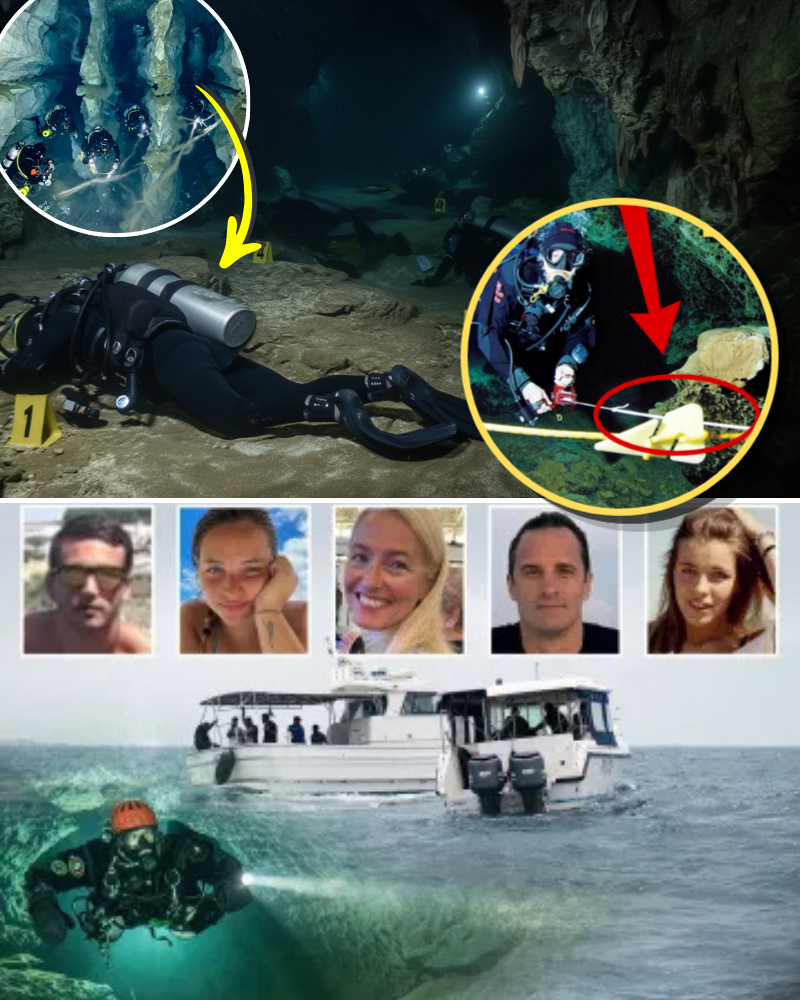
According to reports connected to the ongoing investigation, recovery teams discovered evidence suggesting that sections of the underwater guide line — the critical navigation rope used by cave divers to locate exits in total darkness — may have been damaged, displaced, or severed deep inside the submerged cavern system.
Authorities have not publicly confirmed final conclusions regarding the condition of the lines, but experts familiar with cave diving procedures say the implications could be catastrophic.
In underwater cave exploration, guide lines are considered life-support-level safety equipment.
Unlike open-water diving, cave divers cannot simply swim upward during emergencies because rock ceilings block direct ascent to the surface.
Instead, divers rely on continuous navigation lines running throughout the cave system to find their way back through darkness and complex underwater passages.
Technical diving specialists explain that if visibility suddenly collapses — a common event known as a “silt out” caused by disturbed sediment — the guide line may become the diver’s only remaining connection to survival.
Without it, even elite divers can become completely disoriented within seconds.
The Maldives cave system where the tragedy occurred reportedly contains narrow corridors, unstable sediment zones, multiple chambers, and deep confined passages reaching approximately 160 to 200 feet below the surface.
At those depths, divers already face severe physiological stress including nitrogen narcosis, oxygen toxicity, decompression complications, panic disorientation, and rapidly increasing gas consumption during physical exertion.
Experts say that if the navigation line failed during low visibility conditions, the divers may have become trapped in total darkness with no reliable path back toward the exit.
Recovery teams later described the underwater environment as extraordinarily dangerous even for highly trained rescue specialists.
The operation became even more devastating after a rescue diver participating in recovery efforts reportedly also lost his life inside the same cave system.
Authorities continue reviewing dive computer data, recovered GoPro footage, gas systems, underwater route planning, communication records, and environmental conditions linked to the doomed expedition.
Investigators are also examining whether the dive exceeded operational depth limits associated with the Duke of York used during the excursion.
Meanwhile, Albatros Top Boat previously stated it did not authorize a dive reaching such extreme depths.
The tragedy has generated intense discussion throughout international diving communities because guide-line failures are considered among the worst possible emergencies in technical cave diving.
Mental health experts explain that disasters involving invisible environmental failures often deeply disturb the public because they reveal how quickly survival can depend on a single hidden system most people never even notice.
Authorities continue urging the public not to spread graphic misinformation or unsupported conspiracy theories while the investigation remains active.
As investigators continue reconstructing the divers’ final moments beneath the Maldives seabed, the emerging theory surrounding the damaged guide rope is painting a horrifying picture — one in which experienced divers, surrounded by darkness hundreds of feet underwater, may have suddenly realized the only path leading home had vanished completely.