When Rihanna took the stage at the Super Bowl LVII halftime show, expectations were already sky-high. The global superstar had been largely absent from live performances for years, focusing instead on her business empire and personal life. Yet what unfolded inside State Farm Stadium was not just a long-awaited return—it was a cultural moment that instantly redefined what a halftime show could represent. With a minimalist yet visually striking production, Rihanna delivered a performance that leaned entirely on her catalog, charisma, and commanding presence, without the traditional reliance on surprise guest appearances that have become a staple of the event. The result was a show that sparked widespread conversation and cemented her legacy as one of the most influential entertainers of her generation.
The performance opened with a dramatic reveal, as Rihanna appeared elevated high above the stadium on a floating platform, clad in a bold red ensemble that quickly became one of the most talked-about outfits in recent Super Bowl history. As the first notes of her hit songs rang out, it became clear that this would not be a conventional halftime show. Instead of overwhelming the audience with elaborate stage changes or multiple collaborators, the production focused on synchronized dancers positioned on moving platforms, creating a dynamic yet controlled visual environment. This design allowed Rihanna to remain the focal point throughout, emphasizing her ability to hold the attention of millions with little more than her voice, presence, and a carefully curated setlist.
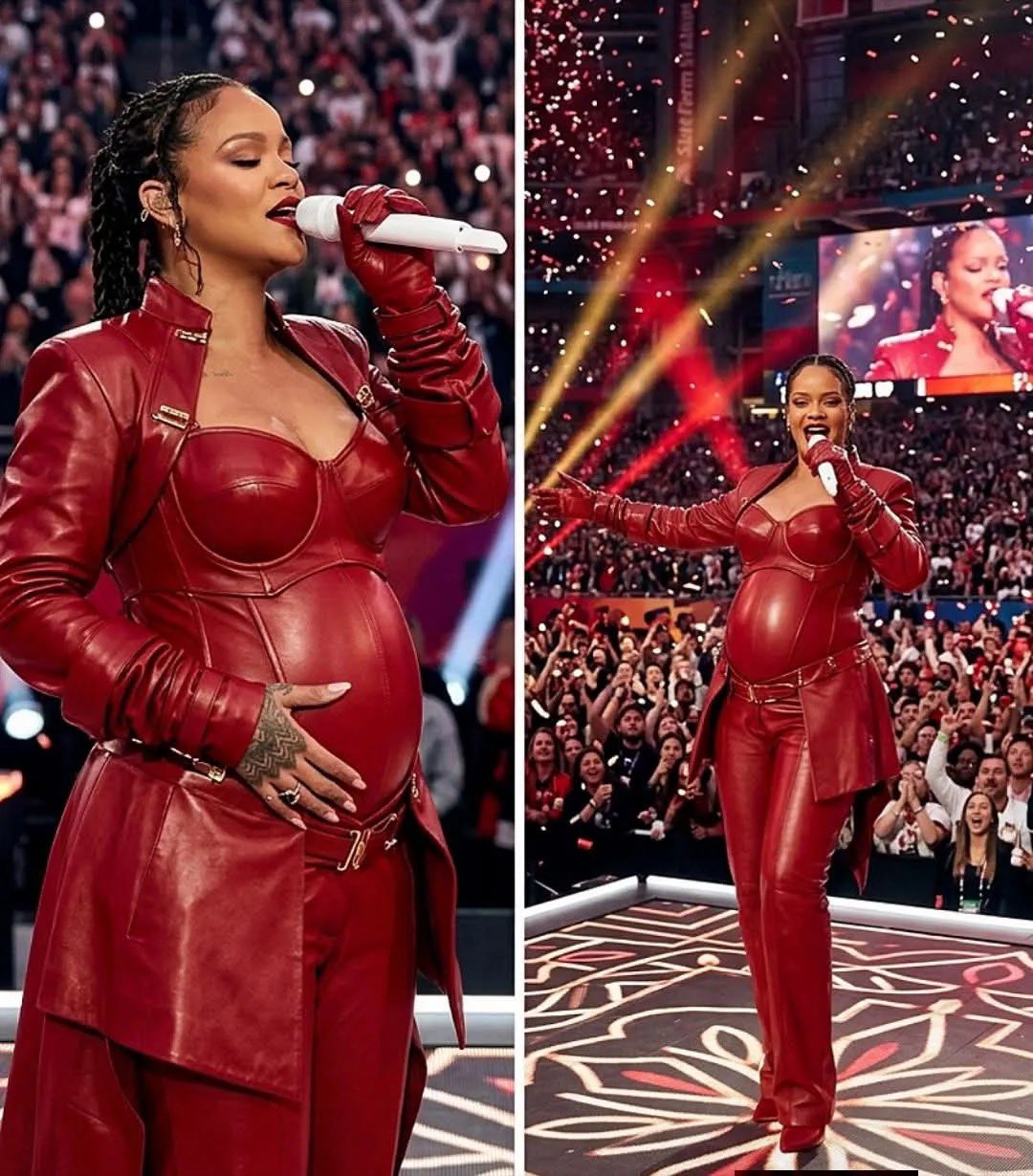
What elevated the performance from memorable to historic was the revelation that Rihanna was pregnant with her second child. While speculation quickly spread across social media during the show, her representatives later confirmed the news, adding a new layer of significance to the performance. In an industry often defined by physical demands and high-energy choreography, Rihanna’s decision to perform under such circumstances was widely interpreted as a powerful statement. Rather than scaling back entirely, she adapted the performance to suit her condition, incorporating measured movements and confident stage command that underscored her professionalism. The image of a visibly pregnant artist headlining one of the world’s largest live events resonated globally, challenging traditional expectations of performers and redefining what strength and capability can look like on such a stage.
From a musical standpoint, the setlist functioned as a concise yet comprehensive journey through Rihanna’s career. Hits like “We Found Love,” “Umbrella,” and “Diamonds” were delivered in rapid succession, each transition seamless and intentional. The absence of guest artists—common in previous halftime shows—proved to be a defining creative choice. By standing alone, Rihanna reinforced the depth and breadth of her discography, reminding audiences that her catalog alone is powerful enough to sustain a performance of this magnitude. Industry analysts noted that this approach shifted the narrative from spectacle-driven entertainment to artist-centered storytelling, placing emphasis on legacy rather than novelty.
The production also highlighted the evolution of halftime show aesthetics in recent years. The floating platforms, geometric choreography, and uniform costuming of the dancers created a futuristic visual language that contrasted sharply with earlier, more traditional halftime performances. This stylistic direction aligned with broader trends in live entertainment, where technological integration and minimalist design are increasingly used to create immersive experiences. Despite the scale of the event, the performance maintained a sense of intimacy, with camera work that frequently focused on Rihanna’s expressions and movements, drawing viewers into the moment rather than overwhelming them with constant visual shifts.
Beyond the performance itself, the cultural and commercial impact was immediate and measurable. Streaming numbers for Rihanna’s music surged across platforms within hours of the broadcast, while her beauty and fashion brands experienced renewed consumer interest. Analysts described the halftime show as a masterclass in brand synergy, demonstrating how a single performance can drive engagement across multiple industries. At the same time, discussions surrounding representation and visibility gained momentum, as Rihanna’s performance was celebrated as a milestone for women, particularly mothers, in the entertainment industry. The show became not just a musical event, but a broader cultural touchpoint that sparked dialogue far beyond the stadium.
Critically, the reception to the performance reflected a shift in audience expectations. While some viewers initially anticipated surprise collaborations or more elaborate staging, many ultimately praised the restraint and focus of the show. Critics highlighted Rihanna’s ability to command the stage without relying on external elements, describing the performance as a “confidence play” that prioritized authenticity over excess. This approach aligned with a growing preference for performances that emphasize individuality and artistic identity, rather than attempting to outdo previous spectacles through sheer scale or complexity.
In the broader context of Super Bowl halftime history, Rihanna’s performance stands as a defining moment that may influence future productions. By stripping back traditional elements and centering the show on a single artist’s vision, she demonstrated that impact does not necessarily require escalation. Instead, it can be achieved through clarity, confidence, and a deep understanding of one’s own artistry. As the entertainment industry continues to evolve, the legacy of this performance will likely be measured not only by its immediate success, but by its lasting influence on how major live events are conceptualized and executed. In that sense, Rihanna did more than deliver a halftime show—she set a new standard, proving that true star power can redefine even the most established stages.