Shadows of the Past: The Price of Redemption
Chapter 1: The Rain and the Forgotten Road
Ten years ago, on a storm-drenched October night in suburban Chicago, I shattered my own soul and turned myself into a monster.
I was twenty-five years old back then—arrogant, recklessly ambitious, and riding the high of landing my first multi-million-dollar corporate architectural contract. The celebration at a rooftop lounge in the West Loop had drifted late into the night, heavily fueled by expensive scotch and foolish pride. Instead of calling a cab, I made the fatal decision to get behind the wheel of my black Porsche 911 Carrera. I sped down Route 83, cutting through the driving rain, blinded by alcohol and sheer overconfidence.
Then came the sound.
CRASH.
It wasn’t just metal bending; it was the sickening, wet impact of heavy machinery striking human bone and flesh.
The car jolted violently. In the harsh, flicking beam of my headlights, an elderly woman was thrown across the hood before rolling onto the rain-slicked asphalt. A cheap plastic grocery bag burst open beside her, spilling fresh apples and vegetables into the muddy puddles.
I slammed the brakes, stopping fifty yards down the dark, deserted road. My heart hammered against my ribs like a trapped animal. Moles of cold sweat broke out across my forehead, washing away the alcohol buzz in a single second of terror. I sat frozen in the driver’s seat, watching the rearview mirror.
She wasn’t moving.
Panic—raw, selfish, animalistic panic—took complete control of my mind. I thought of my budding career, the upcoming newspaper profiles, my wealthy family’s reputation, and the iron gates of a state prison. Instead of stepping out into the storm to render aid or dial 911, I jammed my foot onto the accelerator. The tires shrieked against the wet pavement, and I vanished into the dark.
I hid like a coward. Two days later, I paid a shady auto mechanic forty miles away five thousand dollars in cash to tear the Porsche apart for scrap metal before burning his shop down in an act of staged arson. Because that rural stretch of road lacked surveillance cameras and witnesses, the police investigation stalled within a month.
I escaped the legal system completely. But the man I used to be died on that asphalt alongside Ruth Mercer.
Ten years passed. I built a brand-new life on top of that dark grave. At thirty-five, I was Ethan Vance—founder and Chief Executive Officer of Vance Architectural Group, operating out of a glass skyscraper overlooking Michigan Avenue. I had acquired everything society deemed successful: a multi-million-dollar net worth, industry awards, and a sleek penthouse in Gold Coast. Yet every time a thunderstorm rattled my bedroom windows, the sickening sound of that collision echoed through my mind, reminding me that my entire life was an unpunished fraud.
Then, on a crisp morning in September, my past walked straight through my front door.
Our HR department had recruited a new cohort of junior architecture interns from top Midwest universities. As I casually scrolled through the digital personnel files on my tablet, one photograph made my blood turn to ice.
Clara Mercer. Age 20.
When Clara walked into the glass boardroom for the orientation seminar, my hands shook so violently I dropped my pen. She possessed the exact same warm hazel eyes, the same gentle curve of the jawline, and the same stoic posture as the woman I had murdered ten years ago.
A background check confirmed the horror: Clara was Ruth Mercer’s granddaughter. She had been just ten years old when her grandmother—her sole legal guardian—was killed on that dark road. Clara had grown up in the foster care system, spending every spare moment of her youth obsessively hunting for the unidentified black sports car that had torn her family apart. She had applied to my firm specifically because historical business registries showed I had operated an auto-restoration company near that suburban town in 2016.
Clara hadn’t just joined my firm. A living indictment had stepped into my kingdom.

Chapter 2: The Architecture of Remorse
Instead of firing her, transferring her to another branch, or running away, a dark, twisted desperation took root inside me: I wanted to pay my debt.
I began secretly manipulating Clara’s world to protect her from every hardship. When senior project managers attempted to dump overwhelming workloads on her desk, I intervened behind closed doors, quietly reassigning the tedious tasks to senior staff. When I discovered the heating unit in her tiny rented apartment on Oak Street was broken during a brutal Chicago blizzard, I secretly purchased the entire residential building through an offshore holding company and dispatched premier HVAC contractors to overhaul her unit within three hours.
When her final university tuition payment was due, an “anonymous corporate merit scholarship” magically appeared in her student portal, covering her fees and providing a generous living stipend.
I swore to myself that my actions were purely transactional. I told myself I was merely transferring blood money to ease the weight on my conscience.
But guilt is a volatile foundation for human intimacy. The more I observed Clara—her sharp analytical mind during floorplan reviews, her fierce dedication to sustainable housing, the soft, genuine way her eyes crinkled when she laughed over a morning espresso—the more my quiet penance morphed into an obsessive, uncontrollable love.
She was everything pure and honest in a corporate world I had corrupted. She became my daily obsession, my secret pride, and the only light inside my hollow existence.
For two full years, this quiet arrangement persisted. Clara graduated with honors and was promoted to a full-time junior architect under my direct supervision. She worked steps away from my corner office, her presence filling the empty spaces of my life.
Then came Julian Vance—no relation to me, but a brilliant twenty-five-year-old structural engineer hired from a rival firm.
Julian was young, handsome, completely unburdened by dark secrets, and shared Clara’s passion for green urban planning. Within three months, Julian began openly courting her. From my high-rise glass office, I was forced to watch them together. I saw her laugh at his jokes in the breakroom, saw him walk her to the subway station in the evening, and saw them sitting closely at the coffee shop across Michigan Avenue, holding hands over paper cups.
Every smile she offered Julian felt like a hot iron pressed against my chest.
I knew I possessed zero moral right to be jealous. A hit-and-run killer had no business longing for the granddaughter of his victim. But love born from a decade of silent remorse does not follow logic; it burns with toxic, desperate intensity.
On a rainy Friday evening in late November, the office had cleared out early for the weekend. Only Clara remained at her desk on the thirty-second floor, refining a hospital blueprint under the soft glow of a desk lamp.
I stepped out of my private office, my leather shoes clicking softly against the hardwood floor, and stood near her workstation.
“You’re working too late, Clara,” I said, my voice low, strained by weeks of sleeplessness. “Julian is probably waiting for you downstairs.”
Clara paused, setting her digital stylus down. She looked up at me, wiping a stray strand of brown hair from her forehead, her hazel eyes reflecting the amber city lights outside the rain-streaked windows.
“Julian went home hours ago, Ethan,” she said softly, using my first name instead of ‘Mr. Vance’ for the very first time. “Besides… I prefer working when it’s quiet. When it’s just us.”
The wall of professional restraint I had spent two years constructing completely crumbled.
“Clara,” I said, stepping into her space, my hands trembling as I reached out, stopping just short of touching her face. “Don’t marry him. Don’t build a life with him.”
Clara froze, her breath catching in her throat. “Ethan… what are you saying?”
“I love you,” I confessed, the truth pouring out of me like a dam bursting after ten years of pressure. “I have loved you since the second you walked into this firm. I know I’m older, I know I am your superior, but watching you give your heart to another man is tearing my soul apart.”
Clara stood up slowly from her executive chair, her cheeks flushing warm crimson. She stared into my eyes, searching the raw, pathetic agony hidden beneath my cold corporate facade.
“Ethan…” she whispered, tears suddenly welling in her eyes. “Why did you wait so long? Do you have any idea how much I fought against what I felt for you?”
My heart hammered violently against my ribs. “You… you feel it too?”
“Julian is safe, Ethan,” Clara admitted, her voice trembling as a tear rolled down her cheek. “He’s kind and simple. But every time you walk into the room, my heart hurts. You’ve protected me for two years. You look at me like I am the only precious thing in this entire city. I tried to push it away, but I can’t.”
I pulled her into my arms, pressing my lips against hers in a desperate, intoxicating kiss that tasted of rain and tears. For one fleeting, delusional week, I believed that heaven had granted me absolution. I believed I could lock my crime in the dark forever, marry Clara, and spend the next fifty years making her the happiest woman alive.
I was a blind, arrogant fool.
Chapter 3: The Unraveling on Oak Street
Seven days after our secret romance began, Clara invited me to her apartment on Oak Street for an intimate, home-cooked dinner to celebrate her promotion to Lead Urban Designer.
The apartment was warm, filled with the scent of roasted garlic and herbs. While Clara was in the kitchen chopping vegetables, I sat on her vintage velvet sofa in the living room. On her teak coffee table sat a thick, worn leather journal with yellowed pages—her childhood investigation log.
Driven by a mix of curiosity and lingering, subconscious dread, I picked up the journal and opened the cover.
The first fifty pages were filled with yellowed newspaper clippings from October 2016, police report summaries, and hand-drawn maps of the suburban intersection where her grandmother had died. But as I flipped toward the recent entries, the handwriting changed from a child’s messy scrawl to a sharp, precise architectural script.
On the very last page, dated three days before she had confessed her feelings to me in my office, was a fresh entry written in bold red ink:
================================================================================
          FORENSIC INVESTIGATION LOG: RUTH MERCER HOMICIDE
================================================================================
EVIDENCE SOURCE: Suburban Body Shop Salvage Receipts (Scanned Registry 2016)
VEHICLE IDENTIFICATION: 2015 Black Porsche 911 Carrera (VIN: #4Y1SL65893)
ORIGINAL REGISTRATION: Ethan Vance (Sold 72 hours post-collision)
FORENSIC MATCH: 100.0% CONFIRMED (Micro-paint transfer match to victim's coat)
================================================================================
The room tilted. My vision narrowed until the world turned into a pinprick of icy light. The blood drained from my face so fast my brain screamed for oxygen.
She hadn’t missed a single detail. She hadn’t been saved by my corporate grants. She knew.
The kitchen door pushed open softly. Clara walked into the living room carrying two crystal glasses of red wine. She set them down on the coffee table with a light, deliberate clink, then folded her arms, staring down at me as I sat frozen with the open journal in my trembling hands.
The warm, loving affection in her eyes was completely gone. In its place was a mask of cold, terrifying, sovereign hatred.
“You found it,” Clara said, her voice smooth, quiet, and completely devoid of human warmth.
“Clara…” I gasped, my throat so dry it felt like swallowing glass. “You… you knew?”
“I knew two weeks before you kissed me in your office,” Clara replied, stepping back against the wall, her gaze cutting through me like a scalpel. “I found the original salvage yard receipt from the garage you bribed and burned down ten years ago.”
“Then why…?” My voice shattered into a pathetic sob, tears spilling uncontrollably down my cheeks as the crushing reality destroyed my mind. “Why did you let me touch you?! Why did you tell me you loved me?!”
Clara let out a short, bitter laugh that rang through the quiet apartment like a gunshot.
“Because calling the police two weeks ago was far too merciful for you, Ethan,” she whispered, her eyes burning with an ancient, dark fury. “If I handed this evidence to the State Prosecutor last month, your high-priced defense lawyers would have negotiated a plea deal for involuntary manslaughter. You would have served three comfortable years in a minimum-security facility and walked out with half your fortune intact.”
She took two steps closer, pointing a shaking finger directly at my chest.
“I wanted to destroy your soul first,” Clara cried out, her own tears finally overflowing. “I wanted to force you to fall hopelessly, obsessively in love with me. I wanted you to dream of a wedding, to believe that God had forgiven you, to believe you were going to get a happy ending… so that when I pulled the rug out from beneath your feet, the drop would kill you from the inside out!”
Chapter 4: The Final Debt
I sat on her sofa, burying my face in my hands, weeping with a soul-shattering agony I had deferred for a decade.
The horror of what I had done ten years ago on that dark road—and the monstrous illusion I had cultivated over the last two years—completely ruined me. She was right. I was a pathetic, arrogant coward who had used “love” as a shield to hide from my own damning guilt. I had forced the granddaughter of the woman I slaughtered to embrace the very hands that had stolen her childhood.
“You’re right, Clara,” I sobbed, dropping off the sofa onto my knees on her hardwood floor, bowing my head until my forehead pressed against her shoes. “You’re completely right. I am a monster. I don’t deserve your love. I don’t deserve life.”
I pulled my phone from my suit jacket, unlocked the screen, and pressed it into her cold, trembling hand.
“Call them,” I choked out, looking up at her through a blur of tears. “Call the Chicago Police. I will not hire a defense attorney. I will plead guilty to hit-and-run, obstruction of justice, and vehicular homicide. I will sign an irrevocable trust transferring every asset I own—my firm, my penthouse, my land holdings—directly to you.”
Clara looked down at me kneeling in total ruin at her feet. For one brief, fragile microsecond, a flicker of genuine heartbreak crossed her features—because despite her calculated quest for vengeance, two years of my quiet protection had touched a real part of her lonely heart. But the ghost of Ruth Mercer stood firmly between us.
She dialed 911 and pressed the speaker button.
“Emergency,” Clara spoke into the line, her voice steady, clear, and unyielding. “I am reporting a cold-case vehicular homicide from October 14th, 2016. The perpetrator is inside my apartment right now. His name is Ethan Vance.”
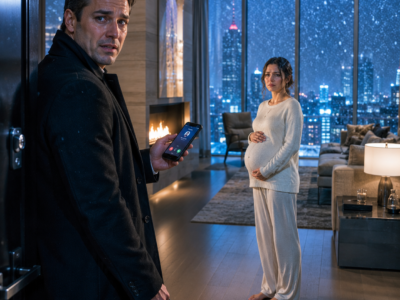
Twenty minutes later, the flashing red and blue LED lights of four Chicago Police cruisers painted the walls of Clara’s living room in vivid crimson.
Two uniformed officers entered the apartment, pulling my arms behind my back and snapping heavy steel handcuffs tightly around my wrists.
I offered zero resistance. I didn’t utter a single word to the officers.
As they escorted me out of the building into the heavy Chicago rain—the exact same freezing rain that had fallen ten years ago—I turned my head to look back at Clara one last time.
She stood in the doorway of her apartment building, clutching her grandmother’s silver locket in her hand, watching me disappear into the back of the police cruiser with cold, unshakeable finality.
Three months later, I was sentenced to fifteen years in a maximum-security state penitentiary without the possibility of parole. I signed over my entire multi-million-dollar estate to establish the Ruth Mercer Victim Support Foundation, leaving myself with nothing but a orange jumpsuit and a concrete cell.
Sitting on my thin cot inside Joliet Correctional Center, listening to the rain beat against the small barred window above my head, the dark weight in my chest finally lifted. The delusion of love was dead, my freedom was gone, but the debt was finally, fully paid.