I sold my eight hundred thousand dollar house while my son called me a burden on his european vacation
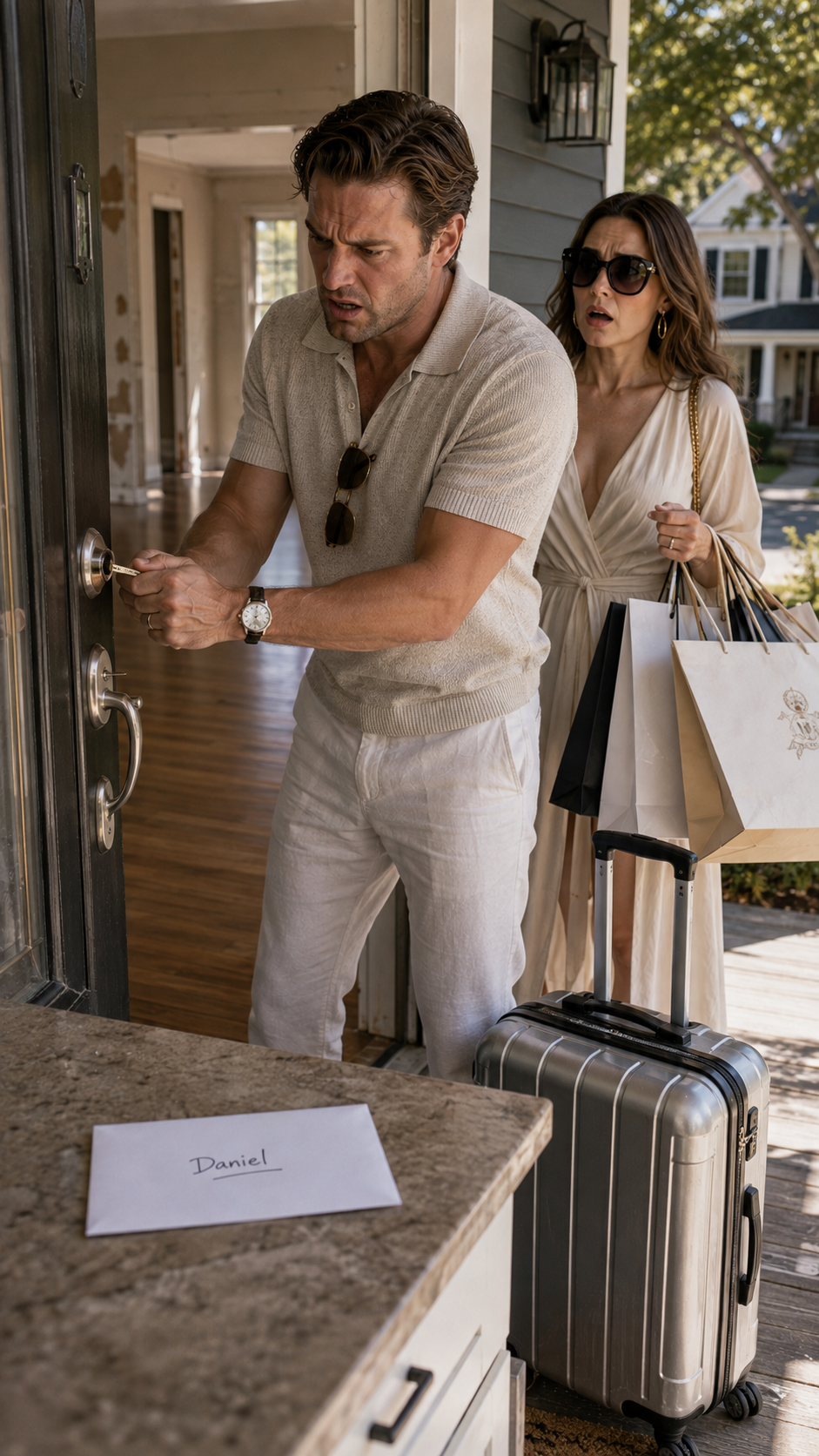
The heavy silver key scraped uselessly against the deadbolt cylinder, making a sharp, frantic metallic clicking that echoed across the quiet, tree-lined suburban street.
My son stood frozen on the front porch of the Cedar Grove property in the exact same clothes he had worn home from his long-haul flight from Rome. One of his hands gripped the handle of a scuffed hard-shell suitcase, while the other forced the key into the lock again and again—pushing, twisting, and rattling the brass handle as if the front door had simply misheard him.
Beside him stood his wife, wearing oversized designer sunglasses, three expensive shopping bags from Milan dangling from her wrist. Her lips were still curved in that polished, artificial vacation smile—until the lock refused them for the fourth time.
Then my son tried again. Harder this time. Shoulder leaning into the solid oak frame.
The smile vanished from his wife’s face.
He pulled the key back out, stared at the shiny silver teeth with confusion tightening his jaw, and then looked at the deadbolt as if the house itself had suddenly turned against him.
It had not.
I had.
My name is Eleanor Vance. I am sixty-eight years old, and three weeks before that moment on the porch, my home still looked like the life I thought I understood. Framed family photographs lined the hallway walls, my late husband Arthur’s old leather armchair sat quietly by the bay window, and the pencil marks inside the laundry room doorframe still tracked every inch my son had grown over thirty years.
Cedar Grove was the kind of town where neighbors waved from their lawns, where hedges were trimmed every Saturday morning, and where families stayed long enough for houses to become history. Arthur and I had spent thirty-two long years paying off the $875,000 mortgage on that four-bedroom property, brick by brick, sacrifice by sacrifice.
And in one painful, silent realization… I realized I had lost my son inside it too.
After Arthur passed away two years ago, my son, Julian, and his wife, Clara, began stopping by much more frequently. Everyone in our neighborhood told me how blessed I was to have such a attentive, devoted son.
Julian brought heavy groceries up the steps. Clara brought homemade soup in neat little glass containers and spoke in a soft, practiced, polished voice—the kind of gentle voice that could make total control sound like pure family kindness.
Then the quiet suggestions began.
“This house is a lot of maintenance for one person, Eleanor.”
“Stairs can be very risky at your age.”
“You really should start planning ahead before something unfortunate happens.”
Julian talked constantly about property taxes, asset management, power of attorney paperwork, and the necessity of “being realistic about the future.” Clara sent me brochures for tidy, gated senior living communities with white fences, blooming gardens, and smiling older people who looked as if they had already surrendered the keys to everything they had ever owned.
They acted as though they were protecting me.
In reality, they were circling me like vultures.
I discovered the bitter truth by complete accident on a Tuesday afternoon.
The day before they left for a month-long luxury vacation across Italy and France, Julian called my cell phone while I was upstairs folding laundry. I didn’t reach the nightstand in time to answer it. A minute later, my phone chimed with a notification: New Voicemail Received.
Julian had pocket-dialed me, failing to end the call before tossing his phone into his cup holder.
I pressed play, expecting an ordinary message about flight times, airport rides, or a reminder about watering their porch ferns while they were away.
Instead, I heard a car door slam shut, followed by Clara’s real laugh—the sharp, careless, condescending laugh she never used when standing in my living room.
Then came my son’s calm, unbothered voice over the speaker.
“She’s a burden, Clara. She just doesn’t see it. We’ve held our financial lives back long enough waiting around for her to move.”
The folded towels slipped from my hands and fell in a soft, heavy heap at my feet.
Then Clara replied smoothly, “Once the house is sorted out and we get the conservatorship papers filed, everything gets so much easier.”
That was the exact second something deep inside my chest shattered, hardened, and locked into place.
It was not just the overwhelming greed. It was not even the cruel words themselves. It was how completely calm, practical, and casual they sounded while saying them.
In that moment, I was no longer Julian’s mother. I was not the woman who had stayed up with him through ear infections, paid his college tuition, or welcomed his wife into our family.
I was an obstacle. A delay. Something old, inconvenient, and expensive standing between them and an $875,000 asset they had already decided belonged to them.
I cried that night. I walked through every empty room in the dark, letting my fingers trace the wooden banister, the keys of the upright piano, the doorframe of Julian’s childhood bedroom, and the tile counter where Arthur used to stand drying dishes after Sunday dinners.
I heard the word burden repeat in my head over and over until it stopped sounding like a word… and started feeling like a prison sentence being handed down against my life.
By sunrise, the tears were completely gone.
I opened Arthur’s old filing cabinet in the study. Then I opened the plastic storage bin Julian had left in the basement three years ago.
What I found inside made the air in the room turn ice-cold.
Printed email chains. Medical consult notes. Drafted legal petitions for adult guardianship. Strategic discussions about “demonstrating cognitive decline,” “household safety hazards,” and “immediate property liquidation.”
They were not merely waiting for me to grow fragile. They were actively constructing a legal narrative to take my home away from me.
So I constructed a narrative of my own.
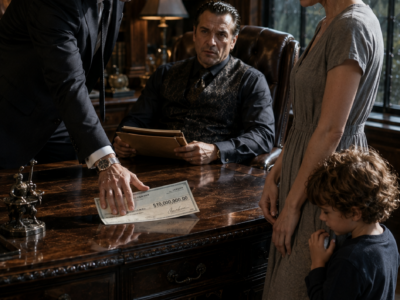
I called a high-end real estate agent who understood absolute discretion. I called Arthur’s corporate attorney. I called my bank.
I moved every single asset, account, and document Julian believed he would one day inherit.
The $875,000 house went into a private, cash-only sale. No “For Sale” sign ever appeared on the manicured front lawn. No family meetings were requested. No warnings were issued.
While Julian and Clara were posting bright, sunlit photographs from Amalfi coast wineries, smiling over glasses of Barolo as if nothing in the world could touch them, professional movers packed my fine china, wrapped my family photo frames, and carried my entire life out through the exact front door my son thought would always stand open for him.
The buyer was an investor who closed in eleven days.
I purchased a quiet, charming cottage near the lake two hours north, transferring the remaining $800,000 directly into a private, irrevocable trust account under my maiden name.
And I left one single thing behind in the empty house.
A white envelope sitting on the bare kitchen counter.
So when Julian and Clara finally returned to Cedar Grove—tanned, relaxed, still carrying the scent of duty-free perfume and expensive European streets—they did not return to my home.
They returned to a hollow, echoing shell.
From inside a tinted rental sedan parked across the street, I watched my son finally throw his weight against the front door, forcing the deadbolt to give way with a loud, splintering crack.
I watched Clara step in behind him, her arms laden with high-end European boutique bags, her heels clicking sharply against the entryway.
And then I watched them both stop dead in their tracks. I watched them stop breathing.
Through the large bay window, I saw their bodies go completely rigid as they took in the view of the bare hardwood floors, the stripped walls, the missing light fixtures, and the suffocating, absolute silence that only exists after someone has erased an entire history.
Julian dropped his hard-shell suitcase onto the floor. Clara’s shopping bags slid from her wrists, spilling onto the bare wood.
Julian ran frantically from the living room into the dining area, then up the stairs toward the bedrooms, his shouting voice muffled by the empty walls as he searched for furniture, paintings, or any sign of life.
When he came back down to the kitchen, his face was flushed, wet with sweat, and twisted in utter panic.
And then his eyes fell upon the solitary white envelope resting on the center island.
His name was written across the front in my neat, elegant cursive handwriting: JULIAN.
He walked toward it as if approaching a unexploded bomb. His hands trembled as he tore open the paper and pulled out the single sheet of stationary inside.
Sitting in my car across the street, I recited the words from memory:
“Dear Julian,”
“I listened to the voicemail you left me on Tuesday before you boarded your flight to Rome. I heard how much of a burden I have been to you and Clara. I heard how inconvenient my life has become to your financial future.”
“I decided it was time to relieve you of that burden permanently.”
“The house has been sold. The proceeds have been placed into a private trust that you cannot access, touch, or contest. My new address is private. Do not look for me, do not call me, and do not attempt to contact my attorney.”
“You spent years believing this home was your safety net. Today, you are learning what it feels like to stand on your own feet.”
“Goodbye, Julian.”
I saw Julian’s knees buckle. He grabbed the edge of the kitchen island to keep from falling, the paper shaking wildly in his grip. Clara snatched the note from his hand, read it in three seconds, and let out a sharp, hysterical shriek that I could hear all the way across the street.
She pointed wildly at the bare walls, screaming at Julian, her face contorted in a mask of pure, ugly rage as the reality of their situation crashed down upon them. They had leveraged their personal credit cards for their European trip, expecting to return home, file their guardianship paperwork, and list the house for a massive payout.
Instead, they were standing in an empty room, broke, exposed, and entirely locked out of my life.
I started the engine of my rental car, shifted into drive, and smoothly pulled away from the curb.
I did not look back in the rearview mirror.
I drove north toward the lake, where the water was quiet, the air was clean, and my new life was just beginning.