Hidden Underwater Drop Theory Emerges After Brighton Sea Tragedy Claims Three Women From Same Family
Authorities in Brighton are continuing to investigate the heartbreaking deaths of three women recovered from the freezing sea as a disturbing new theory surrounding hidden underwater hazards begins to emerge.
The victims, whose bodies were discovered during the early morning hours near Brighton beach, were initially believed to be close friends enjoying a night out together along the city’s busy waterfront district. Investigators later confirmed the women were also relatives, making the tragedy even more devastating for surviving family members and the wider community.
Emergency services, coastguard crews, police officers, and marine rescue teams flooded the shoreline after reports that multiple people had entered the water and failed to return safely.
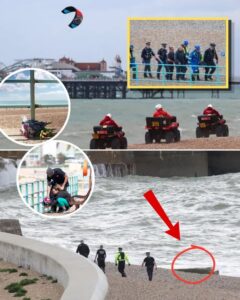
Now, investigators and maritime experts are focusing on the possibility that a concealed underwater drop-off or sudden seabed change near the shoreline may have triggered a rapid chain reaction that pulled all three women into dangerous conditions within seconds.
According to reports connected to the investigation, the women were found fully clothed in what authorities described as typical “going-out clothes,” suggesting they had not planned for an extended swim or deep-water activity.
Even more haunting, personal belongings including handbags and other items were reportedly discovered left untouched on the shore nearby.
Authorities continue emphasizing that there is currently no evidence publicly suggesting foul play or third-party involvement. Instead, investigators are carefully reconstructing the women’s final moments through CCTV footage, witness interviews, environmental analysis, weather reports, and tidal condition reviews.
Maritime safety specialists explain that some coastal areas contain hidden underwater ledges, sudden drop-offs, strong currents, unstable seabeds, or unexpected tidal movement capable of creating deadly conditions very close to shore.
Experts believe one possible scenario is that one woman unexpectedly lost footing or entered distress before the others instinctively attempted to help — ultimately creating a fatal “chain reaction” rescue attempt.
Rescue professionals warn that such tragedies can escalate with terrifying speed, especially in darkness and freezing water.
Cold water shock alone can immediately trigger involuntary gasping, panic, disorientation, muscle failure, and exhaustion even in otherwise healthy adults. Heavy clothing can also become saturated almost instantly, weighing swimmers down and dramatically reducing mobility.
Investigators are reportedly paying close attention to the timing of the incident, which unfolded around dawn after the women had spent the evening near Brighton’s nightlife district.
The lack of signs of struggle, combined with the untouched belongings left on shore, has deeply unsettled both investigators and the public.
Mental health experts say tragedies involving groups of relatives or close friends often resonate especially strongly because they reveal how instinctive acts of loyalty and rescue can quickly become catastrophic under dangerous environmental conditions.
Meanwhile, flowers, candles, and handwritten messages continue appearing along sections of Brighton beach as residents mourn the three women whose lives ended so suddenly.
Social media discussion surrounding the case has intensified dramatically, with many users expressing heartbreak over the possibility that the victims may have desperately tried to save one another in their final moments.
Authorities continue urging the public not to spread unsupported conspiracy theories while the investigation remains ongoing. Officials stressed that many important details surrounding the timeline and environmental conditions have not yet been fully released publicly.
As forensic analysis and coastal reconstruction efforts continue, investigators are now searching for answers beneath the surface itself — examining whether an almost invisible underwater hazard hidden in the darkness transformed an ordinary late-night paddle into one of Brighton’s most haunting recent tragedies.