The quiet town of Marquette, Michigan, nestled along the icy shores of Lake Superior, became the epicenter of a national conversation about digital dangers in March 2022. That’s when 17-year-old Jordan DeMay, a standout athlete and beloved son, took his own life following a relentless online extortion attempt. Now, more than three years later, five men from Georgia and Alabama have pleaded guilty to their roles in laundering the proceeds of the scheme that ensnared Jordan and over 100 other young victims. As federal prosecutors close in on the final threads of this international operation, the case underscores a growing crisis: financial blackmail schemes preying on vulnerable teens, with devastating consequences that ripple far beyond one family’s grief.
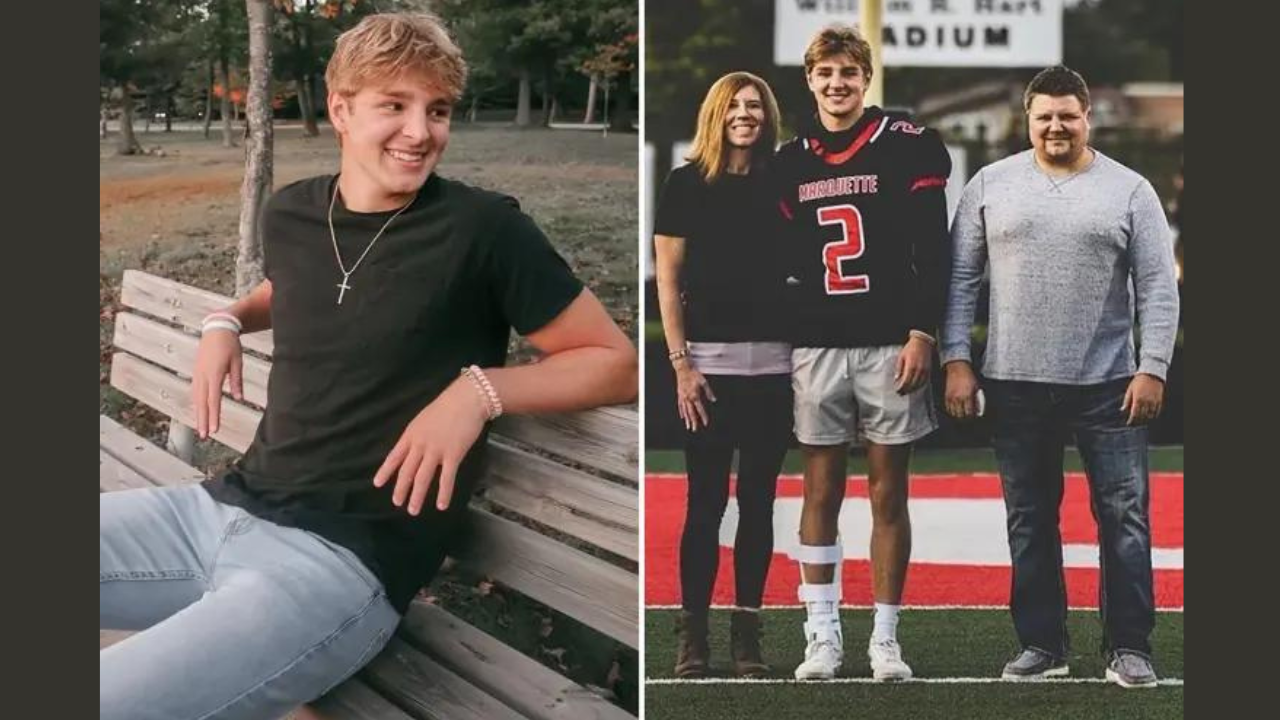
Jordan DeMay was the picture of Upper Peninsula resilience—a high school senior on the football team, an avid outdoorsman who spent summers fishing and winters snowmobiling. At 6-foot-2 and 220 pounds, he was a force on the field, but off it, he was known for his gentle nature and close-knit family ties. His father, John DeMay, a local business owner, often recalled Jordan’s infectious laugh and his habit of helping neighbors with chores without being asked. “He was the kid who made everyone feel included,” John told reporters in the weeks after the tragedy. Jordan’s mother, Jennifer, added that he dreamed of playing college ball and studying engineering, passions he pursued with quiet determination.
The events that unfolded on the night of March 31, 2022, shattered that dream. Jordan, like many teens, was active on social media, scrolling through Instagram during downtime. That evening, a profile under the username “dani.robertts”—later revealed to be a hacked account—reached out, posing as an attractive young woman from Florida. The conversation started innocently enough, with compliments and shared interests, but quickly escalated. The impersonator coaxed Jordan into sending a compromising personal image, a tactic commonly used in these schemes to gain leverage. Once obtained, the demands began: Pay up, or the image would be shared widely online, including with Jordan’s friends, family, and school community.
What followed was a barrage of pressure. Over the course of several hours, the scammers insisted on immediate payments via apps like Apple Pay, Cash App, and Zelle. Jordan wired what he could—hundreds of dollars scraped from his savings and odd jobs—but the threats intensified. When Jordan expressed despair, indicating he couldn’t go on, the response from one of the perpetrators was callous: Proceed quickly, or face worse. Overwhelmed, Jordan ended his life that night in his bedroom, leaving behind a family in pieces and a community searching for answers.

The investigation moved swiftly. Marquette police, tipped off by Jordan’s parents who discovered the messages on his phone, looped in the FBI within hours. Digital forensics traced the Instagram account to a network operating out of Lagos, Nigeria, run by brothers Samuel Ogoshi, then 22, and Samson Ogoshi, 20. The duo, part of a larger group known informally as “Yahoo Boys” for their cyber fraud tactics, had targeted dozens of American teens in similar fashion. Their method was systematic: Hack attractive profiles, build false rapport, extract compromising material, and extort funds under threat of exposure. In Jordan’s case, the brothers had coordinated with U.S.-based intermediaries to handle the money flow, ensuring it evaded easy detection.
By mid-2022, the FBI had connected the dots to over 100 victims, mostly boys aged 14 to 17, from across the U.S. The scheme’s profitability relied on a layered system. Funds from victims landed in accounts controlled by American launderers, who skimmed about 20% as their cut before converting the rest to bitcoin. That cryptocurrency then funneled through an anonymous Nigerian middleman, dubbed “The Plug,” who distributed shares to the scammers. Bitcoin’s anonymity made tracing challenging, especially given restrictions on direct dollar transfers to Nigeria’s naira currency.
The U.S. launderers formed the scheme’s American backbone. In Georgia, Kendall Ormond London, 32, of Atlanta; Brian Keith Coldmon Jr., 30, of Decatur; Jarell Daivon Williams, 31, of McDonough; and Johnathan Demetrius Green, 32, of Stone Mountain each managed receiving wires and processing conversions. In Alabama, Dinsimore Guyton Robinson, 29, of Mobile, handled similar transactions. These men, many with prior minor financial infractions, were recruited via online ads promising easy money for “virtual assistant” work. Federal indictments unsealed in August 2024 charged them with conspiracy to commit money laundering, a felony carrying up to 20 years in prison.
Breakthroughs came through international cooperation. In August 2023, Nigerian authorities, aided by the Economic and Financial Crimes Commission, arrested the Ogoshi brothers following U.S. tips. Extradition to Michigan followed in early 2024, a process John DeMay closely monitored. “Seeing them in cuffs was a step, but justice isn’t just about them,” John said during a 2024 press conference. Trials concluded dramatically in September 2024, with U.S. District Judge Hala Jarbou sentencing each brother to 210 months—over 17 years—in federal prison, plus five years of supervised release. The brothers showed little remorse in court, with Samuel claiming cultural misunderstandings, but the judge emphasized the human toll.
The launderers’ chapter unfolded in 2025. On April 3, all five entered guilty pleas in U.S. District Court in Marquette, sparing lengthy trials but facing sentencing guidelines that could mean years behind bars. Acting U.S. Attorney Shaun M. Birge noted, “These pleas close a critical gap in the chain, ensuring no one profits unchecked from such harm.” Individual hearings began in January 2025, with Robinson pleading first, followed by staggered dates through August. By mid-December 2025, four had been sentenced: London to 48 months, Coldmon to 36 months, Williams to 42 months, and Green to 40 months, all with restitution orders totaling over $100,000 to victims’ families. Robinson’s final sentencing loomed for late December, a closure point John DeMay anticipated with measured hope.
John DeMay’s transformation from grieving father to relentless advocate has been the story’s most inspiring arc. Days after Jordan’s passing, he founded Take It Down NCMEC, partnering with the National Center for Missing and Exploited Children to offer a free tool for victims to remove compromising images from platforms. “If I’d known about this sooner, maybe Jordan would have reached out,” John reflected in a recent interview. He’s logged thousands of miles, speaking at schools, congressional hearings, and international forums. In Michigan alone, he’s trained over 5,000 students on spotting red flags like unsolicited flattery or rapid intimacy requests online.
Legislative momentum has built in his wake. In December 2024, the Michigan House passed a package of bills mandating sextortion education in schools and harsher penalties for financial blackmail. Sponsored by Rep. David Martin, the measures await Senate approval as of December 15, 2025. Nationally, John backs the Kids Online Safety Act (KOSA), a bipartisan bill from Sens. Marsha Blackburn and Richard Blumenthal. Though it stalled in 2024, reintroduction is eyed for 2026, aiming to hold tech giants accountable for protecting minors from harmful content. “Platforms must do more than profit—they need safeguards,” John urged during a Capitol Hill visit last spring.
The crisis extends far beyond Jordan. FBI data from October 2021 to March 2023 logged over 13,000 complaints of online financial extortion, impacting at least 12,600 victims—predominantly teen boys. Reports surged 20% in the latter half of that period, linked to at least 20 self-inflicted tragedies. By December 2025, the tally stood at 38 U.S. teens lost to such schemes since 2021, according to Justice Department tallies. ESPN’s August 2025 investigation highlighted athletes as prime targets, with cases in Texas, California, and Ohio mirroring Jordan’s: Fake profiles luring in during vulnerable moments, like post-game highs.
Experts attribute the rise to social media’s ubiquity and scammers’ sophistication. Groups like the Yahoo Boys, operating from West African internet cafes, exploit time zones and weak cross-border enforcement. “These aren’t isolated pranks; they’re organized enterprises,” said FBI cyber agent Maria Rodriguez in a 2025 briefing. Prevention hinges on education: Teach kids to screenshot suspicious chats, block and report, and confide in trusted adults without shame. Resources abound—the FBI’s Internet Crime Complaint Center (IC3) handles tips, while apps like Bark monitor for risks.
Communities are stepping up too. In Marquette, Jordan’s high school renamed its digital literacy program after him, integrating annual assemblies where John’s story prompts open dialogues. Georgia and Alabama chapters of the PTA have echoed calls for state-level curricula, spurred by the launderers’ local ties. “This hit close to home—our kids aren’t immune,” said Atlanta parent advocate Lisa Hargrove at a April 2025 rally.
Yet challenges persist. Scammers adapt quickly, shifting to TikTok and Snapchat as Instagram tightens rules. Bitcoin’s role complicates seizures; only 30% of laundered funds in Jordan’s case were recovered. International extraditions remain rare, with Nigeria prioritizing domestic fraud. John DeMay remains undeterred. “It’s still happening every day,” he told Fox News in April 2025, following the pleas. “But every voice raised, every law passed, honors Jordan and saves the next kid.”
As winter grips Marquette once more, the DeMay home bears subtle tributes: Jordan’s football jersey framed by the fireplace, a stack of advocacy flyers on the kitchen table. John and Jennifer host weekly support groups for affected families, turning pain into purpose. “He’d want us fighting for the light, not the dark,” Jennifer said softly during a holiday memorial. With sentencings wrapping and bills advancing, the case’s legacy grows—not as a tale of loss, but as a blueprint for protection.
Broader awareness campaigns are gaining steam. The Justice Department’s 2025 “Stop Sextortion” initiative, launched post-pleas, includes PSAs featuring anonymized victim stories and parent toolkits. Partnerships with leagues like Pop Warner Football aim to reach young athletes early. In Alabama, Mobile’s community center now screens John’s TEDx talk, “From Heartbreak to Hope,” drawing crowds of worried guardians.
Financial restitution remains a sticking point. Victims’ families, including the DeMays, have received partial payouts from seized assets, but full recovery eludes many. A federal victims’ fund, proposed in KOSA, could change that, pooling platform fines for support services. John’s nonprofit has already assisted 200 families with counseling and legal aid, funded by donations and speaking fees.
Looking ahead, 2026 promises pivotal battles. Michigan’s bills could set a precedent for Midwest states, while KOSA’s revival tests congressional resolve amid election-year gridlock. John plans a cross-country tour, partnering with ESPN for athlete-focused webinars. “Jordan’s story isn’t ending—it’s evolving,” he affirmed in a December podcast.
In Marquette’s snowy streets, where Jordan once dashed to practice, life resumes with a sharper edge. Schools host “Jordan’s Pledge” events, where students vow to look out for each other online. The football field bears a plaque: “Play Strong, Stay Safe.” It’s a small monument, but one that echoes nationwide.
The Ogoshi case, once a fringe headline, now symbolizes a reckoning. From Nigerian cafes to Atlanta wire rooms, the web of complicity has been dismantled—but vigilance endures. As John DeMay often closes his talks: “One conversation can change everything. Let’s make it the right one.” In honoring Jordan, America edges toward a safer digital frontier, one aware heart at a time.