THE WEDDING DAY EXECUTION: HOW I PLAYED THE RECORDING, TOOK BACK MY MOTHER’S NECKLACE, AND BURNED THEIR LIES TO ASHES.
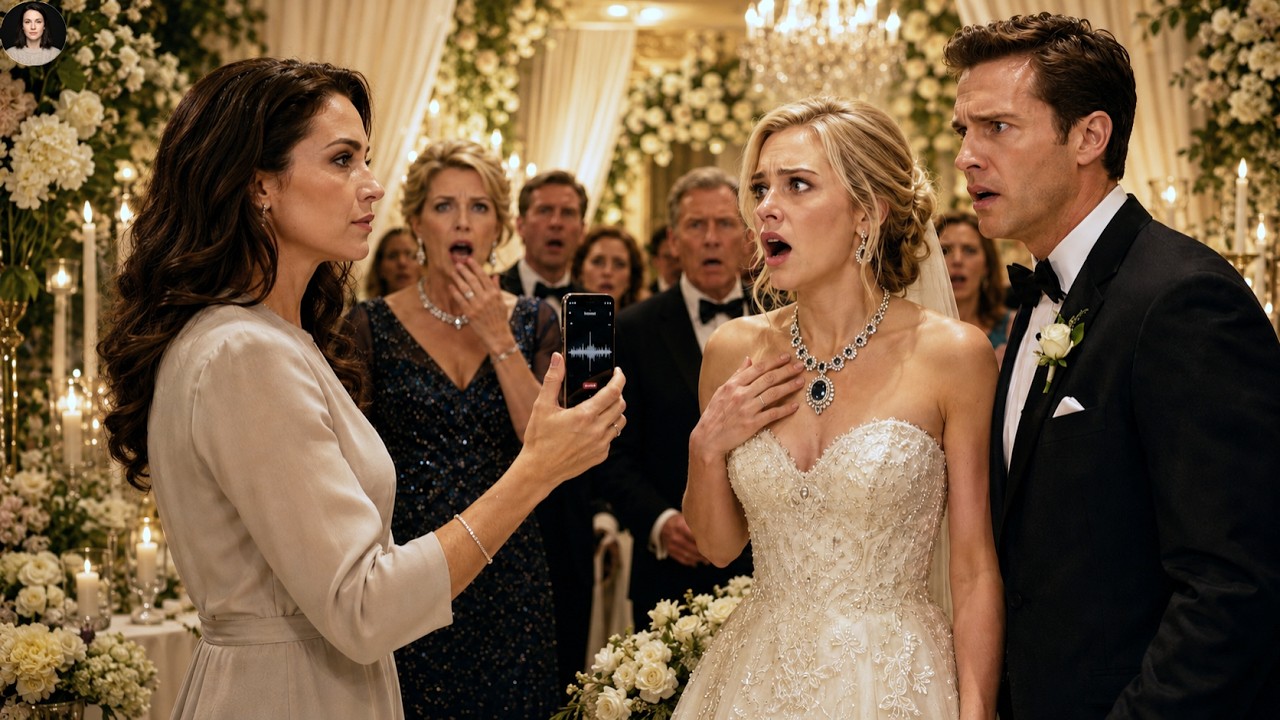
The massive pipe organ inside St. Jude’s Cathedral swelled into a triumphant wedding march, filling the vaulted limestone arches with sound. Under a cascading canopy of white roses and imported orchids, the priest smiled benevolently and turned to the congregation.
“If anyone here knows any reason why these two should not be joined in holy matrimony,” the priest’s voice echoed across the pews, “let them speak now, or forever hold their peace.”
A heavy, breathless silence settled over the cathedral. The air smelled thick of white lilies and expensive cologne.
Then, I rose quietly from the third pew.
My sister, Delia, stood beneath the floral archway in a breathtaking gown of pearl-white satin, wearing our late mother’s priceless emerald and diamond necklace against her throat. Standing right beside her in a bespoke tuxedo was Grant Hail—the man who had spent three years promising to build a future with me, before he traded me in for my younger sister and our family estate.
Grant turned his head, his eyes locking onto mine with the cold, detached gaze of a total stranger. He looked at me as if I were a vagrant who had wandered into the wrong building.
In my palm, I held a small, unassuming black voice recorder.
“I have a reason,” I said, my voice cutting through the sacred quiet like a razor.
The cathedral erupted into a sudden, chaotic hush. Delia’s fingers flew instantly to her throat, her manicured nails clutching the heavy emerald pendant that had belonged to our mother—worn at my graduation, at Delia’s first ballet recital, and at our mother’s bedside during her final, agonizing months in hospice.
Grant stepped away from the altar, his face tightening. “Mara,” he hissed, his voice dropping an octave. “This is not the place—”
“You chose the place,” I replied steadily down the center aisle.
Delia’s lower lip trembled, her wide eyes instantly filling with theatrical, weaponized tears. “She’s trying to ruin my wedding! She’s unstable!”
In the front row, our aging father gripped the handle of his mahogany cane, his knuckles stark white. He had spent months believing he was walking his youngest daughter down the aisle into a storybook romance. He had no idea what I was carrying.
“Play it,” Grant whispered suddenly. His confidence was too fast, too smooth. He already knew what was on the tape. He thought he had prepared for it.
I reached out, placed the small portable speaker onto the front lectern, and pressed Play.
CHAPTER 1: THE BACKROOM DEAL
The harsh, metallic audio of the recorder instantly bounced off the cathedral’s stone walls, amplified by the sound system:
[GRANT’S VOICE]: “Once the wedding is over, Mara loses the house, the trust vote, and the necklace. Delia gets the public sympathy. If Mara keeps fighting, we use the hospital report and make her look unstable.”
[DELIA’S VOICE]: “And Dad? He signs the proxy tonight. After that, he’ll be too ashamed and confused to question anything.”
[GRANT’S VOICE]: “She still thinks the necklace was left to her.”
[DELIA’S VOICE]: “It was left to whoever can prove she’s the better daughter.”
[GRANT’S VOICE]: “What if she shows the letter?”
[DELIA’S VOICE]: “Then we say the letter was written when Mom was losing her mind and confused.”
[GRANT’S VOICE]: “By midnight, she’ll either leave the family trust voluntarily, or be carried out in a straightjacket as a danger to herself.”
I hit the stop button.
The cathedral was so quiet you could hear a pin drop on the marble floor. Delia had gone completely ghost-white beneath her heavy bridal makeup. Grant stared at the tiny black box as if he could physically force the audio back inside its plastic casing.
“Is… is that authentic?” our father whispered, his voice cracking as he looked back at me.
“You can hear the full unedited files later, Dad,” I answered softly. “But yes. Every word.”
“You recorded private conversations without permission?!” Grant’s attorney shouted, springing up from the aisle like a jack-in-the-box. “This is inadmissible! This wedding—”
“You’re worried about permission now?” I interrupted, raising my left hand. Between my fingers was a thick cream envelope sealed with dark green wax. “This is the original letter our mother left with her estate attorney three weeks before she lost her voice. The necklace was not a prize for the ‘better daughter.’ It was legally, explicitly assigned to me.”
Delia’s hand clamped down hard over the emerald pendant. “You’re lying! Mom gave it to me on her deathbed!”
“She was in hospice, heavily medicated, and barely conscious,” I shot back, the grief of the past ten months turning into pure, molten steel in my veins. “She knew who loved her, and she knew who was stealing from her.”
The memory flashed back with blinding clarity. Ten months earlier, our mother had passed away. Two days after the funeral, her velvet jewelry box vanished from the study safe. Delia had wept crocodile tears, claiming it must have been misplaced during the move. Grant had wrapped an arm around my shoulders, telling me not to accuse my grieving sister during a time of mourning.
It had all been a scripted play. Grant had proposed to me first in the winter garden of an old hotel, sliding a diamond ring onto my finger and telling me building a life with me felt like home. Three months later, Delia started working at his firm. Six months after that, Grant postponed our wedding, claiming “estate complications.”
He hadn’t needed time to grieve. He had needed time to evict me from my own life and install my sister in the space meant for me.
CHAPTER 2: THE ANATOMY OF A HEIST
The altar dissolved into absolute, chaotic noise. Delia and Grant began screaming at each other, their polished facades instantly shattering into mutual recrimination.
“You said she didn’t have the letter!” Delia shrieked at Grant, clawing at her veil.
“I said her lawyer might have a draft! You said you destroyed it!” Grant roared back, losing his polished executive composure entirely.
Our father held out a trembling hand. “Mara… bring me the envelope.”
I walked down the center aisle, handing him the cream-colored letter. It still smelled faintly of the lavender our mother used to line her drawers. With shaking thumbs, our father broke the dark green wax seal, unfolded the heavy parchment, and began to read.
As his eyes scanned the legal paragraphs detailing the Ellison Family Trust, the controlling voting shares of our multi-million-dollar vineyard, and the ironclad ownership of the estate, color drained completely from his face.
“She wrote this… she wrote this before the surgery,” he whispered, looking up with horror in his eyes.
“Dad, she was confused! She didn’t know what she was signing!” Delia sobbed, lunging toward him.
“She listed your full name, my full name, the exact trust numbers, and the serial numbers of the land deeds,” our father said, his voice dropping into a cold, terrifying register as he looked at Grant. “Grant… you advised the trust committee. You helped draft these exact legal protections. Why did you tell me the trust was vulnerable?”
Grant’s attorney stepped in quickly, trying to shield him. “Mr. Ellison, let’s not make hasty judgments based on domestic emotional distress—”
“Shut up,” our father said. It wasn’t loud, but it carried the weight of a man who had built an empire from the dirt. He stood up, using his cane for support, and looked straight at me. “Let’s go see Hester.”
CHAPTER 3: THE FIXER’S LEDGER
Hester Vale was seventy years old, sharp-eyed, ruthless, and deeply, personally offended by amateur fraud. As the lifelong chief legal counsel for the Ellison estate, she sat behind her mahogany desk, adjusting her spectacles as she reviewed the audio transcripts, the estate will, and the forged hospital document.
“I warned your mother that people would try to pick the bones clean the moment she closed her eyes,” Hester said coldly, sliding the papers back into their folders. “She left explicit instructions. If anyone attempted to manipulate the trust or misappropriate her personal heirlooms, I was to unlock the contingency clauses immediately.”
“What about the forged hospital document?” I asked, placing the paper on her desk. It was an unsigned psychological evaluation recommending that my trust distributions be seized due to “emotional instability.”
Hester ran a finger down the signature line. “This was drafted on a standard medical template, but it was generated from an IP address registered to Grant Hail’s corporate office network. And look at the witness name at the bottom—Grant’s office manager. They were planning to ambush you with a conservatorship hearing right after the wedding.”
“And the trust funds?” Hester’s assistant burst into the office holding a tablet.
“Hester, we just flagged an emergency wire transfer request from Grant Hail’s account,” the assistant reported breathlessly. “$380,000 drawn directly from the Ellison Family Trust accounts to pay off the wedding venue and a luxury property renovation in downtown Chicago. The bank caught it because Mara’s signature didn’t match the sample file on record.”
Hester smiled—a terrifying, humorless expression. “He’s still trying to raid the accounts while standing in the ruins of his wedding. Perfect. Let him keep digging.”
CHAPTER 4: THE COLLAPSE OF THE CONSPIRACY
Over the next three weeks, the web of lies unraveled with terrifying speed.
Grant tried every trick in the corporate playbook. He sent threatening letters, attempted to intimidate our father into signing emergency proxies, and even called the police to file a fraudulent report claiming I had stolen family property from his office. The responding officers reviewed our ironclad trust documents, took one look at Grant’s forged paperwork, and instead documented his false police report and attempted extortion.
Then came the blowback from Delia.
Realizing that Grant was planning to throw her under the bus to save his own skin, the grand illusion of their passionate romance imploded. The public society columns that had previously praised their fairy-tale wedding now printed blistering exposés detailing the aborted ceremony, the police investigations, and the stolen family heirlooms.
One morning, my phone buzzed with an incoming call from an unknown number. I answered cautiously.
“Mara?” Delia’s voice on the other end was cracked, hysterical, and utterly broken. “He’s abandoning me. He’s telling prosecutors that I engineered the whole thing—that I stole the necklace and forced him to go along with it!”
“He’s telling the truth about one thing, Delia,” I said calmly. “You did steal the necklace.”
“I loved him!” she wailed into the phone.
“You loved being chosen after he tried to destroy me,” I replied, and ended the call.
When Delia realized Grant had no intention of marrying her—and that his legal team was actively handing prosecutors her text messages, encrypted emails, and voice notes proving her active participation in the embezzlement scheme—she broke completely.
She walked into the District Attorney’s office with her own lawyer, signed a full cooperation agreement, and handed over the custom diamond ring Grant had ordered for their secret post-wedding getaway—a ring forged by melting down our mother’s stolen necklace and resetting the raw emeralds.
CHAPTER 5: THE FEDERAL DOCK
By November, the criminal trial opened in a packed, freezing courtroom downtown.
Grant sat at the defense table in a standard-issue gray suit, his hair unstyled, his arrogant swagger completely stripped away. He had been charged on multiple felony counts: conspiracy to commit wire fraud, attempted theft by deception, forgery, witness intimidation, and misuse of fiduciary trust property.
Delia sat several rows behind him, testifying against him as the prosecution’s star witness. She wore a simple black dress, her wrists bare of any jewelry, her eyes fixed on the wooden floor as she detailed every meeting, every forged document, and every cruel joke Grant had made about breaking my spirit.
When the prosecutor played the church recording over the courtroom loudspeakers, Grant closed his eyes and buried his face in his hands. The crystal-clear audio filled the room, erasing every lie he had pitched to the podcasts and tabloid journalists in the months prior.
The jury deliberated for less than forty-eight hours.
When the foreperson stood to read the verdict, the room held its collective breath.
Guilty on all counts.
The judge looked down from the high mahogany bench with profound disgust. “Mr. Hail, you used your professional standing, your personal intimacy, and calculated deceit to systematically rob a grieving family and dismantle an estate built on decades of honest labor. You are sentenced to eight years in a federal penitentiary, full financial restitution, immediate forfeiture of all assets purchased with trust funds, and a lifetime ban from holding any corporate fiduciary or financial advisory role.”
Grant didn’t look up as the bailiffs clicked heavy steel handcuffs onto his wrists and hauled him away.
Delia received a reduced sentence of probation, extensive community service, and mandatory psychological counseling, coupled with a court order to pay back every cent of the unauthorized wedding expenses she had tried to charge to the family accounts.
CHAPTER 6: THE REDEMPTION OF THE VINEYARD
Six months after the trial, the Ellison Family Vineyard was operating at peak efficiency.
The sprawling estate grounds were lush, green, and alive with the bustling energy of harvest season. The workers who had stood by me through the chaos were rewarded with restructured contracts and profit-sharing pools, ensuring that the legacy our mother left behind would never again be vulnerable to corporate parasites.
One crisp afternoon, I stood inside the historic stone barrel hall, running my fingers along the cool oak casks.
“You’re working too late again,” a calm, grounded voice broke the quiet.
I turned around to see Adrienne Cole leaning against the heavy wooden doorframe. Adrienne was a former army logistics officer who had built an ethical, highly successful cold-chain distribution company. He had entered my life through our business partnerships during the trial—not with grand, theatrical romantic gestures or rehearsed pickup lines, but with quiet reliability, transparent contracts, and an unwavering respect for my boundaries.
He didn’t try to rescue me. He simply stood beside me while I built my own fortress.
“I’m just reviewing the winter export manifests,” I smiled, walking over to him.
Adrienne slipped his hands into his pockets, his dark eyes warm and steady. “The manifests can wait. My mother’s recipe for spiced cider is waiting at the cottage, and you promised we’d take the evening off.”
“Did I?” I teased, raising an eyebrow. “Do you have that in writing, Mr. Cole? Did you bring a contract for a walk in the vineyard?”
Adrienne laughed, stepping forward and pulling me gently into his arms. “I brought a partnership agreement for life, Mara. But you can review the terms as many times as you like.”
As we walked out together into the golden autumn sunset, the evening air smelled of rich earth, crushed grapes, and blooming roses. Around my neck, resting securely against my collarbone, hung the restored emerald necklace. The microscopic scratch left by the jeweler who had tried to alter it was still visible under bright light, but it no longer looked like a scar. It looked like survival.
I had learned the hardest lesson a woman can learn: A dramatic public reveal is satisfying, but preparation is what keeps you alive long enough to reach it.
Grant and Delia had tried to rewrite my life, steal my inheritance, and bury me under a mountain of engineered shame. Instead, they had given me the one thing I needed most—absolute, unshakeable clarity. I no longer needed anyone else’s permission to occupy space, to command respect, or to walk proudly through the world.
The ledger was balanced. The truth was spoken.
And for the first time in my life, the seat at the head of the table was entirely, undeniably mine.