The Mistress Sat in the Wife’s Chair—Until Grandma Stood Up and Said “Get Out”.
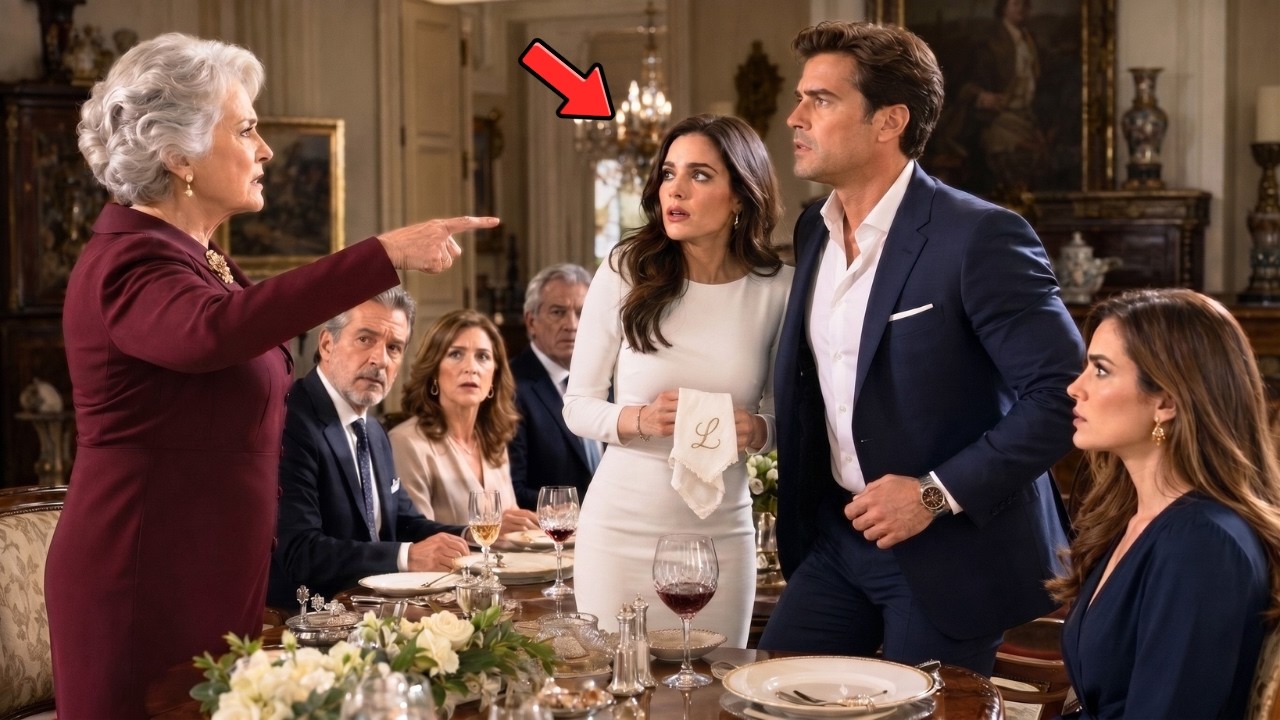
The mistress took the wife’s chair, and in one second the whole family learned exactly what betrayal looked like.
The Lawson dining room had been built for silence. Heavy walnut table. Crystal glasses. Silver forks lined up like soldiers. But that night silence became something sharper.
Vanessa Reed sat at Daniel Lawson’s right hand, smiling softly as if she belonged there. In front of her was the embroidered napkin marked with the Lawson family initial—the place everyone knew had always belonged to Daniel’s wife. Across the room, Clare Lawson sat near the doorway, placed there like an afterthought. She did not cry. She did not beg. She did not even look at Vanessa. And somehow that made it worse.
Daniel leaned back in his chair, acting calm, acting powerful, acting as if the room could not see what he had done. Around the table his uncles, cousins, the family attorney, and close guests lowered their eyes. No one dared to speak.
Then Margaret Lawson, Daniel’s grandmother, slowly rose from her seat.
“Vanessa,” she said, her voice cutting through the room. “Get out of that chair.”
Every glass froze in every hand.
Daniel turned toward her, anger flashing across his face. “Grandma, you’re making this into something it isn’t. Vanessa is only a guest.”
Margaret pointed to the chair beside him. “If she is only a guest,” she said, “why did you move your wife to the door so another woman could sit beside you?”
For the first time that night, Daniel had no answer. And Clare finally lifted her eyes.
That small movement changed the room. Until then everyone had been pretending this was only an awkward seating mistake—the kind of mistake rich families smoothed over with polished smiles and expensive wine. But Margaret Lawson had torn that lie open with one sentence.
Vanessa sat frozen in Clare’s chair, her fingers still resting near the embroidered napkin. The soft smile she had worn all evening disappeared from her face. She looked at Daniel, waiting for him to protect her, waiting for him to turn his grandmother’s words into some harmless misunderstanding. But Daniel did not speak fast enough. For once, the man who always had an answer had nothing.
Margaret remained standing at the head of the table. She did not raise her voice. She did not need to. Her calm was heavier than shouting. For decades that tone had silenced bankers, lawyers, executives, and every proud man who thought money gave him permission to forget respect. Now it was aimed at her own grandson.
“Daniel,” she said, “do not insult this family by calling cruelty a seating arrangement.”
A quiet breath moved around the table. One of Daniel’s uncles shifted in his chair, then stopped. His cousin looked down at his plate. The family attorney stared at his glass as if the answer might be hiding inside it. No one dared interrupt Margaret Lawson.
Daniel’s jaw tightened. “Grandma, you’re embarrassing everyone.”
“No,” Margaret said. “You did that before dinner was served.”
The words landed like a slap.
Clare sat very still near the doorway—the place someone had decided was good enough for a wife who had given years of her life to this family. She had walked into this room with grace. She had seen Vanessa beside Daniel. She had understood in one terrible second that the insult was not private anymore. It had been arranged. Not whispered. Not hidden. Placed in front of everyone. And still she had not made a scene.
That was what made Margaret angrier than anything. Clare’s silence was not weakness. It was the silence of a woman who had been hurt so deeply that defending herself would only give others another chance to humiliate her.
Margaret looked at Vanessa. “Stand up.”
Vanessa swallowed. “Mrs. Lawson, I didn’t mean—”
“You sat where you were placed,” Margaret cut in, “but you knew whose place it was.”
Vanessa’s face flushed. Her hand moved away from the napkin as if it had burned her. Slowly she pushed back the chair. The legs scraped against the floor—a harsh sound in a room where even breathing had become careful.
Daniel stood halfway. “That’s enough.”
Margaret turned to him so sharply he stopped. “No, Daniel. Enough was when your wife was moved like a stranger in her own family. Enough was when you expected all of us to pretend we did not see it. Enough was when you thought Clare’s dignity could be traded for your comfort.”
Clare’s lips parted, but no words came out. Her eyes glistened—not with defeat, but with the shock of being defended when she had already prepared herself to endure the night alone.
Margaret pointed to the chair beside Daniel. “That seat is not about wood, fabric, or tradition. It is about honor. And tonight you tried to give your wife’s honor to another woman in front of the people who should have protected her.”
The room stayed silent.
Vanessa stepped back from the chair. Daniel looked at Clare—then truly looked at her—as if he was only now realizing that every person at that table had seen what he had done. And Clare, still seated by the door, finally understood something too.
She had not lost her place. He had simply shown the world he was no longer worthy of sitting beside her.
Clare’s silence became the loudest thing in the room. Vanessa had stepped away from the chair, but the shame did not leave with her. It stayed there, hanging over the table, clinging to the crystal glasses, the untouched plates, the white candles burning too calmly for a night that had already broken open.
Daniel was still standing, one hand pressed against the back of his chair, his face locked between anger and embarrassment. He wanted to argue. He wanted to make this about his grandmother’s temper, about old traditions, about everyone overreacting to a simple dinner mistake. But everyone knew it was not a mistake.
Clare knew it most of all.
She sat near the doorway with her hands folded in her lap. Her posture was straight, almost gentle. She did not clutch the table for support. She did not wipe her eyes. She did not glare at Vanessa or beg Daniel to explain himself. She did nothing that would give the room permission to call her emotional, jealous, or dramatic. And that restraint made the humiliation impossible to hide.
Because if Clare had screamed, Daniel could have blamed the scene on her. If she had cried, someone might have whispered that she was fragile. If she had thrown Vanessa out herself, the family might have remembered her anger more than his betrayal. But Clare gave them nothing to twist. She simply sat there—quiet and dignified—while the truth stood naked in front of everyone.
Margaret looked at her from across the room, and for the first time that night the older woman’s expression softened—not with pity. Clare would have hated pity. It was something deeper than that. Recognition. Respect. The painful understanding that some women do not fall apart in public because they have already done their breaking in private.
Daniel turned toward Clare as if her silence had finally reached him. “Clare,” he said, his voice lower now. “Say something.”
The request was almost cruel. After making her invisible all evening, he now wanted her voice to rescue him.
Clare slowly lifted her eyes to his. The room seemed to lean toward her. Even Vanessa stopped breathing for a moment. But Clare did not answer right away. She looked at the chair beside Daniel—the one Vanessa had just abandoned. Then she looked at the small place near the door where she had been seated as if she were a distant relative, a guest invited out of obligation, a woman whose years of loyalty could be moved with a servant’s hand and a quiet instruction.
That was what hurt. Not the chair itself. The decision behind it.
Someone had looked at Clare—Daniel Lawson’s wife—and decided she could be pushed aside without consequence. Someone had believed she would accept the insult because she had accepted so many smaller wounds before it. Late nights. Cold answers. A phone turned face down. Excuses that arrived too smoothly. The slow disappearance of a husband who still shared her home but no longer shared the truth.
Clare had carried all of it quietly. But quiet was not the same as blind.
She had seen the way Daniel stopped reaching for her hand in public. She had noticed how his eyes moved toward his phone whenever the room grew still. She had felt the distance in their bedroom, at breakfast, in the long spaces between ordinary words. And now here it was—no longer hidden behind business trips or careful lies. Vanessa in her chair. Clare by the door. The whole marriage reduced to a seating arrangement everyone could understand.
Daniel swallowed. “This has gone too far.”
Clare finally spoke. Her voice was calm, almost soft, and somehow that made every word land harder.
“You are right,” she said. “It has.”
She stood. The movement was unhurried. She did not look at Vanessa again. She did not look at the empty chair that had once been hers. She looked only at Margaret, and in that look there was a quiet gratitude that needed no explanation.
Then she walked out of the dining room without another word.
No one stopped her.
Margaret remained standing long after the door closed. Daniel sat back down as if his legs had finally given out. Vanessa hovered near the wall, suddenly uncertain where she was allowed to exist. The rest of the family stayed silent, each of them understanding that something permanent had just shifted.
The chair beside Daniel stayed empty for the rest of the evening.
Some seats are made of wood and fabric. Others are made of respect.
Once a man gives that seat away in front of the people who know him best, he does not get to decide when the room pretends not to notice.
Clare Lawson left the house that night with nothing but her dignity intact. In the months that followed she filed for divorce, kept her silence about the details, and rebuilt a life that no longer required her to sit near any doorway waiting for permission to be seen.
Margaret Lawson never apologized for the scene she caused. She simply made certain that the next time the family gathered, the chair of honor remained empty until someone worthy of it returned.
And everyone understood, without needing another word spoken, exactly why that seat stayed vacant.