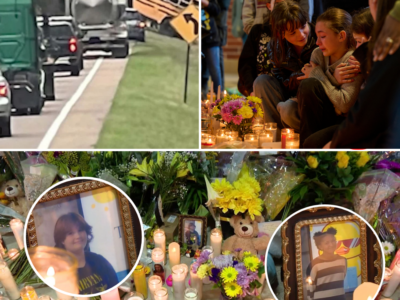
Twelve-year-old Maya Gebala’s battle for life continues to inspire a nation after the devastating mass shooting at Tumbler Ridge Secondary School on February 10, 2026. What began as a nightmare—being shot three times while heroically trying to lock a library door to shield classmates—has evolved into a series of quiet, defiant miracles. The latest: doctors removed her breathing tube, and Maya is now sustaining herself entirely on her own breaths, a step once considered highly improbable given the severity of her injuries.
Her mother, Cia Edmonds, shared the news with profound emotion on social media. In a post accompanied by a tender photo of Maya in her hospital bed, Cia wrote: “Sweet baby. She had her breathing tube removed to see if she can breathe on her own… what a terrifying experience.. I held her hand while she winced, but shes doing great. Best that could have been. My sweet girl, is looking more like her beautiful self today.” The words captured both the fear of the moment—Maya wincing as medical staff carefully extubated her—and the overwhelming relief that followed. For a child who had been fully dependent on mechanical ventilation for weeks, this transition marks one of the most significant milestones in her recovery.
Maya’s injuries were catastrophic: a bullet entered above her left eye, another struck her neck, and a third grazed her cheek and ear. She endured massive brain swelling, cerebral spinal fluid leakage, repeated meningitis scares, pneumonia, and internal hemorrhaging. Medical teams at BC Children’s Hospital in Vancouver initially prepared the family for the worst, stating she was not expected to survive the first night. Yet Maya has consistently exceeded expectations, showing incremental but steady progress: clearer CT scans, increased left-side movement, the ability to push herself up in bed, eye-opening responses to familiar stimuli like her favorite show “Henry Danger,” and now full independent respiration.
The extubation process was carefully monitored. After gradually reducing ventilator support to pressure mode—allowing partial spontaneous breathing—doctors deemed her ready for a trial off the machine. The removal itself, while brief and controlled, was emotionally charged for the family. Cia described holding Maya’s hand tightly as her daughter winced through the discomfort of the tube coming out. Within minutes, monitors confirmed stable oxygen levels and consistent breathing patterns. No immediate complications arose, and Maya’s color and alertness noticeably improved, giving her the appearance of “looking more like her beautiful self.”
This victory did not come in isolation. The entire Tumbler Ridge community, alongside supporters across British Columbia and Canada, has maintained an unbroken chain of support. Prayer circles, card-writing campaigns, GoFundMe drives exceeding initial goals, and daily social media encouragement have created a powerful collective force. Cia has frequently acknowledged this outpouring, stating that “you all are lifting our baby girl up” and crediting the prayers and positive energy for fueling Maya’s fight.
The broader context of the tragedy adds layers of grief and resilience. Eight people lost their lives that day: five students aged 12–13, a teaching assistant, the shooter’s mother, and his 11-year-old half-brother. Maya’s actions in attempting to protect others have been hailed as heroic, yet the physical and emotional toll on survivors—including her younger sister Dahlia, who was also in the school—remains immense. The family continues to navigate collective trauma while celebrating individual breakthroughs.
Adding another dimension, on March 9, 2026, the Gebala family filed a civil lawsuit against OpenAI, alleging the company failed to act on concerning ChatGPT interactions from the shooter that reportedly indicated violent plans. The suit seeks accountability, damages, and systemic changes to prevent future oversights. While OpenAI has remained silent on the matter so far, the legal action has sparked wider discussions about AI safety, content moderation, and corporate responsibility in high-risk scenarios.
Maya’s recovery trajectory remains long and uncertain. Potential long-term effects include cognitive challenges, right-sided weakness or hemiplegia, visible scarring, chronic pain, and psychological impacts such as PTSD. Rehabilitation will encompass physical therapy, occupational therapy, speech-language support (once breathing allows), neuropsychological evaluation, and emotional counseling for both Maya and her family. Future surgeries to address lingering fragments or complications cannot be ruled out.
Yet each milestone reshapes the outlook. From “not expected to survive” to breathing independently, Maya’s journey illustrates the unpredictable power of human resilience and communal love. Her mother’s tender updates—raw, honest, and filled with maternal pride—humanize the statistics and keep hope alive. Every shared breath is a testament to Maya’s fighting spirit and the extraordinary support surrounding her.
As Maya continues her slow but steady climb, the message reverberates: miracles rarely arrive in thunderclaps; they come in quiet moments of progress, a hand held through fear, and a child proving doctors wrong one breath at a time. Canada—and the world—remains locked in solidarity, praying, cheering, and believing that this little warrior has many more victories ahead.
News
Bizarre Scene at Body Discovery Site Fuels Chilling Questions in American Airlines Flight Attendant Eric Gutierrez Molina Case.
The discovery of a body believed to be that of 32-year-old American Airlines flight attendant Eric Fernando Gutierrez Molina has taken a darker turn, with police uncovering a bizarre scene…
Virgin River Season 8 Confirmed — Four-Month Time Jump, Baby Heart Surgery Drama, and Major Cast Changes Revealed.
Netflix’s hit romantic drama “Virgin River” is officially returning for an eighth season, and new details about the upcoming chapter have fans both excited and anxious as the story prepares…
My Life with the Walter Boys Season 3 Trailer Unleashes Chaos — Jackie’s Final Choice, New Twists, and the Walter Family Drama Intensifies.
Netflix’s beloved teen drama “My Life with the Walter Boys” is officially returning for Season 3, and the newly released official trailer has sent fans into a whirlwind of excitement,…
Old Money Season 2 Trailer Sparks Massive Fan Frenzy — Release Date, Plot Twists, and Returning Romances Revealed.
Netflix’s hit Turkish romantic drama “Old Money” is officially heading for a second season, and the newly released trailer announcement has sent fans into a frenzy of excitement and speculation….
Nancy Guthrie Family Issues Emotional Plea to Tucson Community — “Someone Knows Something” as FBI Shifts Focus to Local Leads and Weekend Patterns.
As the search for 84-year-old Nancy Guthrie stretches into its 50th day, her family has released a heartfelt, six-paragraph statement approved by the FBI, directly addressing the people of Tucson…
Nancy Guthrie Recognized Her Masked Attacker at the Door, FBI Profilers Confirm — Botched Personal Revenge Plot and Amateur Mistakes Exposed in Tucson Disappearance.
In the early hours of February 1, 2026, 84-year-old Nancy Guthrie vanished from her home in Tucson, Arizona, in a case that has left investigators, behavioral experts, and the public…
End of content
No more pages to load