Survivor’s Terror: The Moment Chaos Erupted Inside the Air Canada Cabin After Deadly Runway Smash.
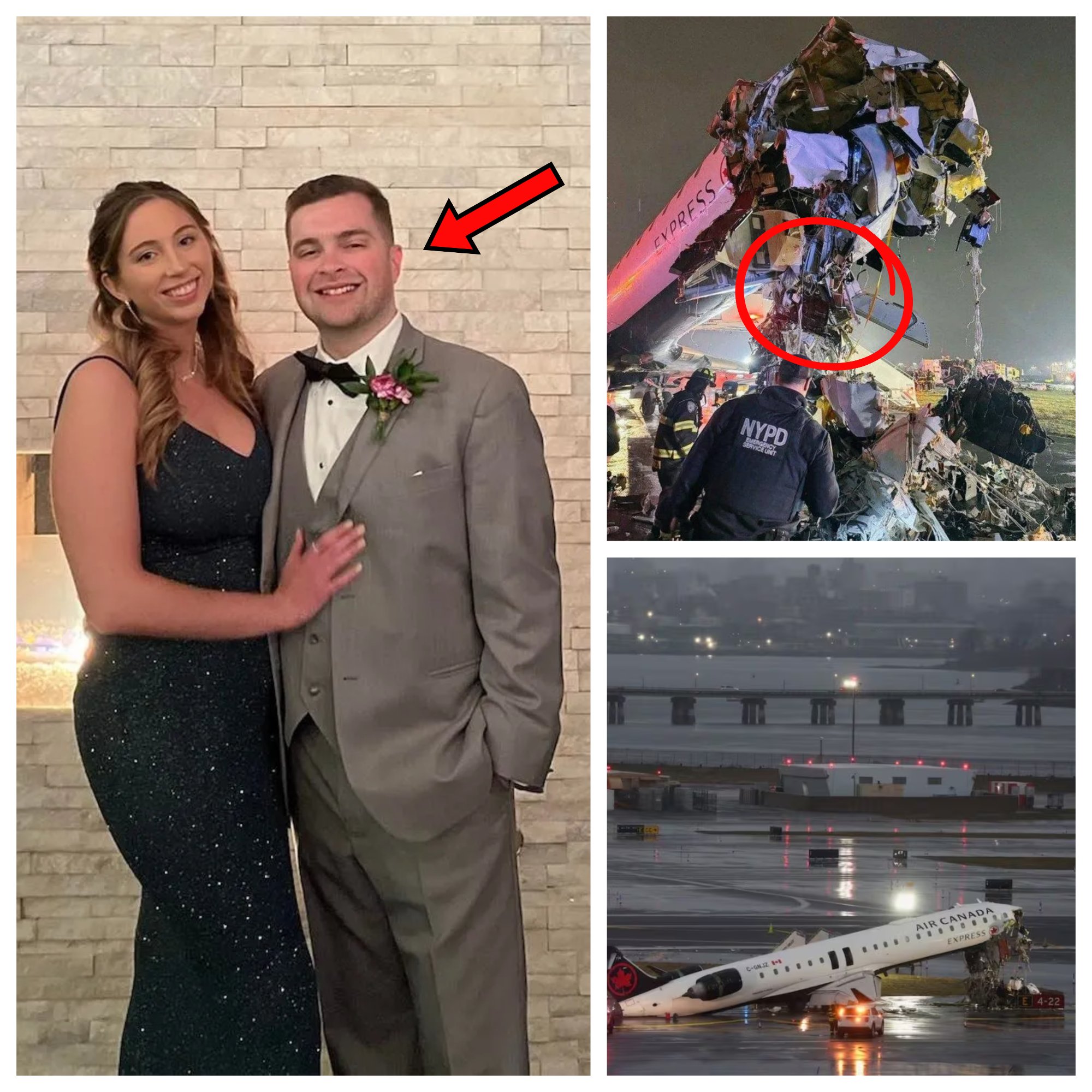
A survivor from the devastating Air Canada Express collision at LaGuardia Airport has described the sudden shift from calm to utter pandemonium inside the cabin when the CRJ-900 slammed into a Port Authority fire truck on the runway. Joe Capio, 29, and his fiancée Peyton Northrop, 27, both New York residents returning from Montreal, were seated aboard Flight AC8646 when the horror unfolded late Sunday night, March 22, 2026. The couple, among the 72 passengers and four crew members on board, recounted the terrifying sequence to The U.S. Sun in an exclusive interview that has since circulated widely.
Capio recalled the landing feeling deceptively normal. “I’d say about 11:40 p.m., we were landing,” he said. “It was a very smooth landing. We hit the ground, started to slow down.” For the first 30 to 40 seconds after touchdown, everything seemed routine—the aircraft decelerating steadily as expected. Then, without warning, the plane lurched violently. “Everyone ended up jerking forward, abruptly,” Capio explained. “And then there was a loud crash and a bang.” The impact felt like the aircraft had been hit by something massive, sending shockwaves through the fuselage.
In the immediate aftermath, the sensation was surreal. “It felt like the plane was just skating down the runway for a good distance, until it came to a complete stop,” Capio described. The sudden halt threw passengers against their seatbelts, amplifying the disorientation. Screams filled the cabin as fear took hold. Smoke or the acrid smell of burning materials may have begun to permeate the air, heightening the sense of imminent danger. Overhead bins rattled, trays clattered, and the dim emergency lighting flickered on as the aircraft’s systems reacted to the trauma.
Peyton Northrop, seated beside Capio, shared the overwhelming panic that swept through the group. People began unbuckling frantically, some crying out for loved ones, others frozen in shock. The couple emphasized the rapid escalation from confusion to chaos—passengers shouting questions, flight attendants calling for calm while moving swiftly to assess injuries and prepare exits. “It was pure chaos,” Capio said, noting how the confined space amplified every sound and movement. The violent forward jerk had caused whiplash and bruises for many, while the abrupt stop contributed to concussions and fractures among those not braced properly.
Capio found himself near an exit door. Acting on instinct and crew instructions, he helped remove it, allowing passengers to clamber onto the wing. “I just took the exit door off, and we all went on the wing,” he recounted. “Someone eventually came over and then we slid down the wing and they took us to the grass area on the tarmac.” Emergency slides deployed elsewhere on the aircraft, with flight attendants guiding people down amid the darkness and flashing lights of responding vehicles. The evacuation, though frantic, proceeded with remarkable efficiency given the circumstances—preventing what could have been far greater casualties.
The couple’s account aligns with broader reports from the scene. The collision sheared away much of the cockpit, killing both the pilot and co-pilot instantly from catastrophic blunt force trauma. Forty-one individuals, including passengers, crew, and the two firefighters in the truck, were transported to hospitals with injuries ranging from serious to moderate. Many have since been released, but the psychological impact lingers. Capio and Northrop, hospitalized briefly for evaluation, expressed profound shock but gratitude for their survival. “I don’t want to speculate on the cause,” Capio added cautiously, “but we were shaken up.”
The fire truck had been crossing Runway 4 to respond to a separate United Airlines aircraft reporting an onboard odor emergency—a standard precautionary measure. Air traffic control audio later revealed desperate repeated commands of “Stop, stop, stop, Truck 1, stop,” but the warnings arrived seconds too late. The jet, still carrying significant speed after touchdown, struck the vehicle at an estimated 30 to 40 mph in the collision zone, though initial touchdown velocity was higher. Radar data and flight recorders are central to the ongoing NTSB investigation, which includes FAA, Transport Canada, and Canadian Transportation Safety Board participation.
LaGuardia Airport shut down immediately, stranding travelers and causing widespread cancellations across the Northeast. The facility’s constrained layout—bordered by water and dense neighborhoods—has long complicated ground operations, making precise coordination essential. This incident revives concerns about runway incursions, a persistent safety challenge despite advances like surface radar and automated alerts. The NTSB’s “Most Wanted” list continues to highlight the need for enhanced protocols, especially for emergency vehicle movements during active landings.
Air Canada and Jazz Aviation, the operating partner, issued statements expressing deep sorrow for the lost pilots and full support for affected families and passengers. Counseling services were activated swiftly, recognizing the trauma of sudden violence in what should have been a routine arrival. The airline pledged complete cooperation with investigators while emphasizing its unwavering commitment to safety.
For Capio and Northrop, the experience has left an indelible mark. The couple, planning their future together, now faces recovery from both physical and emotional wounds. Their story humanizes the statistics—behind the headlines of two fatalities and dozens injured are real people thrust into terror without warning. The smooth descent that turned into a nightmare underscores aviation’s razor-thin margins: a routine landing disrupted by a split-second misalignment, resulting in irreversible loss.
As the investigation progresses, focus will sharpen on communication breakdowns, workload in the tower, and potential technological safeguards. Could automated barriers or AI conflict prediction have intervened? Were staffing levels adequate for the late-night shift? These questions will drive recommendations aimed at preventing recurrence.
Yet amid the scrutiny, survivor accounts like Capio’s remind us of the human element. The panic in the cabin—the screams, the desperate evacuation, the relief of reaching safety—captures the raw reality of survival against sudden catastrophe. In those chaotic moments, trained crew, quick-thinking passengers, and emergency responders bridged the gap between disaster and deliverance. The couple’s willingness to share their ordeal adds a vital perspective: even in the worst seconds, humanity’s instinct to help one another can prevail.
The LaGuardia collision stands as a tragic milestone, but also a catalyst for reflection and reform. For Joe Capio, Peyton Northrop, and all who endured that night, the echoes of the bang and the slide down the wing will endure long after the runway reopens.