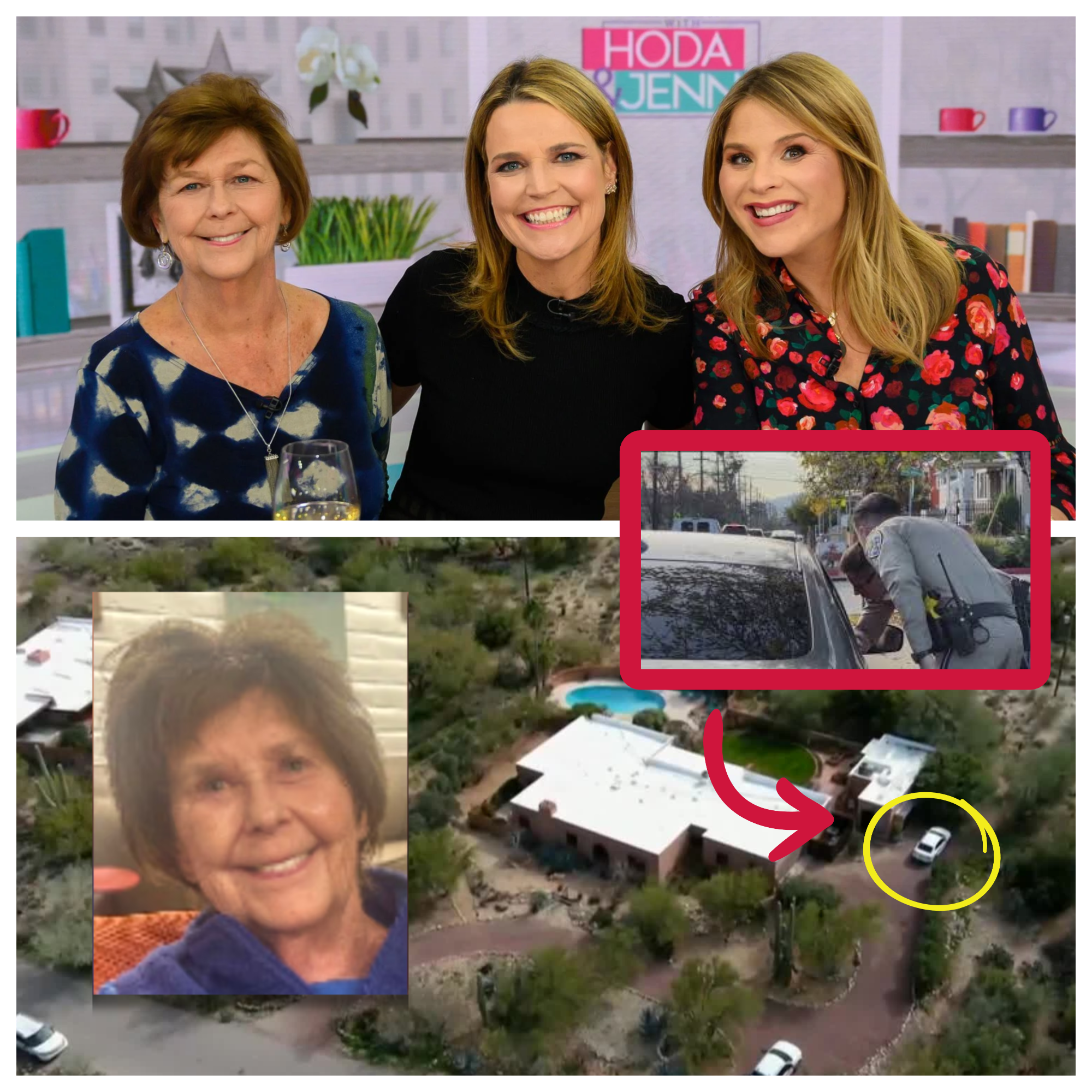
A neighbor’s dashcam has delivered what may be the most pivotal evidence yet in the suspected abduction of 84-year-old Nancy Guthrie, mother of NBC Today co-anchor Savannah Guthrie. The footage, timestamped beginning at approximately 8:20 p.m. on Saturday, January 31, 2026, shows a hooded male figure loitering persistently in front of and around her single-story residence in the Catalina Foothills neighborhood of Tucson—more than an hour before Nancy’s own indoor security camera captured her last known movement at 9:40 p.m.
The video, voluntarily provided to the Pima County Sheriff’s Office on Sunday afternoon after Nancy was reported missing, depicts the man in a dark hooded sweatshirt with the hood drawn tightly, concealing his face entirely. He walks slowly along the sidewalk, pauses frequently to turn and stare toward the house, retreats a few steps, then returns—repeating the pattern for over 65 minutes. At various moments he stops near the driveway apron, appears to glance at his phone or wrist, and once leans against a street-adjacent tree as though settling in to wait. He never crosses onto the property line or attempts to approach the front door during this observed period, but his repeated returns to the same vantage points have been characterized by investigators as deliberate surveillance.
Sheriff Chris Nanos held an urgent media briefing on February 3 to discuss the clip, calling the man’s behavior “deeply troubling and highly inconsistent with someone simply passing through the neighborhood.” He noted that the figure remained in the immediate vicinity until roughly 9:25 p.m.—only about 15 minutes before Nancy was last recorded alive inside her home. “This is not a casual evening stroll,” Nanos said. “This individual is clearly monitoring the residence, and the timing is impossible to ignore. We are treating him as a person of interest and need the public’s assistance in identifying him as quickly as possible.”
The dashcam quality is sufficient to provide key details despite the evening lighting: the man appears to be between 5’10” and 6’1″ tall, medium build, dressed in all dark clothing including black or navy pants and athletic-style shoes. No visible logos, reflective strips, or distinctive accessories stand out on his attire. No vehicle is seen pulling up or departing in the primary clip, leading detectives to believe he may have parked several blocks away or arrived on foot from a nearby location. Additional private cameras along the street have been collected to trace his approach and departure routes.
The footage aligns disturbingly with other evidence already in hand. Nancy’s internal security system recorded her walking calmly through a hallway at 9:40 p.m. before she disappears from the frame in an instant—no visible struggle, no raised voices, no sudden motion suggesting force. Yet the house showed clear signs of disturbance upon discovery the next day: a living-room chair pulled slightly askew, an end-table lamp cord unplugged, the back door standing ajar despite Nancy’s lifelong habit of double-locking every entrance, and her cellphone absent from its charging cradle on the kitchen counter. A small folded paper bearing cryptic, non-standard symbols was later found tucked in her wallet—untouched cash and cards still inside—further suggesting the intruder’s purpose was not financial but something far more specific and calculated.
The extended pre-incident surveillance captured on the dashcam has shifted the investigative theory toward a planned operation. Detectives now believe the hooded man may have been conducting reconnaissance—watching for lights going off, confirming she was alone after family members departed around 9:45 p.m., or waiting for her to settle for the night. The 65-minute window of observed activity indicates patience and intent rather than impulse. Investigators are re-analyzing the 8-second internal clip in light of this new context, searching for any subtle anomaly that might correlate with the external figure’s movements.
Nancy’s medical needs have placed extreme urgency on the case. She requires daily medication for a serious cardiac condition; missing doses beyond 24–48 hours significantly raises the risk of life-threatening complications. As of February 3, she has been missing for more than 84 hours. Search operations have intensified across the Catalina Foothills and beyond, with K-9 units (including cadaver dogs), thermal-imaging drones, helicopters, ground teams, and hundreds of volunteers sweeping desert washes, mountain trails, abandoned structures, and remote canyons within a 30-mile radius.
Savannah Guthrie has remained in Tucson since Sunday, staying close to family and law enforcement. In a short statement released through NBC she said: “Every new piece of information, every video clip, every tip brings us one step closer. We are so grateful for the love and support surrounding us right now. Please keep sharing anything you know—no detail is too small.” She has been seen briefly outside the sheriff’s substation, visibly emotional as she embraced relatives amid ongoing briefings.
The normally tranquil Catalina Foothills—characterized by spacious lots, mountain vistas, and a low-crime reputation—has been gripped by unease. Residents have flooded the tip line with additional footage: one camera farther down the block caught the same hooded silhouette walking purposefully at 7:50 p.m., suggesting earlier reconnaissance; another resident reported seeing a dark sedan without headlights parked on an adjacent side street around 8:10 p.m., though no direct link has been established. Neighbors who once felt insulated by distance and elevation are now reviewing their own systems obsessively and coordinating neighborhood watch groups.
Sheriff Nanos has released a single enhanced still from the dashcam—cropped tightly to the man’s hooded silhouette and general build—urging the public to study the clothing style, posture, and gait. “Someone in this community knows this person,” he said. “Maybe you saw him that night, maybe you know someone who dresses this way, maybe you recognize the way he moves. Call us. Anonymity is guaranteed.” The tip line has surpassed 600 submissions, with analysts prioritizing any matches to the physical description or behavioral pattern.
The convergence of evidence—the cryptic note in the wallet, the untouched valuables, the sudden vanishing from internal camera view, and now this prolonged external surveillance—paints a picture of a deliberate, methodical act rather than a random crime of opportunity. Federal partners, including the FBI’s Behavioral Analysis Unit and violent-crime specialists, have been brought in to assist with video gait analysis, behavioral profiling, and cross-referencing the symbols on the note against known databases.
For Nancy’s family and the broader community, the hooded figure represents both dread and a fragile lifeline. If he can be identified—through clothing, height, mannerisms, or a tip from someone who saw him later that night—he may lead directly to where Nancy is being held. The quiet cul-de-sac home, now cordoned off and guarded, stands as a silent monument to the 60+ minutes of unseen danger that preceded her disappearance. Every passing hour without her medication heightens the desperation.
Tucson, Arizona, and a nation transfixed by the story wait for the next breakthrough. The man caught on that neighbor’s dashcam holds answers that could bring Nancy Guthrie home alive—or explain why she may never return. The search for truth continues, one frame, one tip, one clue at a time.
News
The Black Bag in the Ravine: Chilling Discovery in the Death of American Airlines Flight Attendant Eric Gutierrez.
The tragic case of 32-year-old American Airlines flight attendant Eric Fernando Gutierrez Molina took an even darker turn as investigators in Colombia recovered a black bag linked to the missing…
The Secret Weekend Pattern: How the FBI’s Latest Breakthrough May Finally Trap Nancy Guthrie’s Abductor.
As March 2026 draws to a close, the disappearance of 84-year-old Nancy Guthrie from her home in Tucson’s Catalina Foothills has entered its 55th day with no arrest and no…
The Insider Who May Have Opened the Door: FBI Hunts for the Person Who Knew Nancy Guthrie’s Home Too Well.
In the affluent Catalina Foothills neighborhood of Tucson, Arizona, where residents often leave garage doors open and security feels routine, the abduction of 84-year-old Nancy Guthrie on the night of…
The Vacant House Perch: SWAT Commander Reveals How the Kidnapper Likely Staged Nancy Guthrie’s Abduction.
In the upscale Catalina Foothills of Tucson, Arizona, where million-dollar homes boast layered security and residents pride themselves on knowing every face and vehicle, the disappearance of 84-year-old Nancy Guthrie…
The Empty House Next Door: Chilling Clues FBI Uncovered in Nancy Guthrie’s Kidnapping.
In the exclusive Catalina Foothills neighborhood of Tucson, Arizona, where seven-figure mansions sit behind layered security gates and vigilant residents know every vehicle and routine, an unthinkable crime shattered the…
The Hidden Daughter Who Inherited the Entire Guthrie Ranch – The Will No One Saw Coming.
In the rugged hills near Billings, Montana, the Guthrie family ranch stood as a symbol of American grit for decades. What began as a modest 30-acre lease in the 1940s…
End of content
No more pages to load