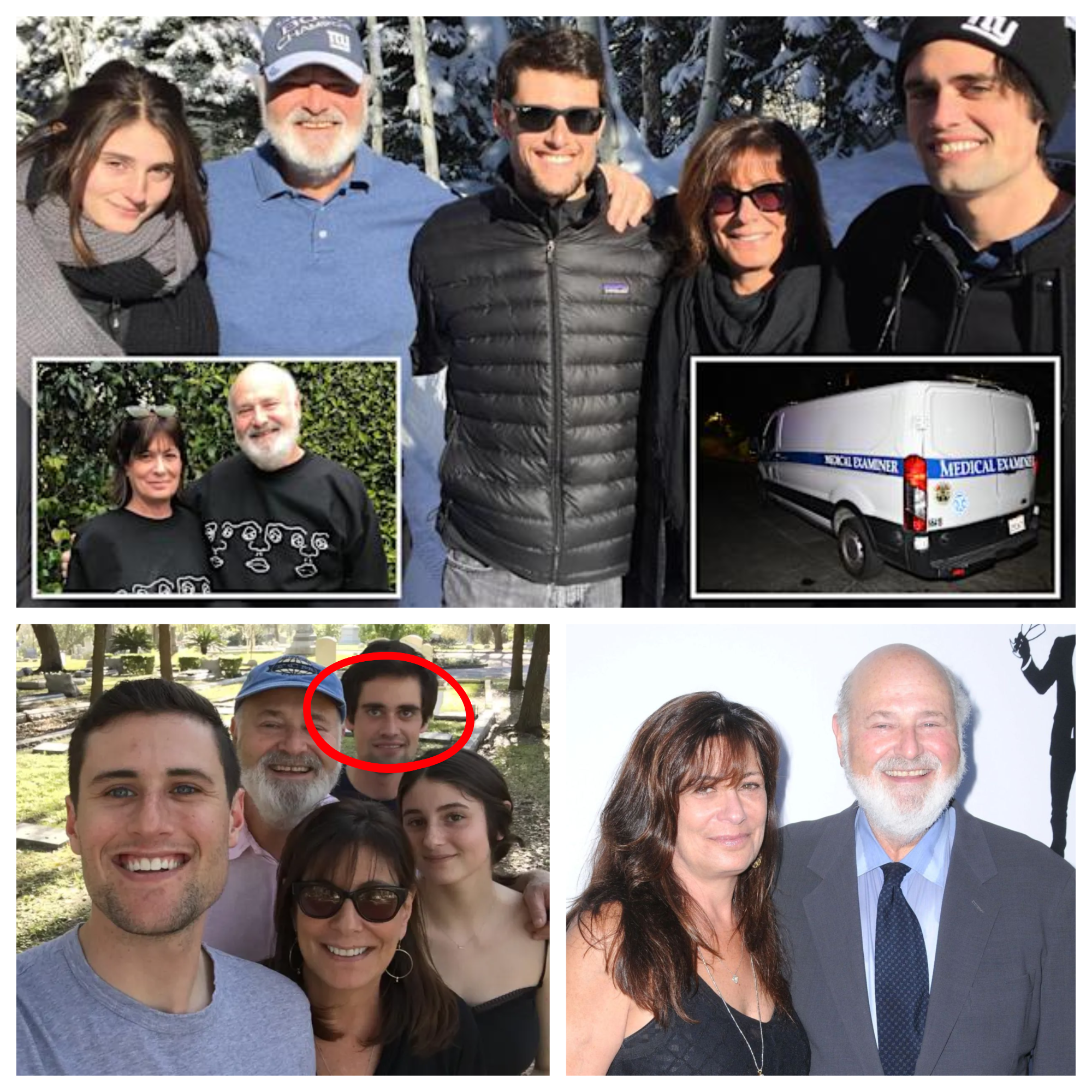
Rob Reiner, the legendary filmmaker behind timeless classics like “The Princess Bride” and “A Few Good Men,” and his wife of more than three decades, Michele Singer Reiner, were discovered deceased in their longtime Brentwood residence on a quiet Sunday afternoon. The couple, both pillars of the entertainment world, left behind a legacy of creativity and resilience that now faces an unimaginable shadow cast by circumstances pointing to internal family strife.
It was their 28-year-old daughter, Romy Reiner, who made the harrowing discovery around 3:30 p.m. local time. Upon alerting authorities, Romy provided investigators with a pointed observation: she believed another family member bore responsibility for the incident. This disclosure, shared with Los Angeles Police Department officers on the scene, immediately shifted the focus of the preliminary inquiry toward those closest to the victims. Sources close to the matter, speaking under conditions of anonymity, described Romy’s composure amid the chaos as remarkable, noting that her insight stemmed from an acute awareness of ongoing household tensions. While details remain sealed to protect the integrity of the active investigation, her statement has propelled a relative into the spotlight as a key figure of interest.
The Los Angeles Fire Department initially responded to what was reported as a medical emergency at the upscale home in the affluent Brentwood enclave, a neighborhood synonymous with privacy and prominence. Firefighters and paramedics arrived swiftly, only to confirm the worst: Rob, 78, and Michele, 68, were beyond aid. The LAPD’s Robbery-Homicide Division took over, establishing a perimeter and canvassing the area for potential leads. As of Monday evening, no formal charges had been announced, but family members were being interviewed methodically to piece together the timeline.
At the center of early scrutiny is Nick Reiner, the couple’s 32-year-old son, who has resided intermittently with his parents in recent years. Multiple insiders, including those with direct knowledge of family dynamics, indicated that Nick is cooperating with detectives, though his involvement has not been officially corroborated by law enforcement. LAPD Deputy Chief Alan Hamilton addressed the media briefly outside the residence, emphasizing a commitment to thoroughness: “We are in the early stages of this sensitive case and will follow every avenue to ensure justice.” He urged the public to refrain from speculation, highlighting the emotional toll on surviving relatives.
The Reiner household, once a haven of collaborative spirit and artistic fervor, had navigated its share of private challenges in the years leading up to this tragedy. Rob and Michele, married since 1989 after a serendipitous meeting on the set of “When Harry Met Sally…,” built a life intertwined with the rhythms of Hollywood. Their union produced three children—sons Jake and Nick, and daughter Romy—each carving paths influenced by their parents’ storied careers. Rob, the son of comedy titan Carl Reiner and actress Estelle Reba, had long balanced his professional triumphs with personal advocacy, particularly in mental health and addiction recovery initiatives. Michele, a producer in her own right, complemented this with a quiet strength, often credited by Rob as the steady force behind their family’s creative endeavors.
Nick’s journey, however, has been marked by profound hurdles that tested the family’s resolve. From his mid-teens, he grappled with substance dependency, cycling through rehabilitation programs and periods of instability that spanned multiple states. In a candid 2016 interview with People magazine, Nick opened up about the depths of his struggles: homelessness in Maine, New Jersey, and Texas; nights and weeks spent on the streets; and the relentless pull of addiction that isolated him from the stability his parents fought to provide. “It was not fun,” he reflected at the time, a raw admission that underscored the human cost of such battles. Yet, there were glimmers of progress. By 2016, Nick had returned to Los Angeles, reintegrating into family life and channeling his experiences into “Being Charlie,” a 2015 film co-written with his father. The semi-autobiographical drama portrayed a young man’s turbulent path to sobriety, earning praise for its unflinching honesty and serving as a testament to the Reiners’ collaborative ethos.
Friends and acquaintances paint a portrait of Nick as a young man of evident talent overshadowed by inner turmoil. A former classmate, reached by reporters, recalled his early promise: “He was always creative, always drawing or writing, but you could sense the weight he carried.” She described a pattern of relapses that strained relationships, yet emphasized the unwavering support from Rob and Michele. “They never gave up on him,” she said, her voice tinged with sorrow. Neighbors in Brentwood echoed this, recounting instances where the couple extended compassion not just to Nick, but to their entire circle. One longtime resident remembered Rob’s habit of hosting impromptu barbecues, where stories flowed as freely as laughter, fostering a sense of community amid the gated enclaves.
Tensions within the home reportedly simmered over treatment approaches. Family discussions, according to those familiar, often revolved around Nick’s preference for at-home support versus structured facility care. Rob, drawing from his own advocacy work through the Reiner Foundation—dedicated to children’s well-being and mental health—pushed for comprehensive interventions. Michele, ever the mediator, balanced these efforts with daily acts of nurturing. A security professional who patrolled the area post the January Palisades Fire described the couple’s generosity: daily check-ins, shared meals, even an umbrella on a rainy shift. “They were the sweetest people,” he recalled, his account highlighting the warmth that defined their public and private lives.
Romy’s role in this unfolding narrative adds layers of complexity and heartbreak. As the youngest of the three siblings, she has maintained a lower profile, pursuing interests in production and philanthropy that mirror her mother’s. Sources describe her as the family’s emotional anchor, often bridging gaps during Nick’s more volatile episodes. Her decision to name a relative upon discovery speaks to a prescience born of proximity—years of witnessing the push-pull of recovery and relapse. In the immediate aftermath, Romy coordinated with siblings Jake and Tracy Reiner (Rob’s daughter from his first marriage to the late Penny Marshall) to issue a unified statement: “It is with profound sorrow that we announce the tragic passing of Michele and Rob Reiner. We are heartbroken by this sudden loss, and we ask for privacy during this unbelievably difficult time.” The words, released through a family spokesperson, conveyed a collective grief that resonated across social media, where tributes poured in from fans and peers alike.
The broader Reiner legacy amplifies the shockwaves of this event. Rob’s career trajectory—from breakout star on “All in the Family,” where he embodied the era’s social upheavals as Archie Bunker’s liberal son-in-law, to auteur of box-office gold—cemented his status as a cultural touchstone. Films like “Stand by Me,” adapted from Stephen King’s novella, captured the innocence of youth against life’s undercurrents, while “This Is Spinal Tap” revolutionized mockumentaries with its satirical bite. His producing credits extended into television, nurturing talents like those on “The West Wing” and “Freaks and Geeks.” Beyond the screen, Rob’s activism spanned environmental causes, civil rights, and, crucially, addiction awareness, informed by Nick’s path. The 2006 documentary “Al Franken: God Spoke,” though politically charged, showcased his willingness to engage contentious issues head-on.
Michele’s contributions, though less spotlighted, were no less vital. As a film producer, she collaborated on projects that blended commerce with conscience, including initiatives supporting emerging filmmakers. Her marriage to Rob, forged in the whirlwind of “When Harry Met Sally…,” became a Hollywood archetype of enduring partnership. The couple’s 36 years together weathered industry storms, from Rob’s directorial dry spells in the 2000s to personal trials like Penny Marshall’s passing in 2018. Tracy Reiner, now a mother and occasional actress, honored her stepmother in tributes, calling Michele “the glue that held us all.” Jake, the middle son and a musician, has similarly credited his parents’ influence in shaping his worldview, often sharing acoustic covers of folk tunes on platforms like Instagram.
As investigators delve deeper, forensic teams process the scene with forensic precision, cataloging evidence that could clarify the sequence of events. Preliminary reports suggest the incident unfolded rapidly, possibly amid an escalated discussion, though officials caution against premature conclusions. The absence of external forced entry points to an internal origin, aligning with Romy’s initial assessment. Psychologists consulted by the family, per anonymous sources, have emphasized the interplay of untreated mental health factors in such scenarios—a theme Rob himself explored in advocacy forums. His 2017 testimony before Congress on opioid crisis funding underscored the need for accessible care, a message now hauntingly poignant.
Hollywood’s response has been swift and somber. Norman Lear, the “All in the Family” creator who launched Rob’s career, issued a statement via his foundation: “Rob was more than a collaborator; he was family. This loss dims the light he brought to so many.” Directors like Judd Apatow and Nora Ephron’s estate representatives echoed this, recalling Rob’s mentorship. On set visits, he was known for fostering environments where vulnerability fueled creativity—lessons drawn from his own brushes with doubt. The Academy of Motion Picture Arts and Sciences announced plans for a memorial screening, potentially featuring clips from his oeuvre alongside testimonials from collaborators.
For the Reiner children, the path forward is fraught. Romy, thrust into an unwelcome prominence, has retreated from public view, supported by a network of cousins and extended kin. Jake, based in New York, has deferred media inquiries to focus on logistics, while Tracy coordinates memorial arrangements from her Los Angeles base. Nick’s status remains fluid; if formal proceedings advance, legal experts anticipate a defense centered on diminished capacity, given his documented history. California’s mental health courts, bolstered by reforms Rob championed, could play a role, offering pathways beyond punitive measures.
This tragedy unfolds against a backdrop of rising concerns over familial pressures in high-profile circles. Studies from the National Alliance on Mental Illness highlight how wealth and fame can exacerbate isolation, with public scrutiny compounding private pains. Rob’s own foundation, now under sibling stewardship, vows to redouble efforts in addiction research, channeling grief into action. Donors have already pledged support, viewing the Reiners’ story as a clarion call for systemic change.
Neighbors, still processing the boulevard’s altered serenity, leave flowers at the wrought-iron gates—lilies for Michele’s grace, sunflowers for Rob’s optimism. A makeshift vigil draws locals and passersby, whispers of “What a waste” mingling with prayers. The security guard, Trevor Taufahema, lingers nearby, umbrella in hand as a talisman. “They deserved peace,” he says simply, encapsulating the sentiment rippling through Brentwood’s manicured streets.
As the sun sets on another Los Angeles evening, the Reiner saga reminds us of fragility beneath glamour’s veneer. Rob’s films, with their themes of redemption and connection, offer solace: “Stand by Me” whispers of bonds unbroken by circumstance; “The Princess Bride” affirms love’s triumph over adversity. In death, as in life, the Reiners compel reflection—not on endings, but on the enduring power of story to heal.
Yet questions linger. What unspoken fractures led to this precipice? How might earlier interventions have altered trajectories? Investigators, sifting through diaries, communications, and witness accounts, seek answers that may elude full resolution. Romy’s revelation, a daughter’s instinct in crisis, underscores the acuity of familial intuition—a double-edged sword in times of duress.
The entertainment community, ever resilient, rallies. Streaming platforms queue Reiner retrospectives, sparking renewed appreciation for his craft. Podcasts dissect his influence, from improvisational comedy to dramatic heft. Fans, too, contribute: online fundraisers for mental health causes surge, tagged #ForTheReiners, amassing thousands overnight.
In the weeks ahead, court filings will illuminate more, but for now, Brentwood holds its breath. The LAPD promises transparency, vowing to honor the victims with diligence. Family attorneys, preparing contingencies, stress unity amid division. Jake, in a rare post, shared a photo of Rob on set, captioning it: “Your lessons live on.”
Rob Reiner’s final project, an untitled dramedy on legacy and forgiveness, sits in post-production limbo. Producers debate its release, pondering if art can mirror life’s unresolved chapters. Michele’s unproduced script, a family comedy, evokes laughter through tears—a fitting epitaph.
This is more than a headline; it’s a mirror to society’s undercurrents. Addiction’s grip, unchecked; mental health’s stigma, unyielding; family ties, both ballast and burden. The Reiners, in their humanity, challenge us to listen closer, act sooner.
As dawn breaks over the Hollywood Hills, one truth endures: stories, like lives, persist beyond the page. Rob and Michele’s, woven into cultural fabric, invite us to weave stronger safety nets—for the Nicks, the Romys, the all of us navigating shadows.