She Called the Plus-Size Baker Fat at a Family Dinner—Seconds Later a Pie Hit Her Face, and the Grandfather Said, “She Was Defending Me”.
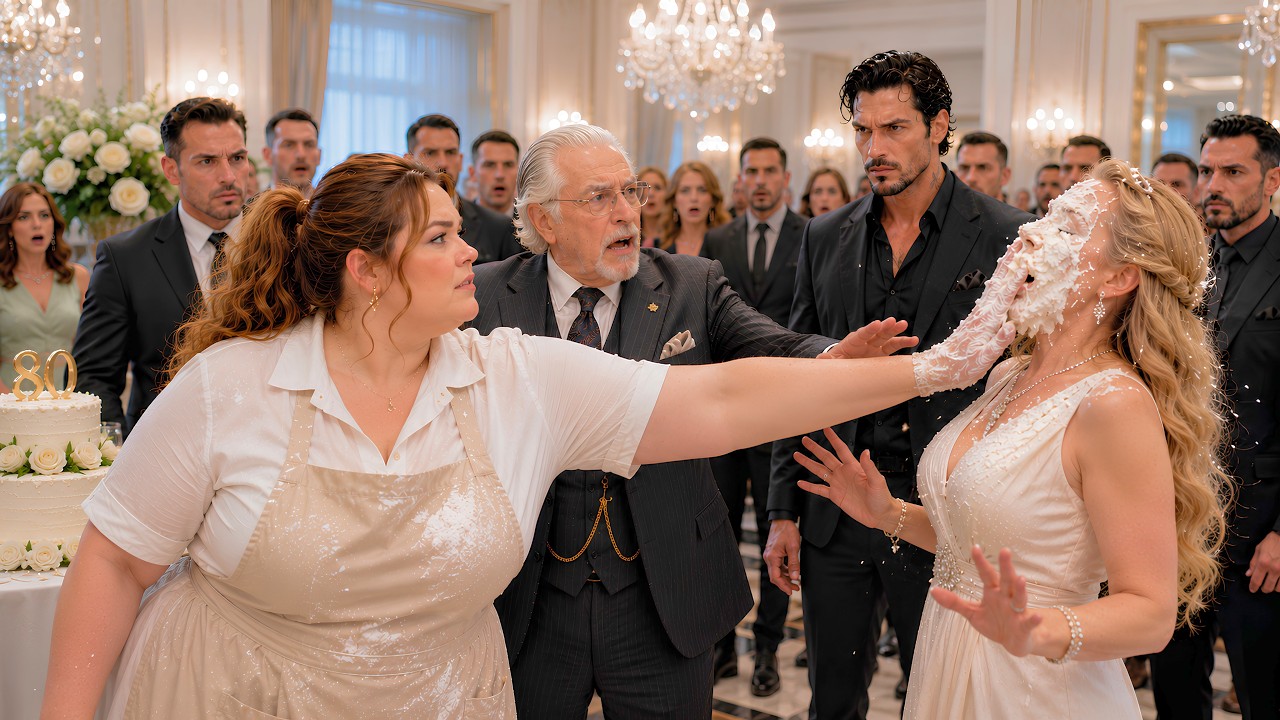
“Call me fat again,” I said, “and the next pie goes lower.”
Whipped cream slid down Sophia Crowe’s perfectly powdered cheek. For one stunned second the private dining room of the Reed family estate held its breath. Two men in dark suits took a step toward me.
Julian Reed stopped them with a look.
“She assaulted me,” Sophia screamed.
Then an eighty-year-old man stepped between us, wiped a smear of cream from his own lapel, and announced, as if he were introducing a toast, “She defended me.”
I stared at him. “You started this.”
Elias Reed grinned. “True.”
Julian looked from his grandfather to me, then at the ruined dessert table, then back at me as if I had personally rearranged his entire evening.
“Would somebody,” he said, very calmly, “tell me why my birthday dinner became a food fight?”
My name is Clara Ellison. I am thirty-two, a baker, and until four weeks earlier I had never expected a corrected birthday cake to lead me into a room full of people who measured worth by waistlines and last names.
Four weeks earlier I was piping buttercream roses when a man in a black suit set a bakery box on my counter.
“There’s a problem.”
I looked up. Tall. Dark-haired. Impossibly composed. The kind of man who looked as though problems usually apologized to him first.
I opened the box. Across the cake, in elegant gold lettering, were the words Happy 88th, Francis.
I checked the order slip. “Frank?”
“Yes.”
“We wrote Francis.”
“Yes.”
I looked at him. “He’s eighty.”
“Correct.”
“And still angry about Francis.”
“Extremely.”
I nodded. “I respect the commitment.”
Something almost moved at the corner of his mouth. “I need it fixed.”
“That’s generally what happens after we make a mistake.”
I repaired the inscription while a coworker whispered, “Do you know who that is?”
“No.”
“Julian Reed.”
I knew the name. Most of Chicago did. Reed holdings were everywhere—real estate, restaurants, foundations with very long tables. I looked back at him.
“Congratulations. You’re still waiting ten minutes.”
He stared at me. Then, unexpectedly, he waited.
That evening Elias Reed loved the cake. Two days later he walked into Rose & Rye without my realizing who he was. He studied the pastry case and pointed.
“Two cannoli.”
I noticed the medical alert bracelet and the folded dietary card in his pocket.
“How many does your doctor allow?”
He looked offended. “My doctor doesn’t work here.”
“That wasn’t my question.”
“One.”
I boxed one.
“At my age I can eat whatever I want.”
“At your age,” I said, “apparently you can also lie to your cardiologist.”
He burst out laughing. He came back the next morning, and the morning after that. Soon I knew his coffee order, his opinion of every pastry in the case, and his belief that eighty was far too young to be supervised.
Then Julian walked in. Elias immediately looked guilty. Julian noticed the pastry.
“Grandfather.”
“Don’t use that tone.”
“You left security.”
“I went for a walk.”
“You crossed six blocks.”
“Excellent cardiovascular exercise.”
Julian turned to me. “You’ve been serving him pastries.”
I folded my arms. “I’ve been preventing him from ordering two. He has a heart condition.”
“Then tell him that. Don’t put a tracking device on him.”
Julian went very still. Elias leaned toward me.
“I told you she’d win.”
“This isn’t a competition,” Julian said.
“It is now.”
I looked between them. “Wait. This is your grandfather?”
“Yes.”
Elias smiled. “And this is the woman who fixed my birthday cake.”
Recognition clicked in Julian’s eyes.
“Mr. Birthday Cake Emergency,” I said.
“Don’t call me that.”
“Oh, I’m definitely calling you that.”
He should have been irritated. Instead, as his grandfather laughed beside me, he looked like a man fighting a smile he had not budgeted for.
A week later Elias volunteered Rose & Rye to provide desserts for a Reed charity event. I discovered this when my manager handed me an order for four hundred cupcakes and said Frank had already paid the deposit.
Of course he had.
By Saturday the van refused to start. Four hundred buttercream cupcakes sat in a warm bakery. A familiar black car stopped at the curb. Julian had come to collect Elias, who was inside arguing with me about whether one cupcake counted as quality control.
Julian surveyed the boxes. “What happened?”
“Transportation has betrayed me.”
He glanced at the dead van. “I have vehicles.”
“I’m not sending cupcakes to a charity event in a motorcade.”
He stared at me. “Would you prefer four hundred cupcakes melt on principle?”
I considered the boxes. Then him. “Fine. You carry boxes.”
One of his men became fascinated by the ceiling.
“You want me to carry cupcakes?”
“Unless your empire has a religious exemption from lifting.”
Twenty minutes later Julian Reed was carrying boxes into a ballroom while I supervised him like an unusually intimidating delivery driver.
“Keep them level.”
“I know how to carry a box.”
I opened the one he had just set down. Several cupcakes leaned dangerously sideways.
“Your empire has concerning logistics.”
“That happened in the car.”
“Accountability. Excellent leadership quality.”
He kept helping. No disappearing once his men could take over. When a teenage assistant knocked over a tray of empty stands, he picked them up before anyone could blame her. I noticed. He noticed different things: that I did not raise my voice when people panicked, that I would rather explain five minutes late than two hundred ugly cupcakes.
People listened to me because they trusted me. He found that unexpectedly compelling. I found it unexpectedly dangerous.
Elias created the girlfriend problem without using the word girlfriend. At a family lunch an aunt asked Julian when they would meet “the woman he was bringing to the charity dinner.” Julian cornered his grandfather later.
“I am not bringing Clara.”
“Why not?”
“Because she’s not my girlfriend.”
“I never said girlfriend.”
“You implied it.”
“At my age, people misunderstand me.”
Meanwhile Elias appeared at my counter. “I need you at the charity dinner.”
“No.”
“You haven’t heard why.”
“I’ve learned.”
He claimed the bakery needed someone to supervise dessert service. I narrowed my eyes. “Is this legitimate?”
“Mostly.”
I went because four hundred cupcakes were my responsibility, not because a powerful family wanted a plus-size baker as table decoration.
The dinner was long, gleaming, and full of people who smiled with their teeth and measured with their eyes. Sophia Crowe arrived in white silk, Julian’s former fiancée, the kind of beautiful that expected rooms to rearrange themselves. She found me near the dessert table.
“You’re the baker,” she said, as if confirming a rumor. “Frank talks about you constantly. How sweet. He always did collect strays.”
I set down a tray. “He collects cannoli. I’m the person who limits him to one.”
Her gaze traveled over me with professional precision. “Julian has a type. It used to be… lighter.”
The word hung there. Not shouted. Designed.
Elias, who had been pretending not to listen, set down his fork. “Say that again.”
Sophia laughed softly. “I only meant she doesn’t look like she belongs at this table. Some bodies are built for kitchens, not for family photographs.”
The room nearest us went quiet.
I picked up a lemon cream pie that had been meant for the second course display. I did not throw it in rage. I placed it, firmly and accurately, against the sentence she had just finished.
Cream bloomed across her face.
“Call me fat again,” I said, “and the next one goes lower.”
That was when the men moved, Julian stopped them, and Elias stepped in.
“She defended me,” he repeated, louder this time. “I asked her what she thought of a woman who insults the person keeping his grandfather alive one pastry at a time. Clara answered. With dessert. I find that efficient.”
Julian looked at Sophia, then at me, then at the pie.
“You could have used words,” he said.
“I did. Then I used pie. She started with my body. I finished with pastry.”
Sophia demanded I be removed. Julian did not raise his voice.
“She stays,” he said. “You can leave if the cream offends you.”
The twist nobody in that room expected—including me—was not the pie. It was that Julian did not ask me to apologize for existing at his table. He asked Sophia to sit down or go home. Elias looked insufferably pleased. The charity auction continued. I plated the remaining desserts with hands that only shook after I reached the kitchen.
Later, on the service stairs, Julian found me wiping frosting from my wrist.
“I don’t need you to protect me from your family,” I said.
“I know.”
“I also don’t intend to become smaller so I fit a photograph.”
“I know that too.”
He stood there, expensive and inconveniently sincere. “My grandfather likes you because you tell him no. I am beginning to understand the appeal.”
“That is not a compliment I asked for.”
“It wasn’t meant as one. It was an observation.”
I looked at him. “If you ever introduce me as a project, or a phase, or a statement, I will bring a pie to every event you host for the rest of your life.”
The corner of his mouth moved. “Noted.”
We did not fall into each other’s arms on the stairs. That would have been a different story, and I do not bake those. What we did was simpler and harder: we kept showing up. He carried boxes when the van failed again. I refused to let Elias order two of anything. Sophia faded from the family table after discovering that cream photographs poorly and that Julian would not rewrite the evening to spare her pride.
Months later, when someone at another dinner asked whether I planned to “work on myself” now that I was seen with him, Julian answered before I could.
“She works on cakes,” he said. “The rest of us can work on our manners.”
I did not need him to rescue me. I needed him to mean it when he told the room to sit down.
He did.
And the next time Elias tried to volunteer my bakery for an event of four hundred, I looked at Julian and said, “You carry the boxes.”
He already had his sleeves rolled up.
Some love stories begin with a ring.
Mine began with a misspelled cake, one legal cannolo, and a pie that found the exact face that had earned it.
I still refuse to change my body to belong in anyone’s photograph.
I only changed the ending of the sentence they tried to write for me.