Seconds from Safety: How a Single Air Traffic Control Error Led to Deadly Collision at LaGuardia Airport.
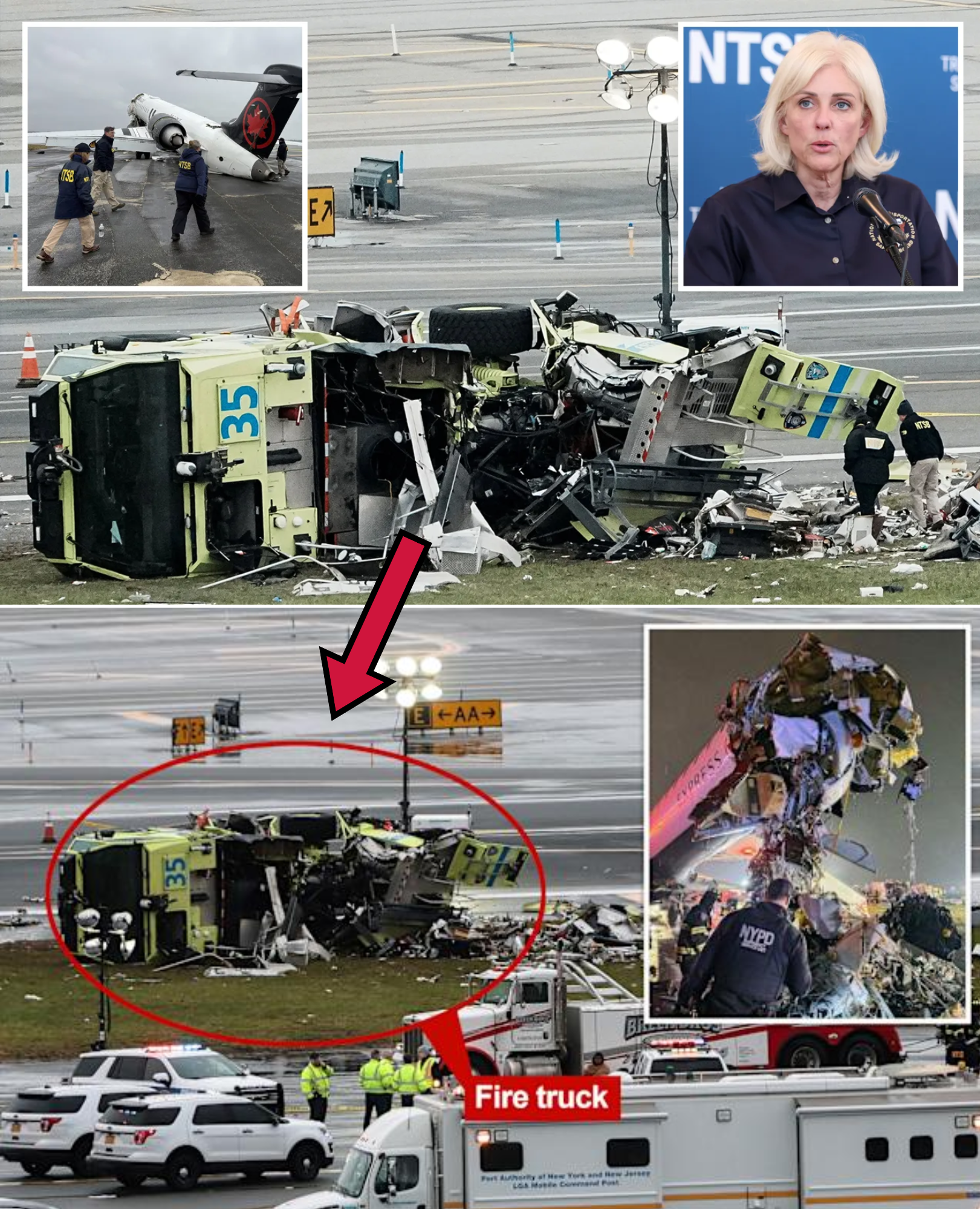
In the final moments before midnight on March 22, 2026, Air Canada Express Flight 8646 from Montreal approached Runway 4 at New York’s LaGuardia Airport carrying 72 passengers and four crew members. The regional CRJ-900 jet, operated by Jazz Aviation, was moments from a routine landing when disaster struck. The aircraft slammed into a Port Authority fire truck crossing the active runway, killing both pilots instantly and injuring 41 others in one of the most shocking runway incidents in recent U.S. aviation history.
The two pilots who lost their lives have been identified as Captain Antoine Forest from Coteau-du-Lac, Quebec, and First Officer Mackenzie Gunther, a 2023 graduate of Toronto’s Seneca Polytechnic. Colleagues and passengers have since praised their quick actions in braking hard and keeping the plane from veering off, likely preventing an even greater catastrophe that could have claimed many more lives.
The fire truck was responding to a separate emergency — a United Airlines flight that had reported an “issue with odor” on board. According to air traffic control recordings released in the hours following the crash, the truck requested permission to cross Runway 4 at taxiway Delta. The controller initially cleared the vehicle to proceed. Seconds later, as the Air Canada jet was already on short final approach, the same controller realized the deadly error and began frantically transmitting: “Stop, stop, stop. Truck 1, stop. Truck 1, stop.” The urgent calls came too late. The jet, traveling at approximately 39 kilometers per hour (about 24 mph) upon touchdown, collided with the truck, shearing off the nose of the aircraft and obliterating the front section where the pilots were seated.
A flight attendant was violently ejected from the plane still strapped to her jump seat and was found more than 320 feet away on the runway. Miraculously, she survived with injuries. Both officers inside the fire truck were also hospitalized. In total, 41 people were taken to area hospitals, with nine remaining in serious condition as of March 24. LaGuardia Airport was forced to close for most of Monday, March 23, causing hundreds of flight cancellations and massive travel disruptions across the Northeast.
Audio from the tower paints a chilling picture of the final seconds. After the impact, one controller can be heard informing the pilots, “I see you collided with a vehicle there. Just hold position.” Roughly 20 minutes later, in a transmission to another aircraft, the same controller admitted fault, saying, “We were dealing with an emergency earlier… I messed up.” The admission has fueled intense scrutiny of the air traffic control procedures at one of America’s busiest airports.
Aviation experts have not held back. Retired FAA air traffic controller Harvey Sconick, with over 38 years of experience, told reporters the incident appeared “avoidable,” describing the controller’s actions as momentarily “brain-dead.” He noted that standard protocol demands absolute separation between arriving aircraft and ground vehicles on active runways. Runway incursions — unauthorized entries onto runways — are a known risk, yet this one involved an emergency vehicle cleared by the tower itself.
The National Transportation Safety Board (NTSB) launched an immediate investigation, with teams on scene examining the wreckage, cockpit voice recorder, flight data recorder, and tower communications. Early focus includes whether the controller was distracted by the concurrent United Airlines odor incident, potential fatigue, staffing levels in the LaGuardia tower, and why the airport’s runway warning systems did not alert in time. Investigators are also reviewing whether the fire truck lacked certain safety equipment or if ground radar performed as expected.
Passengers aboard Flight 8646 described chaos in the cabin the moment of impact. “We immediately hit something and it was just chaos,” one survivor recalled. Many credited the pilots with heroic efforts to slow the aircraft, minimizing the force of the collision and preventing fire or a more severe breakup of the fuselage. One passenger noted the quick response of cabin crew and the fact that the plane came to rest relatively intact despite the mangled front end.
This tragedy marks the first fatal runway collision at LaGuardia in 34 years, harking back to a 1992 incident in snowy conditions that claimed 19 lives. Aviation safety advocates are already calling for renewed emphasis on runway incursion prevention technologies, including enhanced ground movement radar, better real-time alerts, and stricter protocols for emergency vehicle movements during active landings.
For Air Canada and Jazz Aviation, the loss of two young pilots has sent shockwaves through the Canadian aviation community. Both men were described as dedicated professionals at the start of promising careers. Tributes poured in from fellow pilots, flight attendants, and the families they left behind. “They had guardian angels watching over the passengers,” one relative said, highlighting how the pilots’ final actions likely saved dozens.
The broader implications for LaGuardia and the Port Authority of New York and New Jersey are significant. The airport, long criticized for congestion and aging infrastructure despite recent modernization efforts, now faces questions about operational safety under pressure. With multiple airlines operating tight schedules and frequent concurrent emergencies, the margin for human error appears razor-thin.
As the investigation continues, authorities have promised transparency. The FAA and NTSB are expected to release preliminary findings in the coming weeks, potentially including recommendations that could reshape ground control procedures nationwide. Meanwhile, LaGuardia has resumed operations, but the images of the damaged CRJ-900 and overturned fire truck remain etched in the minds of travelers and aviation professionals alike.
This incident serves as a sobering reminder that even in an era of advanced technology, aviation safety ultimately depends on split-second human decisions. A single cleared crossing, a moment of distraction amid another emergency, and lives were forever altered. The pilots of Flight 8646 will be remembered for their composure under pressure, while the industry grapples with how to ensure such a heartbreaking mistake never repeats.
The families of Antoine Forest and Mackenzie Gunther, the injured passengers and crew, and the first responders now face long roads to recovery. For the flying public, the event raises uncomfortable questions about the invisible safety net that protects millions of flights each year. As experts analyze every transmission and data point, one thing is clear: those final frantic calls of “Stop, Truck 1, stop” came just seconds too late — a tragic gap that no one can undo.