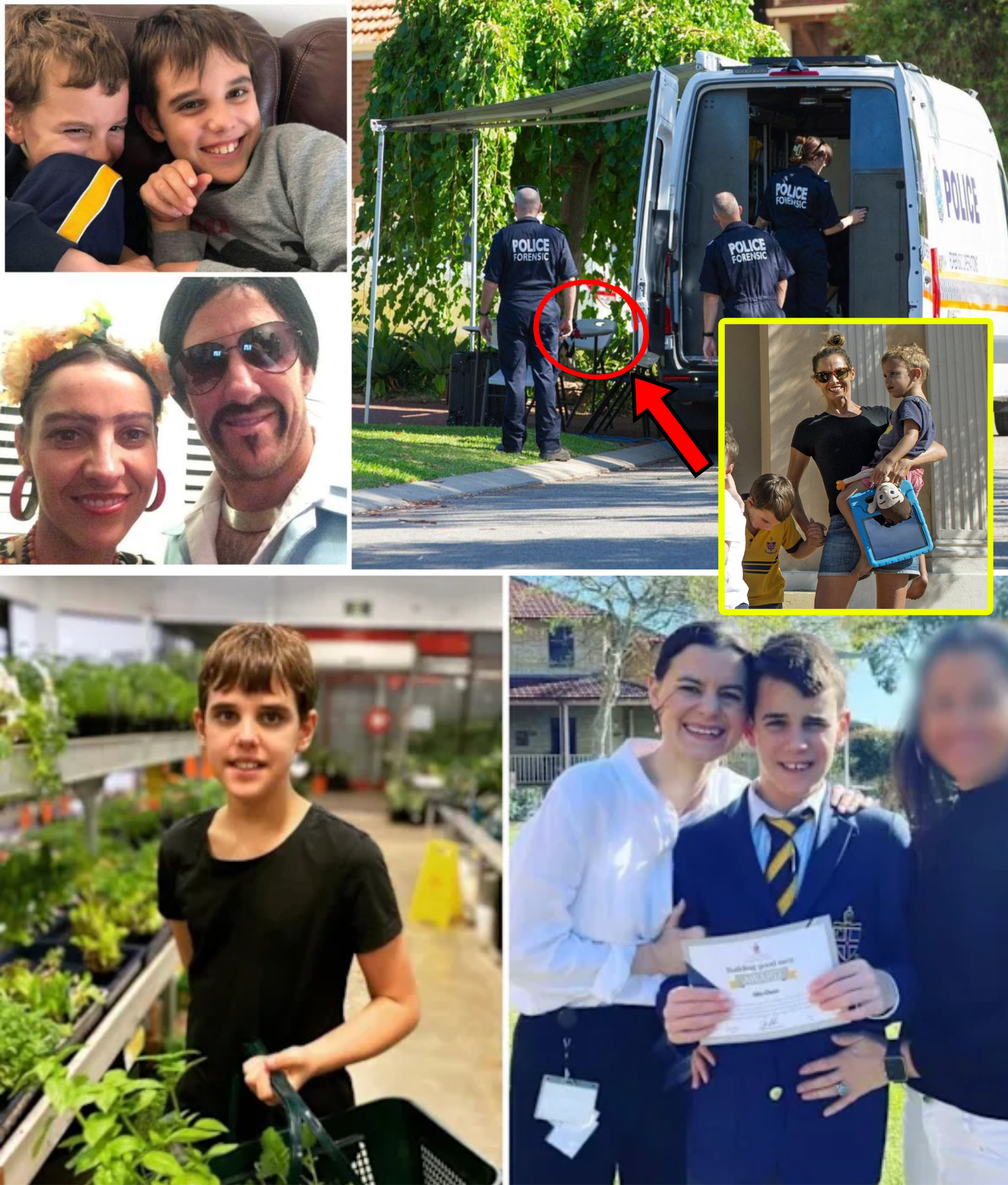
Western Australia Police have revealed that a second handwritten note, discovered inside the Mosman Park family home, is now considered a pivotal piece of evidence in the suspected double murder-suicide that claimed the lives of Jarrod Clune, 49-year-old Maiwenna Goasdoue, and their two autistic teenage sons, Leon, 16, and Otis, 14. Described by senior investigators as “critical,” the document was found among the bodies and three deceased family pets on January 30, 2026, and is believed to contain far more than final instructions—it allegedly articulates the parents’ reasoning, emotional state, and perceived lack of alternatives in the days leading up to the tragedy.
The initial discovery began with a short note affixed to the front door of the Mott Close residence. It explicitly warned visitors not to enter and to summon police without delay. When officers forced entry shortly after 8:15 a.m., they encountered a scene that has since haunted the affluent Perth suburb: Jarrod and Maiwenna found in one section of the home, the boys in another, and the family’s two dogs and cat also deceased. No firearms were present, and the absence of defensive wounds or signs of struggle supported the early classification of double murder followed by suicide.
While the exterior note functioned as a barrier to prevent immediate discovery, the interior note—located in a prominent yet private area of the house—has emerged as significantly more revealing. According to sources briefed on the investigation, the second letter runs several pages and includes detailed provisions for financial matters, asset distribution, and arrangements for any remaining obligations. More crucially, it reportedly contains passages in which the parents attempt to explain their actions, expressing profound despair over their sons’ lifelong care needs, recent erosions in support services, and a growing conviction that no viable path forward existed. Homicide Squad detectives are treating the document as a window into premeditation, joint decision-making, and the psychological tipping point.
Maddie Page, the family’s long-time autism mentor and carer, had previously broken down while describing Jarrod and Maiwenna as the “biggest and fiercest advocates” for Leon and Otis. She highlighted the boys’ capacity for joy when properly understood—small moments of connection that transcended their severe communication barriers. Yet she also pointed directly at systemic shortfalls, stating that the National Disability Insurance Scheme (NDIS) had “failed them” and contributed to the belief they had “no other choice.” Friends of the family later confirmed that funding packages had been reduced in recent reassessments, slashing access to critical respite care, intensive behavioral support, and overnight assistance—resources that had previously provided the parents with rare breathing room.
The second note’s contents, though not yet released publicly due to the sensitive nature of the coronial inquest, have intensified scrutiny on these claims. Advocacy organizations argue that the document underscores a broader crisis: families supporting multiple children with profound autism frequently face unsustainable demands. Daily life involves constant supervision to manage self-injurious behaviors, sensory dysregulation, and safety risks, often without adequate external help as parents age into their late 40s and 50s. Research consistently links such chronic strain to elevated risks of depression, anxiety, physical exhaustion, and in the most extreme cases, catastrophic breakdowns in reasoning.
WA Police have maintained a tight lid on specifics, emphasizing that forensic examination of both notes—including handwriting analysis, ink dating where possible, and content cross-referencing—is ongoing. The Homicide Squad continues to lead, with no suggestion of third-party involvement or community threat. Premier Roger Cook publicly acknowledged the case’s profound impact, calling it an “unimaginable loss” and encouraging those in similar distress to reach out for support through established helplines.
Public reaction has been intense. Candlelight vigils organized by the Australian Neurodivergent Parents Association drew hundreds across Perth and interstate, with participants lighting candles at 5 p.m. in silent tribute. Online memorials overflow with shared photographs from happier times—Leon beaming during school river excursions, Otis smiling at beach outings with fish and chips. These images stand in stark contrast to the reality described by those closest: a household where love coexisted with unrelenting exhaustion and fear of the future.
The tragedy has reignited fierce debate over the NDIS framework. Critics highlight bureaucratic delays, inconsistent plan approvals, and frequent downgrades that disproportionately affect high-support-needs households. Carer advocacy groups point out that without reliable, long-term funding—particularly for respite and behavioral intervention—burnout becomes almost inevitable. In this instance, the second note is seen by many as a tragic final plea: evidence that the parents felt abandoned by the very system designed to sustain them.
For Leon and Otis, the future should have held more moments of connection—more creative communication breakthroughs, more shared joys in a world built to accommodate their needs. For Jarrod and Maiwenna, it should have included robust backing that honored their lifelong commitment. Instead, the second note stands as a heartbreaking artifact of perceived failure—both personal and systemic.
As detectives continue dissecting its every line, the Mosman Park case compels Australia to confront difficult questions: How many other families are quietly reaching breaking point? What reforms are urgently needed to prevent history from repeating? The answers may not bring back the Clune family, but they could ensure that no other household is left feeling that tragedy is the only remaining option.
News
The Black Bag in the Ravine: Chilling Discovery in the Death of American Airlines Flight Attendant Eric Gutierrez.
The tragic case of 32-year-old American Airlines flight attendant Eric Fernando Gutierrez Molina took an even darker turn as investigators in Colombia recovered a black bag linked to the missing…
The Secret Weekend Pattern: How the FBI’s Latest Breakthrough May Finally Trap Nancy Guthrie’s Abductor.
As March 2026 draws to a close, the disappearance of 84-year-old Nancy Guthrie from her home in Tucson’s Catalina Foothills has entered its 55th day with no arrest and no…
The Insider Who May Have Opened the Door: FBI Hunts for the Person Who Knew Nancy Guthrie’s Home Too Well.
In the affluent Catalina Foothills neighborhood of Tucson, Arizona, where residents often leave garage doors open and security feels routine, the abduction of 84-year-old Nancy Guthrie on the night of…
The Vacant House Perch: SWAT Commander Reveals How the Kidnapper Likely Staged Nancy Guthrie’s Abduction.
In the upscale Catalina Foothills of Tucson, Arizona, where million-dollar homes boast layered security and residents pride themselves on knowing every face and vehicle, the disappearance of 84-year-old Nancy Guthrie…
The Empty House Next Door: Chilling Clues FBI Uncovered in Nancy Guthrie’s Kidnapping.
In the exclusive Catalina Foothills neighborhood of Tucson, Arizona, where seven-figure mansions sit behind layered security gates and vigilant residents know every vehicle and routine, an unthinkable crime shattered the…
The Hidden Daughter Who Inherited the Entire Guthrie Ranch – The Will No One Saw Coming.
In the rugged hills near Billings, Montana, the Guthrie family ranch stood as a symbol of American grit for decades. What began as a modest 30-acre lease in the 1940s…
End of content
No more pages to load