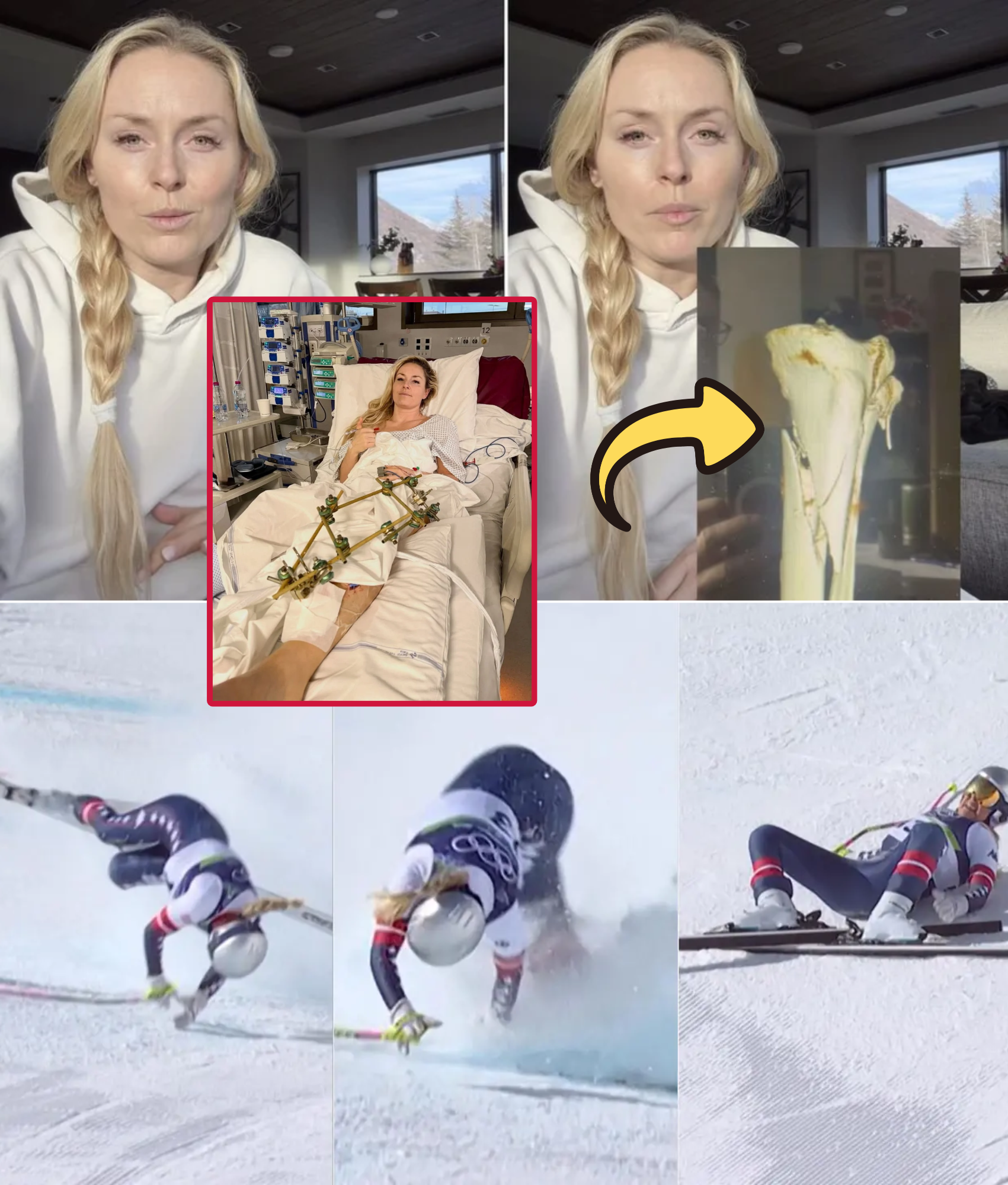
Lindsey Vonn has revealed the full extent of the life-altering injury she suffered during a high-speed crash at the Cortina d’Ampezzo World Cup downhill event on February 12, 2026, admitting that doctors seriously considered amputating her left leg in the immediate aftermath. The 41-year-old American skiing legend, who came out of retirement for a one-off return to competition, described the moment as the closest she has ever come to ending not just her career, but her ability to walk normally.
The incident occurred midway down the Olympia delle Tofane course during the women’s downhill training run. Vonn, starting with bib number 18, caught an edge on a high-speed left turn, lost her balance, and was catapulted into the safety netting at approximately 130 km/h. The impact tore through her left knee and lower leg, causing a compound fracture of the tibia and fibula, severe ligament damage, and significant soft-tissue trauma. Medical teams rushed to the scene within seconds, administering pain relief and stabilizing the limb before airlifting her to a specialized trauma center in Belluno.
In the emergency room, orthopedic surgeons initially assessed the damage as potentially irreparable. Vonn later recounted the conversation that still haunts her: “They told me straight—the circulation was compromised, the bones were shattered in multiple places, and there was so much contamination from the snow and debris that infection risk was extremely high. Amputation was on the table as a real option to save my life.” The decision to attempt salvage surgery came after hours of deliberation among a team of vascular, orthopedic, and plastic surgeons. They performed an eight-hour operation involving external fixation, vascular repair, debridement, and temporary wound closure.
The recovery process has been grueling. Vonn spent the first week in intensive care, followed by daily wound care, hyperbaric oxygen therapy to combat infection risk, and aggressive physical therapy to restore blood flow and prevent muscle atrophy. She has undergone two additional procedures to address compartment syndrome and remove necrotic tissue. As of late February, circulation has stabilized, but the leg remains at risk of long-term complications including chronic pain, limited mobility, and possible need for future reconstructive surgery.
Vonn spoke publicly for the first time about the ordeal in an exclusive interview with ESPN from her rehabilitation facility in Vail, Colorado, where she returned shortly after discharge from Italy. “I kept thinking about my kids, about never being able to chase them around again, about losing the independence I’ve fought so hard for,” she said. “I’ve broken bones before, torn ligaments, had concussions—but nothing like this. The thought of waking up without part of my leg was terrifying.” She credited the medical team, her family, and her mental resilience for pulling her through the darkest days.
The crash has reignited debate about safety on the World Cup downhill circuit. The Cortina course, known for its extreme speed and technical difficulty, has seen several serious incidents in recent years. Vonn herself had advocated for better netting and course design before her retirement in 2019. After the accident, she reiterated her call for change: “We love this sport because it’s dangerous, but it shouldn’t be deadly or life-altering in this way. The athletes deserve better protection.”
Vonn’s return to competition had been billed as a symbolic comeback—her first race since 2019, intended as a farewell to the sport she dominated for over a decade. She won four Olympic medals, three World Championship golds, and 82 World Cup races, making her the most successful American alpine skier in history. The decision to race in Cortina was personal: the venue hosted her final World Cup victory in 2018, and she wanted to close the chapter on her terms.
Instead, the crash has forced her into a different kind of fight. Rehabilitation is expected to last at least 12–18 months, with no guarantee of full recovery. Vonn has already begun light weight-bearing exercises and hydrotherapy, but doctors caution that nerve damage and joint instability may limit her mobility permanently. Despite the uncertainty, she remains determined: “I’m not done fighting. This leg has carried me down mountains at insane speeds—it’s not giving up on me now.”
The skiing community has rallied around her. Messages of support poured in from athletes past and present, including Mikaela Shiffrin, who called Vonn “the toughest person I know,” and retired stars like Bode Miller and Ted Ligety. Fans have flooded social media with #StayStrongLindsey, sharing photos and memories of her most iconic runs. Several sponsors have extended support, covering additional medical costs and rehabilitation.
Vonn has also used the platform to raise awareness about orthopedic trauma and recovery. She plans to document parts of her journey, hoping to inspire others facing similar injuries. “If I can help one person not give up when doctors say the odds are bad, then this was worth it,” she said.
For now, the focus remains on healing. Vonn spends her days in physical therapy, surrounded by family and her dogs, watching old race footage and planning what comes next—whether that’s commentary, coaching, or simply enjoying life without bindings on her feet. The leg that carried her to greatness now carries her through the hardest battle of her life.
In a sport defined by risk and resilience, Lindsey Vonn has once again shown why she remains one of its greatest icons—not just for the races she won, but for the way she refuses to lose, even when the mountain fights back.