My Parents Left My Graduation Seats Empty to Attend My Sister’s Modeling Final—Eight Years Later They Came Asking for Help, and I Set the Terms.
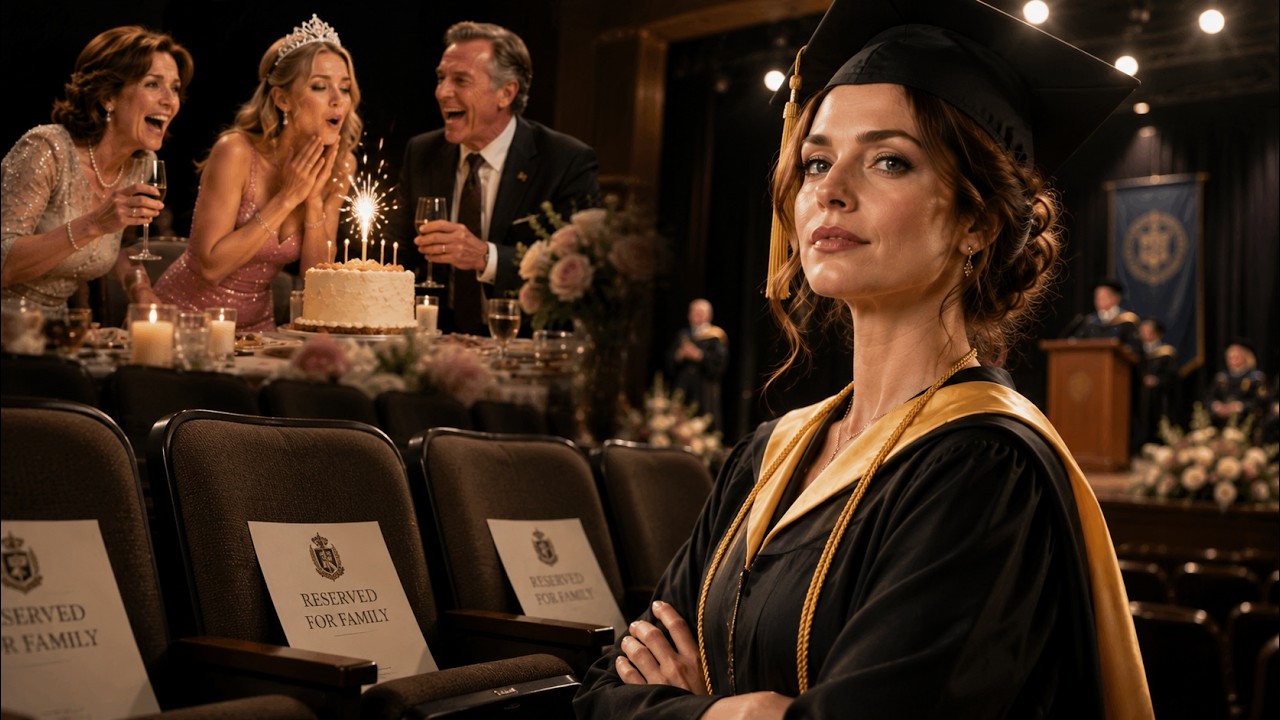
I still remember the exact sound of two empty chairs.
Not silence. Chairs make a sound even when no one sits in them—a kind of absence that hums. I was sitting on a folding metal seat in the university auditorium, gown draped over my shoulders, cap pinned crooked because my hands were shaking too much to get the bobby pin right. Behind me, two seats reserved and marked with a folded index card in my own handwriting: Reserved for the family of Clara Ellison. Both empty.
My name is Clara Ellison. I want to tell this story in order, because the order is what makes it hurt and the order is what makes the ending worth it.
I grew up in a narrow brick house in Manchester in a family of four. My father Elias ran a small accounting firm. My mother Victoria had given up a nursing career to raise us and never quite forgiven the world for the trade. My younger sister Natalie, three years behind me, and me—the older one, the sensible one, the one who was supposed to need less.
That word, sensible, became a cage before I understood what a cage was.
Natalie was born with a kind of light people noticed from across a room. She was funny without trying, pretty in the effortless way that made adults coo, and from the time she could walk she had a gift for making every person feel like the most important one in her world. My mother adored her without complication. My father adored her too, though his was quieter—a soft laugh at her jokes, a hand on her shoulder, an extra ten minutes of attention that somehow never made its way to me.
When Natalie struggled in school, my parents hired tutors, sat with her every evening, celebrated a C-plus like it was a prize. When I brought home straight A’s, my mother would glance at the report card and say, “Good. That’s what we expect from you,” and return to whatever she was doing.
I was nine when I first understood the shape of it. Natalie had a dance recital—twenty children in matching leotards shuffling through a routine no one outside the room would remember by dinner. My mother took the whole day off to help with hair and makeup. That same week I had a regional spelling bee I had practiced for since September. I came in second. My father picked me up twenty minutes late, still in his work clothes, and said, “Sorry, love. Your sister needed me to run lines.” He never asked how the bee went. I told him anyway, to the back of his head, while he checked his phone at a red light.
There were a thousand versions of that afternoon over the years. A thousand small erosions. Alone, none of them would break a person. Together they carved a canyon.
By seventeen I had built an entire personality around not needing anything from them. I got a part-time job at a bookshop so I would not have to ask for spending money. I applied to universities without telling them until the acceptance letters arrived, because I did not want to watch them care less about my future than they cared about Natalie’s homework. Children who learn that love is rationed unevenly do not stop needing it. They simply go looking for somewhere else to land. Mine landed on ambition. If I could not be loved the way Natalie was loved, I decided I would become undeniable. I would build a life so solid that no one could ever again look through me like glass.
I got into a top economics program in London on a partial scholarship. The night the letter came I ran downstairs holding it. My mother read it, smiled, said, “That’s wonderful, sweetheart,” and turned back to the kitchen table where she and Natalie were choosing fabric swatches for Natalie’s sixth-form ball gown. I stood in the doorway for a full minute. Nobody looked up again. I went to my room and did not cry. I had stopped crying about this sort of thing years before. Instead I made a quiet, cold promise in the dark: one day they will have to see me. And when they do, it will be too late for it to mean what it should have meant.
University was the first place I existed as myself and not as Natalie’s older sister or the sensible one. I graduated top of my class in my second-year exams, secured a coveted summer placement at a financial firm in Canary Wharf, and by final year I already had a graduate job offer signed. I called home every few weeks. The conversations were short, pleasant, and empty.
Then came the invitation to submit names for graduation seating. Two guest seats per graduate in the front block reserved for top-honor students. I was graduating with a first-class degree and a departmental prize. I called my mother, genuinely excited for the first time in years, and told her the date—July 14th. I told her it mattered to me. I actually said the words: “This one matters to me, Mom.” It was as close as I had come in a decade to admitting I needed anything from her. She said they would both be there.
I spent three weeks planning it in my head—small, embarrassing fantasies. My father shaking my hand outside the auditorium. My mother’s eyes actually wet for once over me. I told myself I was not hoping for too much. I was hoping for the bare minimum: two people in two chairs watching me finish what I had started entirely without their help.
Ten days before the ceremony Natalie announced she had reached the final of a regional modeling competition in Leeds—the kind of event with maybe forty entrants and no real prize beyond a development contract that rarely led anywhere. The final fell on July 14th.
I found out my parents were not coming through a text message, not even a phone call. A text sent by my mother at eleven at night, three days before:
Darling, huge conflict. Natalie’s final is the same day as your ceremony and it’s such a big opportunity for her. We really need to be there to support her. We’re so proud of you though. We’ll celebrate properly when we’re back. Love you xx
I read it four times. I sat on the edge of my bed in my shared student flat waiting for the second message that would say they had found a way to split the day. It never came. I did not call. I did not scream. Something in me had gone very still and very cold. I texted back a single line—Okay. Have fun in Leeds—and put the phone face down.
On the day itself I filled out the guest cards anyway. Reserved for the family of Clara Ellison. Some small, humiliated part of me still hoped a car would screech up outside, that my father would come jogging in halfway through apologizing. I hoped right up until the moment the dean called my name and I walked across that stage and turned to look out at the crowd and found two folded index cards on two empty chairs.
Nobody in that auditorium knew what those empty seats meant. Only I knew. A scoreboard tallied since I was nine years old at a spelling bee nobody asked about, finally read out loud in a room full of strangers.
I finished the ceremony. I smiled for photos with friends who lent me their families for an hour. On the train back that evening I opened my laptop and wrote a document I titled with dark humor: Long Game. At the time it was nothing more than a list of goals. Over the following eight years it became a plan.
I worked. I saved. I took every opportunity that came and manufactured the ones that did not. By twenty-eight I was a senior analyst at a major firm. By thirty I had left to start my own consultancy. By thirty-two the firm employed forty people and advised clients across three countries. I bought a quiet flat overlooking the river. I built friendships that felt like chosen family. I did not go home for Christmas. I did not answer every call. The distance was not dramatic. It was simply the natural result of two empty chairs.
Eight years after graduation, the phone rang on a Tuesday evening. My father’s voice was thinner than I remembered.
“Clara. We need to talk. The firm… things have gone badly. We’re in real trouble.”
The accounting practice he had run for decades was failing. Bad investments, a major client lost, mounting debts. Natalie had never developed a stable career; the modeling opportunities had faded years earlier. My mother had no independent income. They were facing the possible loss of the house.
I listened. I did not interrupt. When he finished I said, “I will help. But I will set the terms.”
There was a long silence.
“What terms?”
“You will accept the help as a business arrangement, not a rescue. A formal loan, documented, with a repayment schedule once the firm stabilizes. You will not contact me outside of scheduled updates. And you will not rewrite the past. I will not pretend those empty chairs never existed.”
He started to protest. I stopped him gently.
“I am not angry anymore, Dad. Anger requires energy I stopped giving you a long time ago. But I will not be invisible again. Not even to save you.”
They accepted. The papers were signed the following week. I transferred the funds through my firm’s legal team. I did not visit the house. I did not attend the family meetings they invited me to. I simply fulfilled the agreement I had written.
Months later my mother called once more. Her voice was quieter than I had ever heard it.
“I saw the empty chairs in every photograph from that day,” she said. “I never looked properly until now.”
I did not offer absolution. I simply said, “I know.”
The loan was repaid, on schedule, three years later. The firm survived in a smaller form. Natalie eventually found steady work in retail management. My parents remained in the house. We exchange polite cards at Christmas. That is the extent of it.
I still keep the document titled Long Game on an old hard drive. The last entry is short:
They saw me. It was too late for it to mean what it should have meant. And that was enough.
The empty chairs had done their work. So had I.