My First Love Walked Into the Hospital With Bodyguards — Seven Years After He Vanished Without a Word.
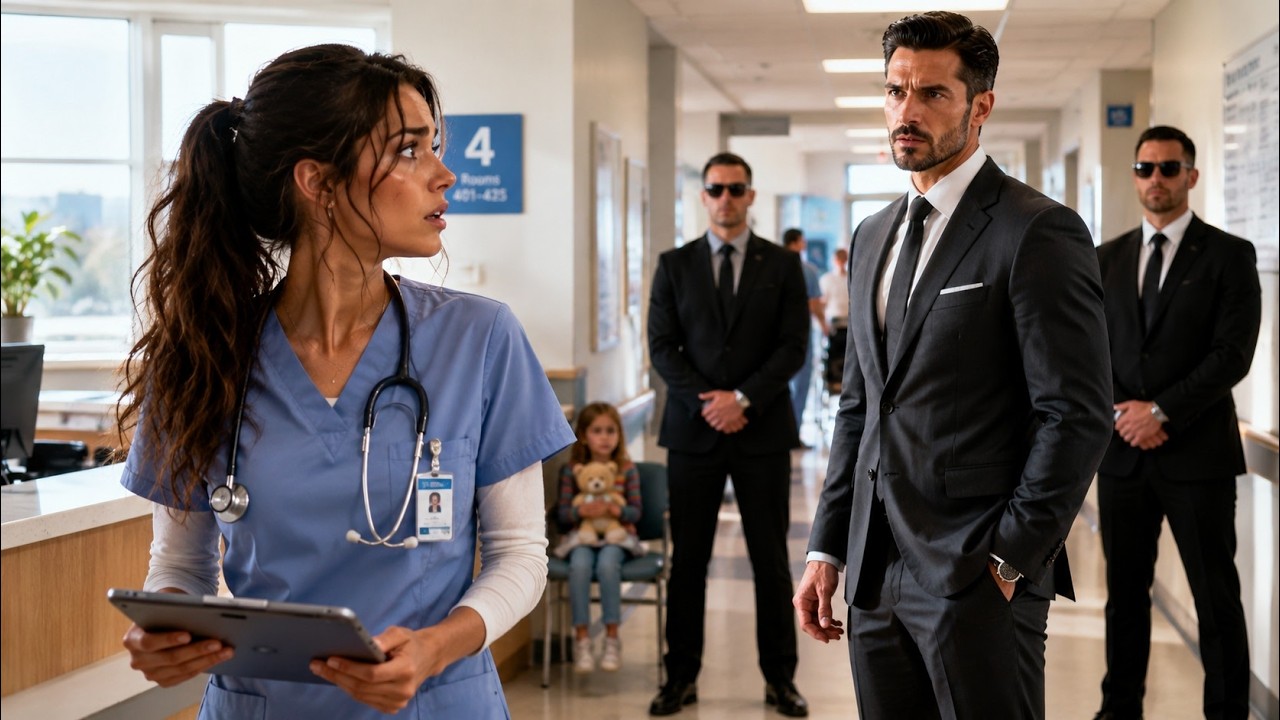
The morning I ran into him again, I was twenty-three minutes late and still had a coffee stain on my scrubs from the gas-station bathroom where I had tried and failed to fix it. The hospital corridor smelled the way it always did — antiseptic, bad cafeteria food, and something underneath that I had stopped being able to identify after the first six months.
I had Sophie’s permission slip in my jacket pocket (the one I had forgotten to sign until 11:30 the night before) and a voicemail from my landlord I still hadn’t listened to because I already knew what it said. That was my life then: permission slips and voicemails I wasn’t ready to hear.
I came around the corner near the elevators with my head down, reading the patient chart on my tablet, and walked straight into a wall of expensive cologne and a chest that did not move when I hit it.
“Sorry — I’m so sorry, I wasn’t—”
I looked up.
The world did something strange for a second. Not movie slow-motion. More like when you’re driving and you go over a hill too fast and your stomach drops before your brain catches up.
His name rose from somewhere deep before I could stop it.
He was looking at me the same way — that same strange lag, that same catch in the expression before the mask came back down.
“Lena.”
I hadn’t heard my name said like that in seven years.
His name was Julian Crowe. He had been twenty-two the last time I saw him, sitting in the parking lot of the grocery store on Fifth where we used to meet, telling me he had to go, that he couldn’t explain why, and that he was sorry. He had held my hands for a long time before he let go. I remembered that specifically — the way he hadn’t wanted to let go.
I had told myself that part hadn’t mattered. I had spent a long time telling myself a lot of things.
He was thirty now, same as me, but he didn’t look the same. He was wearing a suit that cost more than my monthly take-home. Two men in dark coats stood a half-step behind him, looking at me the way security looks at everyone: assessing, neutral, already deciding I wasn’t a threat. There was a small silver pin on his lapel — the kind that meant something to someone, just not to me.
“What are you doing here?” I asked. My voice came out steadier than I expected.
“My uncle. Room 412. He had a bypass last night.”
“I’m sorry to hear that. Are you on this floor?”
“Not usually. I cover three floors depending on the shift.” I looked back down at my tablet. Professional. Fine. I was completely fine. “I hope your uncle recovers well.”
I walked past him. I made it to the nurses’ station before my hand started shaking.
I didn’t tell anyone. Who would I have told? My coworker would have turned it into a story she brought up at every happy hour for the next three years. My mother would have said something like, “Well, Lena, you always did have terrible timing with men,” and then asked if I’d tried the new Bible study at her church. And my daughter — Sophie was six, and she didn’t know anything about the people who had existed in my life before her.
I went home at 5:15, picked Sophie up from the after-school program, made macaroni and cheese from the box because it was Tuesday, and sat at the kitchen table while she told me about a boy named Theo who had eaten part of an eraser on purpose.
“Was he okay?”
“He got to go to the nurse,” she said with unmistakable admiration.
I gave her a bath, read two chapters of her book, and sat in the hallway outside her door for a while after the light went out — something I still did sometimes when the days felt off-center. Then I sat on the couch, opened my laptop, looked at my bank account, and closed it again. The building had been sold. The new owners were raising rents. I had thirty days to decide whether I was signing a new lease at four hundred dollars more a month (which I absolutely could not do) or finding somewhere else to go.
I had been here for four years. Sophie had started kindergarten two blocks away. I knew which steps on the staircase creaked. I had a hook by the door where I kept her backpack so I never lost it. Small things. The kind of small things that make up an entire life when you look at them all together.
I fell asleep on the couch with the TV on and dreamed about the grocery-store parking lot and Julian Crowe holding my hands and not letting go.
He was there the next morning.
Not in the hallway this time — in the cafeteria at a corner table, alone. His two shadows sat at a separate table nearby. He was eating eggs and reading something on his phone. He looked up the exact moment I walked in.
I got my coffee. I considered the options. Then I walked over.
“Your uncle doing better?”
He set the phone down. “Sitting up this morning, complaining about the food. So yes.”
“That’s a good sign.”
I sat down across from him because standing over someone to have a conversation felt pointed, and I didn’t want to be pointed. I wanted to be fine.
“Can I ask you something?” I said. “What did you do… after?”
He looked at me steadily. He had always been able to do that — hold a look longer than most people. I had found it unbearable at twenty-two and I found it unbearable now.
“That’s a long answer.”
“I’m not asking for the long version.”
He was quiet for a moment. Outside the cafeteria windows a blue sky was doing its best over the parking garage across the street.
“My father,” he said finally, “was in trouble with people he shouldn’t have been in trouble with. The only way to get him out of it was to go work for them instead. The kind of work you don’t announce. The kind you don’t get to leave easily.” He paused. “I couldn’t bring you into it. I couldn’t explain it to you in a way that wouldn’t make you a liability just by knowing.”
“So you just left.”
“I thought it was for a few years. I thought I’d find a way out faster.” He looked at the table. “I didn’t.”
“Are you out now?”
Something shifted in his expression. Not quite yes. Not quite no.
“I’m working on it.”
That was when one of the men in dark coats appeared at the table’s edge, phone extended. Julian glanced at it, and something moved across his face — efficiency, control — and then he stood.
“I have to take this. Thank you for asking about my uncle.”
He walked away. The two men folded in around him, and then they were gone, and I was sitting alone at a cafeteria table with my coffee going cold.
On Thursday, Sophie got a fever. Not a bad one — 101, enough to keep her home from school but not enough to be truly frightening. I called in, which I hated doing and couldn’t really afford to do, and spent the day on the couch with her watching animated movies.
By evening she was cooler and bored and asking me to do puzzles. So we did puzzles. By eight she was asleep with her hair all tangled across the pillow the way it always was when she ran a fever.
I checked my phone.
A text from a number I didn’t have saved.
This is Julian. I got your number from the hospital directory. I shouldn’t have. I know that. But I also know that whatever I’m going to say next I’d rather not say in a cafeteria.
I stared at it for a while.
Okay, I wrote back.
Are you free Saturday?
I thought about the puzzle pieces still on the coffee table. I thought about the lease I hadn’t signed. I thought about the grocery-store parking lot.
That depends. What kind of free are you talking about?
Dinner. Somewhere quiet. I owe you an explanation longer than the one I gave you.
I put the phone down and went and stood in the kitchen for a while looking at the permission slip still stuck to the fridge with a strawberry magnet. Sophie’s handwriting was on it. She’d added a drawing of what she said was me but looked more like a potato with hair.
I took the phone back.
Saturday works.
I didn’t tell myself it was a mistake. I had gotten tired of telling myself things.
He sent a car. Not a limo — just a clean black sedan with a driver who didn’t speak. The restaurant was small, expensive, and almost empty. Julian was already there, no bodyguards visible this time, though I was certain they were somewhere nearby.
He stood when I arrived. For a moment neither of us spoke.
“You look tired,” he said finally.
“You look expensive.”
A corner of his mouth moved. “Fair.”
We ordered. We talked about safe things first — his uncle’s recovery, my shift schedule, the weather. Then the conversation turned, the way conversations with people who used to know you always eventually do.
“I never stopped looking for a way out,” he said. “It just took longer than I planned. There are still people who would rather I stay useful. Leaving isn’t as simple as walking away.”
“And now?”
“Now I’m closer than I’ve ever been. But closer still means dangerous. For anyone standing near me.”
I set my glass down carefully. “Then why are you here?”
He looked at me for a long time.
“Because seven years was long enough to pretend I didn’t still think about the girl in the parking lot who let me hold her hands until the last possible second. And because when I saw you in that hospital corridor with a coffee stain on your scrubs and a tablet full of other people’s problems, I realized I had spent seven years becoming someone I didn’t recognize, and the only person who still looked at me like I was human was you.”
The words settled between us.
I could have left it there. I almost did.
Instead I said the thing I had carried alone for six years and four months.
“Her name is Sophie. She’s six. She has your eyes. And she doesn’t know you exist.”
Julian went completely still.
The silence that followed was different from every other silence we had shared. This one had weight. This one had a child in it.
“Lena—”
“I didn’t tell you because you left. I didn’t tell you because I was nineteen and terrified and you were gone. And I didn’t tell you when I saw you again because the man who walked into my hospital had bodyguards and a pin on his lapel that meant something I didn’t understand, and I wasn’t going to put my daughter in the middle of whatever that is.”
He leaned forward. His voice was low and rough.
“Is she safe?”
“Yes. For now.”
“Does anyone else know?”
“No.”
He closed his eyes for a second. When he opened them again, the controlled man in the expensive suit was gone. In his place was the twenty-two-year-old who hadn’t wanted to let go of my hands.
“I want to meet her,” he said. “Not as the man with bodyguards. As her father. But only if you say it’s safe enough. And only if you say yes.”
I looked at him across the table — the boy I had loved, the man he had been forced to become, and the father he had never known he was.
Outside, the night was quiet. Somewhere in the city, two men in dark coats were probably watching the restaurant. Somewhere else, a little girl with his eyes was asleep with her hair tangled across the pillow.
I took a breath.
“Not yet,” I said. “But soon. And when it happens, you don’t get to disappear again. Not from her. Not from me.”
Julian Crowe — first love, vanished man, father — nodded once.
“I won’t,” he said. “Not this time.”
For the first time in seven years, I believed him.