My Fiancé Announced His Pregnancy with His First Love on Stage at Our Charity Gala—So I Dropped the Ring in His Champagne and Exposed the $300 Million Hole.
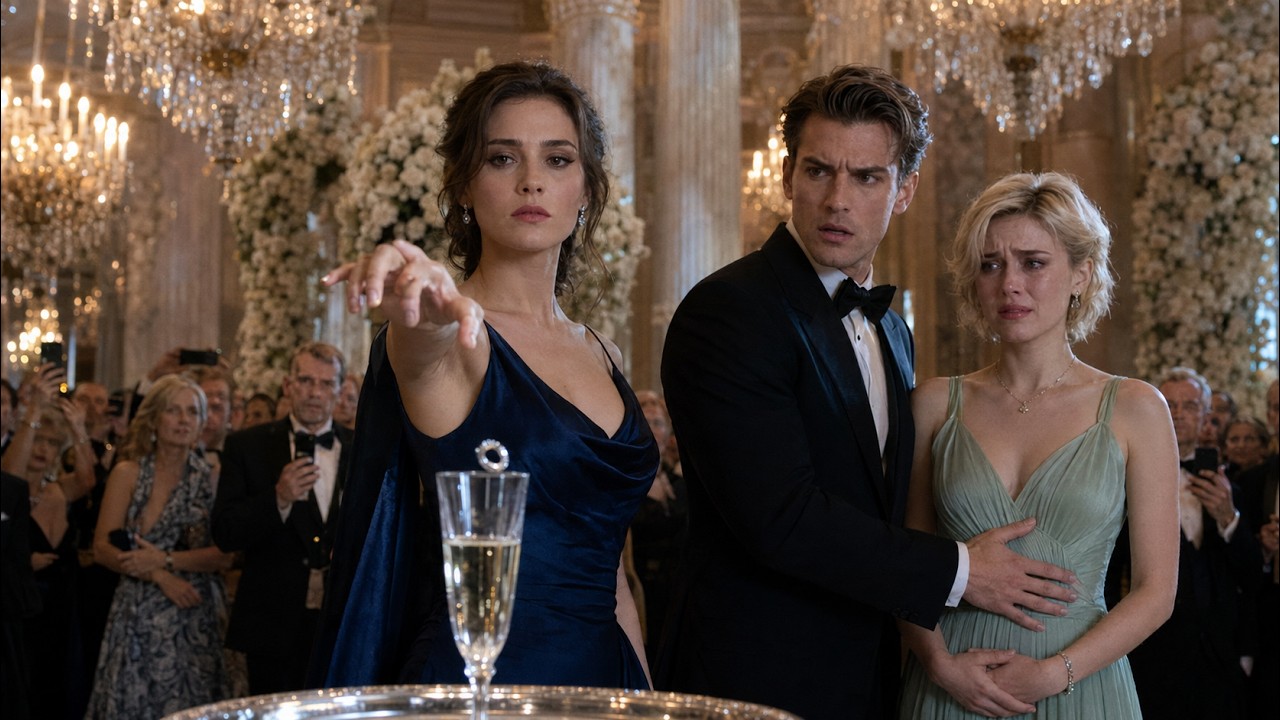
Every camera in the ballroom turned before I could breathe.
Marcus Hale lifted his glass and destroyed our engagement with a smile. Then he placed one hand on another woman’s stomach.
The room went silent in the hungry way rich rooms did. Not shocked. Interested.
Crystal chandeliers burned over the Grand Aster ballroom. Champagne waited in thin glasses. White roses climbed the marble columns. A string quartet played near the charity auction table, soft enough to make betrayal sound elegant.
I stood beside Marcus on the stage. I wore midnight blue. He wore the Hale name like armor.
We had come to announce a new pediatric wing funded by Hale Group. That was what the invitation said. That was what the press expected. That was what I had prepared for during six straight weeks of donor calls, finance reviews, and late nights with numbers that refused to make sense.
Marcus had prepared something else.
“Before we celebrate generosity,” he said into the microphone, “I need to be honest.”
His father stiffened at the head table. I turned slightly.
Marcus did not look at me.
“Elena and I have been engaged for strategic reasons,” he said. “Our families wanted stability. The board wanted confidence. But love cannot be scheduled by a board.”
A low sound moved through the crowd. I heard it before I understood it. Phones rose. Reporters leaned forward.
Marcus reached down and took Natalie Crowe’s hand. Natalie stepped from behind a hedge of white roses. She was small, blonde, and shaking in a pale green dress. Her face looked made for apology, but she did not apologize. Marcus guided her to his side.
“The woman I love is Natalie,” Marcus said. “And tonight, I am proud to say she is carrying my child.”
The flashbulbs started.
I felt the heat of them on my skin. One by one, like matches.
Marcus finally looked at me. There was triumph in his eyes, but also a warning. Do not make a scene. Do not embarrass me. Do not forget what you owe.
I lowered my gaze to the ring on my left hand. Five carats, blue-white, Hale money. It had never fit.
My mother had cried when Marcus proposed. His mother had smiled with closed lips. The board had applauded. The business pages had called it the merger of two American dynasties, though my family had no dynasty left. My father had built Voss Logistics, then lost it in a medical bankruptcy and a bad loan. The Hales had bought the pieces. I had come with the pieces.
Marcus had liked that. Useful woman. Pretty enough. Grateful enough.
He had been wrong.
I slid the diamond from my finger. The room leaned closer.
I stepped to the microphone.
Marcus’s smile thinned. “Elena,” he whispered.
I placed the ring in his empty champagne glass. It struck the crystal with a clean, hard note.
Then I smiled for the cameras.
“The company still has a three-hundred-million-dollar hole in its finances,” I said. “Good luck with the wedding.”
I walked off the stage before anyone remembered to stop me.
Behind me, the ballroom cracked open. Reporters shouted. Marcus said my name. Natalie covered her mouth. Hale Group’s chief financial officer reached for his phone and missed his pocket twice.
I did not run. I crossed the polished floor in a straight line, past senators, bankers, donors, and women who had once asked where I bought my shoes.
Outside, the winter air hit my face. It was March in New York, cold enough to make pain feel clean. My driver opened the black town-car door.
I shook my head. “I will walk.”
“Miss Voss, there are photographers.”
“There are always photographers.”
I stepped onto Fifth Avenue and kept moving. For two blocks I heard only traffic and my own pulse.
Then my phone began to shake. My mother called. Marcus called. His father called. The board secretary called. Unknown numbers called. News alerts stacked on the screen: Hale Heir Chooses Pregnant First Love Over Fiancée. Charity Gala Shock. Elena Voss Hints at Company Debt Crisis.
I stopped under the awning of a closed jewelry store and watched my reflection in the dark glass.
No ring. No tears. Just a pale line on my finger where the diamond had trapped the light.
The first call I answered came from Ruth Bell, Hale Group’s general counsel.
“Elena,” Ruth said, voice tight. “Do not talk to anyone else.”
“Too late.”
“What you said on that stage may expose you.”
“What Marcus said exposed me first.”
“This is not personal now.”
I almost laughed. “It became personal when he used a charity gala as a guillotine.”
Ruth breathed once. “Where are you walking? Come to the office.”
“No.”
“Elena, listen to me. The board is panicking. Marcus is furious. They want to contain this.”
“They should have contained the offshore losses.”
The line went quiet.
I looked up at the dark windows of the jewelry store. “You knew.”
“I read numbers for a living.”
“Do you have documents?”
“I have my work product.”
“That answer matters.”
“I know.”
I ended the call. I had learned caution the hard way.
Six months earlier I had still believed Hale Group could be fixed.
The company owned logistics yards, hotel properties, commercial real estate, and a tired chain of luxury outlets across the East Coast. It looked strong from the outside. Inside, it was hollowing out.
Supplier invoices were stretched to ninety days. Bank covenants were being massaged. A bridge loan had vanished into an entity in the Cayman Islands. Two hotel renovations had been booked as completed, though the walls were still open.
I had flagged each issue.
Marcus had smiled. “That is why I need you,” he had said.
At first I mistook dependence for trust. He brought me into meetings. He let me rebuild vendor schedules. He sent me to banks when lenders got nervous. He introduced me as his future wife and the best operator in New York.
Then I started seeing Natalie’s invoices.
Natalie Crowe Designs. Consulting. Brand Refresh. Lifestyle Activation.
The payments came from subsidiaries that had no need for furniture, fabric, or influencer parties.
I asked Marcus once. He kissed my forehead.
“Do not turn every number into a crime.”
That was when I began saving copies of my own analyses—not confidential customer files, not trade secrets, my spreadsheets, my notes, my emails asking lawful questions, my calendar records showing who approved what and when. I sent nothing outside the company.
I waited. I hoped I would not need them.
Now I did.
By midnight I was in a bar on West 46th Street, sitting at the end where the light was bad and the television was worse. The gala replayed above the bottles every fifteen minutes. My own face appeared on the screen—cool, still, unkind in the way dignity could look unkind.
A man at the bar recognized me and then pretended not to. The bartender asked if I wanted another bourbon. I said no, then yes.
The stool beside me moved.
“You made half of Manhattan forget the charity was for children.”
I turned. Julian Reed sat down without asking.
Everyone in New York finance knew his face. Forty. Calm. Dark hair cut close. Gray suit, no tie. He ran Reed Capital, a private investment firm famous for buying companies no one else wanted and making their owners regret neglecting them. He was not loud. That made him more dangerous.
I looked back at my glass. “If you came for gossip, buy a magazine.”
“I came because you were right about the three hundred million.”
My hand stopped.
Julian signaled for water, not liquor.
“You are either reckless,” he said, “or you have proof.”
“Those are not the only choices.”
“No. But they are the ones Marcus will understand.”
I studied him. He had the stillness of a man who never chased rooms because rooms eventually turned toward him. His watch was plain. His shoes were expensive but scuffed at the heel. There was a faint scar near his jaw, old and silver.
“Why do you care?” I asked.
“Because Hale Group owes two of our portfolio companies eighteen million. Also, because I tried to hire you last year.”
I remembered the email. Reed Capital had approached me after I renegotiated Hale’s supplier terms and bought the company six months of breathing room. I had declined. Marcus had called it loyalty. I had called it hope.
“I still decline,” I said.
“Good. I am not offering you a job. I am offering you leverage.”
We talked until the bar closed. I did not give him documents that night. I gave him the shape of the problem. He gave me the shape of a solution that did not require me to become the villain in anyone’s story but Marcus’s.
Over the next eleven days the evidence moved through the proper channels. Forensic accountants. Independent auditors. A carefully timed letter to the lenders who held the bridge facility. None of it was dramatic. All of it was precise.
When the board finally convened an emergency meeting, Marcus arrived prepared to call me unstable. He left without a company.
The three-hundred-million-dollar hole was real. The transfers to Natalie Crowe Designs were real. The forged completion certificates on the hotel projects were real. Marcus’s personal guarantees were real. The pregnancy announcement had been timed to distract from a quarterly review he knew he could not survive.
He lost the company. He lost the board’s protection. He lost the freedom to pretend the numbers had been someone else’s fault.
Natalie disappeared from the society pages within a week.
I did not celebrate in public. I returned to the office the board had once treated as temporary and began the slow work of reconstruction. Reed Capital took a minority position under terms that required transparency, not control. Julian never once suggested I owed him anything beyond competence.
Six months later the pediatric wing still opened—funded this time by a consortium that did not need a gala to announce its intentions. I cut the ribbon myself. The cameras were there again. This time they photographed a woman who no longer wore anyone else’s ring.
People still ask whether I planned the stage moment.
I tell them the truth.
I planned the numbers. The stage was simply the first place the numbers became impossible to ignore.
And when a man chooses to announce a new life in front of cameras, he should not be surprised when the old one answers with the same clarity.