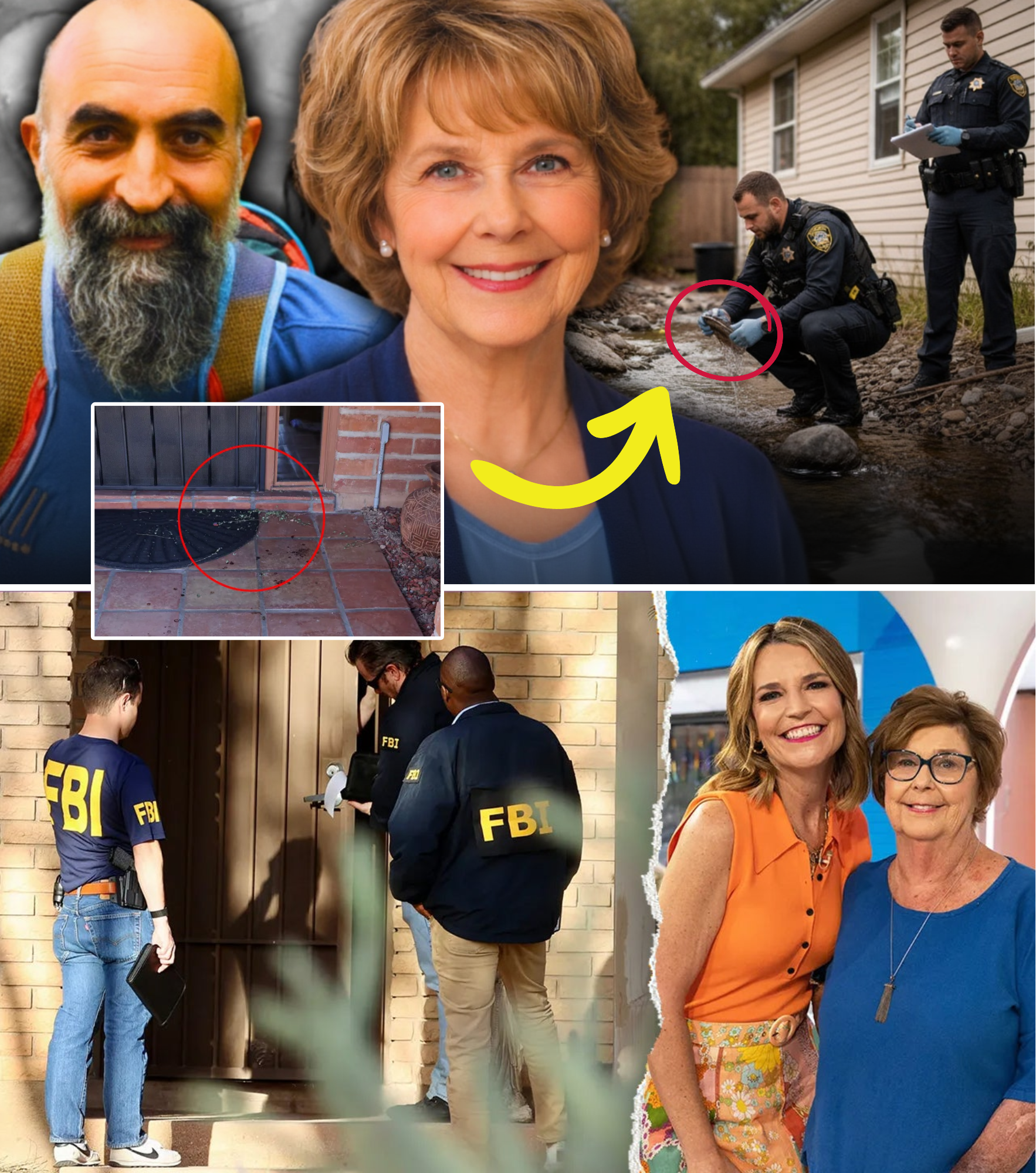
A major development has emerged in the baffling disappearance of 84-year-old Nancy Guthrie from her Tucson, Arizona home, as new clothing items were found in a dry riverbed directly behind the house of her daughter Annie Guthrie.
The discovery, made on March 28, 2026 — day 56 since Nancy was reported missing on February 1 — comes from independent searcher “Exploring with Jim,” who has been conducting systematic grid searches in the challenging Sonoran Desert terrain. Jim located several pieces of clothing, including a dark jacket and pants, in the same drainage channel where he had previously found another pair of pants.
This wash runs behind Annie’s property and offers a natural, unpaved route that lacks streetlights, surveillance cameras, or heavy foot traffic. Its rocky, uneven ground and desert vegetation make it difficult to navigate and search, yet the repeated clustering of items in one specific location has raised serious questions among online sleuths and the local community.
The finds were carefully photographed in place, documented with GPS coordinates, and immediately reported to the Pima County Sheriff’s Department (PCSD). While forensic testing — including DNA analysis, fiber matching, and dating — is still required to determine any connection to Nancy or the night of her disappearance, the proximity to Annie’s home has dramatically shifted theories about how the elderly woman could have left her property unseen.
Nancy Guthrie, mother of NBC journalist Savannah Guthrie, vanished under circumstances that remain largely unexplained. There is still no identified suspect, no confirmed crime scene inside the home, and no clear footage or witness account of her departure. The house reportedly showed some blood evidence, and FBI-released doorbell camera images captured a masked, gloved individual with a backpack tampering with the camera system on the morning Nancy went missing. Yet authorities have faced growing criticism for what some former law enforcement officials describe as a “permanently corrupted” initial crime scene and lack of transparency.
Citizen investigators like Jim have stepped into the void left by official efforts. Using nothing more than boots, a camera, and persistence, Jim has returned to the same wash multiple times, noting how flash flooding and shifting terrain can both hide and eventually reveal items. The latest cluster of clothing strengthens the idea that the wash may have served as an escape or disposal route — one that avoids detection from neighboring properties or roads.
The geography itself tells a compelling story. The wash provides a concealed pathway through the desert, potentially allowing someone to move without being captured on cameras or observed by neighbors. Multiple finds in the identical spot, according to analysts following the case, are unlikely to be pure coincidence. As one observer noted, “The geography doesn’t lie. It doesn’t have an agenda. It just holds things until someone finds them.”
Public frustration with the PCSD has intensified. A no-confidence vote against Sheriff Chris Nanos, combined with public statements from former officials including Rick Castigagar and Dr. Richard Carmona highlighting investigative shortcomings, has fueled demands for greater involvement from the FBI or state resources. Community members point out that in “no-body homicide” cases, physical evidence recovered from secondary scenes often becomes the breakthrough that solves the mystery.
Savannah Guthrie has used media appearances to urge continued pressure on law enforcement while sharing limited updates. Details such as investigators examining a bed in the home and responses to possible ransom notes have surfaced in reports, adding layers of complexity to an already puzzling case. The family continues to plead for any information that could bring Nancy home or provide closure.
The discovery in the wash has reignited online discussions, with maps, distance calculations, and terrain analysis circulating widely. Some theories suggest the items could belong to an intruder or even indicate an attempt to stage a disappearance. Others caution that without forensic confirmation, jumping to conclusions risks contaminating the narrative further. Desert conditions mean clothing can remain preserved for weeks or months, but flash floods can also move or damage evidence.
For now, the key question remains: Will the Pima County Sheriff’s Department promptly collect and test these items? Experts emphasize that rapid forensic processing is essential before any potential evidence degrades or is lost to the elements.
The Nancy Guthrie case has captivated national attention not only because of her connection to a prominent journalist but also due to the eerie lack of straightforward answers. An elderly woman seemingly vanished from her own home in broad daylight, with minimal signs of struggle or forced entry reported initially. The emergence of citizen-led searches highlights both the power of community involvement and the gaps in official responses.
As the investigation enters its third month, the newly found clothing in the wash behind Annie’s house represents the most tangible lead in weeks. If DNA or other tests link the items to Nancy or the events of February 1, the wash could transform from a remote desert feature into a documented secondary crime scene — one that might finally explain the mechanics of the disappearance.
Until those results come back, the case remains open and deeply unsettling. The desert holds its secrets tightly, but persistent searchers and growing public scrutiny may yet force the truth into the light. Families, friends, and the wider true-crime community continue to watch closely, hoping that these scattered pieces of clothing will help piece together what really happened to Nancy Guthrie.
News
Best Friend Reveals Terrifying Final Phone Call from Slain American Airlines Flight Attendant Eric Gutiérrez Molina — Pointing to Sinister Motive Behind Murder in Colombia.
In a devastating new twist in the murder investigation of 32-year-old American Airlines flight attendant Eric Fernando Gutiérrez Molina, his closest friend has come forward with shocking details from what…
Best Friend Reveals Chilling Final Phone Call from Slain American Airlines Flight Attendant Eric Gutiérrez Molina — Exposing Dark Motive Behind Murder in Colombia.
In a heartbreaking new development that has intensified the investigation into the murder of 32-year-old American Airlines flight attendant Eric Fernando Gutiérrez Molina, his best friend has come forward with…
Police Discover Bizarre Scene at Remote Body Site — Shocking Clues Emerge in Disappearance of American Airlines Flight Attendant Eric Gutiérrez Molina.
Colombian authorities have confirmed the grim discovery of a body believed to be that of 32-year-old American Airlines flight attendant Eric Fernando Gutiérrez Molina, who vanished during a layover in…
Police Uncover Bizarre Scene at Body Discovery Site — Shocking Clues in Missing American Airlines Flight Attendant Case Spark Chilling Questions.
In a grim development that has gripped both the United States and Colombia, authorities have confirmed the discovery of a body believed to be that of 32-year-old American Airlines flight…
Bridgerton Season 5 Official Trailer Unveils Time Jump, Francesca’s New Romance & Groundbreaking Same-Sex Storyline for 2026.
Bridgerton Season 5 is officially on the way, and the newly released trailer has sent the internet into a frenzy with its bold narrative choices, emotional depth, and a groundbreaking…
Maxton Hall Season 3 Trailer and First Look Set Up Emotional Final Chapter with High Stakes for Ruby and James.
Maxton Hall – The World Between Us is returning for its highly anticipated third and reportedly final season on Prime Video, and the first official trailer and leaked first-look footage…
End of content
No more pages to load