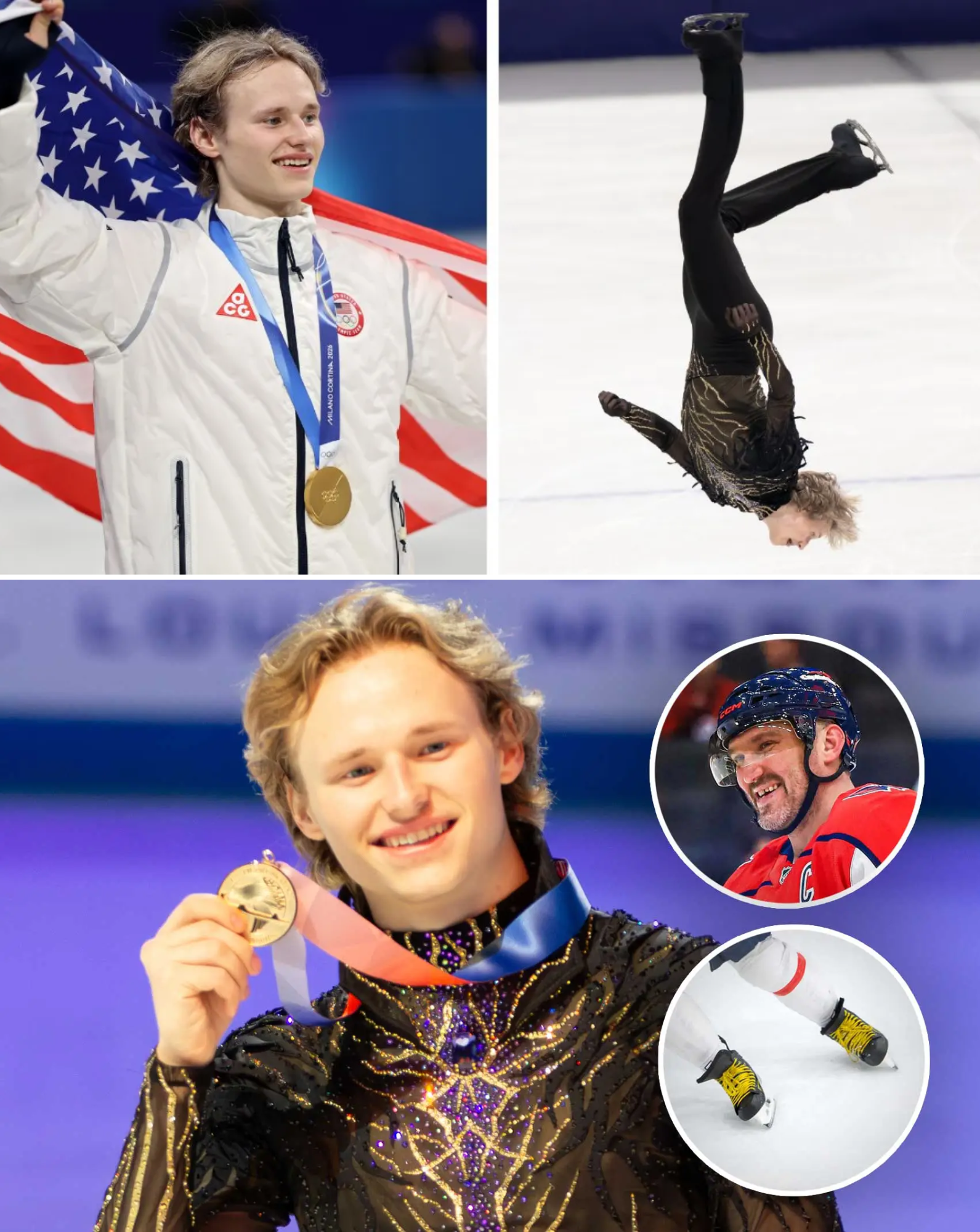
Ilia Malinin, the 21-year-old American figure skating sensation nicknamed the “Quad God,” delivered one of the most electrifying performances in Olympic history during the men’s free skate of the team event on February 8, 2026, at the Milano Ice Skating Arena in Milan-Cortina. In a program that blended technical mastery with audacious flair, Malinin executed a flawless backflip—ending a nearly half-century prohibition on the move in international competition—and helped propel Team USA to consecutive gold medals in the figure skating team discipline.
The backflip, banned by the International Skating Union (ISU) since 1976 for safety concerns, had been deemed too risky due to the potential for severe injury upon landing. The rule persisted through decades of Olympic cycles until the ISU lifted the restriction in 2024, allowing skaters to incorporate it legally. Malinin, already renowned for landing the first ratified quadruple Axel in competition in 2022, seized the opportunity to make history. He first attempted the backflip in the team short program on February 7, nailing it cleanly to close his routine and drawing massive applause despite finishing second in that segment. Undeterred, he doubled down in the free skate, landing a spectacular one-footed version mid-program that sent the crowd into a frenzy and secured the decisive points for America’s victory.
Malinin’s free skate program, set to a medley titled “A Voice,” opened with a crisp quadruple flip, one of five quads he attempted. He powered through a mid-routine stumble, opting for a triple Axel instead of pushing for his signature quad Axel under pressure. Sequences including a quad Lutz, quad toe-half loop-triple flip combination, and quad Salchow into triple Axel showcased his resilience. Yet it was the backflip—executed with perfect rotation and a dramatic one-foot landing—that stole the show. The move, performed on the front of his blade in a near-miss clean execution, elicited an absolute roar from the arena, with commentators and fans alike calling it one of the most iconic moments of the Games.
The performance proved pivotal. Entering the final men’s free skate, Team USA and Japan were tied at the top. Malinin’s strong showing, despite not topping the segment individually, provided the necessary margin for the U.S. to claim gold—marking back-to-back team titles after their 2022 triumph in Beijing. His contribution underscored the depth of American skating, alongside teammates who delivered in pairs, ice dance, and women’s events.
Malinin’s journey to this moment has been meteoric. Born in Virginia to Russian skating parents, he burst onto the scene as a teenager, becoming the first to land a quad Axel and dominating senior competitions with unprecedented technical difficulty. His nickname “Quad God” reflects his mastery of quadruple jumps, but the backflip added a layer of showmanship and historical significance. The move’s revival pays homage to past trailblazers like Surya Bonaly, who famously landed one on one foot at the 1998 Nagano Olympics—though it was prohibited then and received no points. Malinin’s legal execution has sparked discussions about crediting pioneers, particularly Black skaters like Bonaly whose innovations were once penalized.
Reactions poured in immediately. NBC commentators called it “historic” and “jaw-dropping,” while social media exploded with clips garnering millions of views. Fans praised Malinin’s courage and precision, with one viral comment noting the crowd’s “hysterical” roar. Critics and advocates highlighted the evolution of figure skating rules, crediting the ISU’s 2024 decision for allowing greater athletic expression while maintaining safety protocols.
Beyond the technical feat, Malinin’s composure under Olympic pressure solidified his status as a generational talent. At 21, he combines raw power with artistic maturity, often choosing music that blends emotion and drama. His ability to fight through imperfections—stumbles, blade-edge challenges—and still deliver show-stopping elements speaks to mental toughness honed through years of high-stakes competition.
The team gold adds to Malinin’s growing legacy. As the Games continue, expectations soar for his individual events, where he could chase more quads and potentially another backflip. For now, the February 8 performance stands as a landmark: a forbidden move reborn, a young star ascending, and a nation celebrating renewed dominance in figure skating.
Malinin’s backflip wasn’t just a jump—it was a statement. In lifting the ban, the sport embraced innovation; in landing it at the Olympics, Malinin proved that boundaries are meant to be pushed. The roar of the Milan crowd echoed a new era for figure skating, where danger meets dazzle, and one athlete’s boldness inspires the next generation to soar higher.