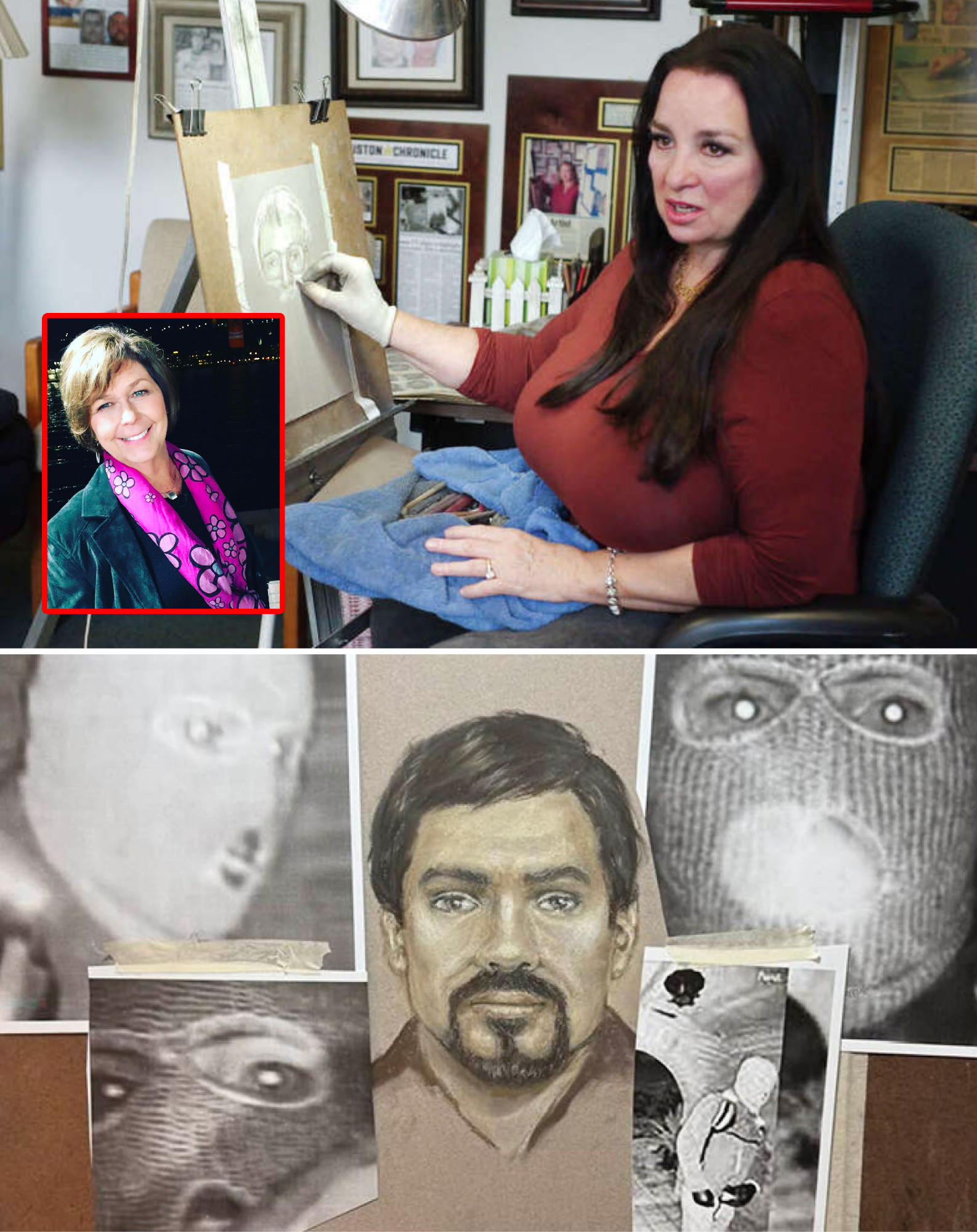
Lois Gibson, Houston’s most celebrated forensic sketch artist with a career spanning over four decades and credited with helping solve hundreds of violent crimes, has produced an unofficial but strikingly detailed facial reconstruction of the masked suspect in the abduction of 84-year-old Nancy Guthrie from her Tucson home on February 1, 2026. The portrait—created purely from public-domain doorbell camera stills released by the FBI—was unveiled on February 16 during a private consultation with family associates and has since circulated widely online, prompting intense debate and renewed calls for tips.
Gibson, renowned for her ability to translate vague witness recollections into precise likenesses that have led to arrests in cases ranging from serial assaults to homicides, was not officially commissioned by the Pima County Sheriff’s Department or the FBI. Instead, she volunteered her time after seeing the enhanced footage on national news broadcasts and feeling compelled by the case’s urgency. Nancy Guthrie, mother of TODAY co-anchor Savannah Guthrie, remains missing, dependent on daily heart medications and a pacemaker, making every visual lead potentially life-saving.
The doorbell camera captured a masked male suspect, approximately 5’9″ to 5’10” tall with an average build, wearing dark clothing and black gloves, tampering with the device at 1:47 a.m. and disconnecting Nancy’s pacemaker monitoring app at 2:28 a.m. Only the eyes and a narrow strip of skin around them were visible in the infrared footage. Gibson used her signature technique: analyzing micro-features visible in the grainy image—eye shape, lid curvature, distance between brows, subtle crow’s feet tension, and even the angle of reflected porch light on the sclera—to extrapolate the rest of the face.
The resulting sketch is stark and unsettling. It depicts a man in his late 30s to mid-40s with deep-set eyes, prominent cheekbones, a straight nose with a slight dorsal hump, thin lips, and a strong jawline that tapers toward a squared chin. Gibson noted in her accompanying notes (shared with permission by family intermediaries) that “the orbital structure and supraorbital ridge are distinctive; the eyes appear hooded but alert, with a slight asymmetry in the left lid that may indicate prior injury or natural variation.” She emphasized that the portrait is interpretive rather than forensic, but added: “In my experience, when the visible portion is this clear, the overall likeness can be remarkably accurate.”
The sketch’s release has electrified online communities following the case. Side-by-side comparisons with the original doorbell stills show eerie alignment: the eye shape, spacing, and even the way light catches the lower lid match the limited visible area perfectly. Amateur analysts zoomed in on reflections in the suspect’s eyes, speculating they might reveal porch furniture or a vehicle silhouette, though no conclusive detail has emerged. Hashtags #NancyGuthrieSketch and #UnmaskedSuspect trended within hours, with many users declaring the portrait “too accurate to be coincidence.”
Investigators have not publicly endorsed Gibson’s work. A spokesperson for the Pima County Sheriff’s Department stated: “We welcome assistance from forensic artists and experts, but all leads must be verified through official channels. Composite sketches are investigative tools, not conclusive evidence.” Privately, sources indicate detectives have quietly added the sketch to internal case files for comparison against known persons of interest, including individuals previously detained and released during the February 13 SWAT operation near East Orange Grove Road.
The portrait arrives at a critical juncture. Black gloves recovered 1.5 miles from the home yielded DNA results now under comparison, while phone records and financial documents have linked other persons of interest—including a couple whose silver Range Rover was towed—to suspicious contacts in the days prior. Multiple ransom notes demanding Bitcoin payments have surfaced but produced no verified proof of life. Nancy’s medical needs make time the most pressing factor; without medication, her survival window narrows daily.
Savannah Guthrie has not commented directly on the sketch but reposted a general appeal for tips with the caption: “Every memory, every detail, every face matters. Thank you for not giving up on my mom.” Camron Guthrie, another sibling, shared a family photo with Nancy and wrote: “We see her in every lead. Keep looking.”
Lois Gibson’s involvement carries symbolic weight. Her career highlights include sketches that helped convict the “I-45 Killer” and numerous Houston cold-case breakthroughs. She has previously stated that she only takes on cases where she feels a strong personal pull; her decision to create this portrait unprompted speaks to the national attention and emotional gravity surrounding Nancy’s disappearance.
Critics caution against over-relying on the image. Forensic art, while powerful, remains subjective and susceptible to confirmation bias. The visible eye area in the footage is small, and infrared distortion can alter perceived features. Yet supporters argue Gibson’s track record—over 80% accuracy in likeness identification in cases where suspects were later arrested—makes her interpretation worthy of serious consideration.
As the investigation enters its third week, the sketch has become a focal point for public engagement. Community groups in Tucson have printed flyers featuring the portrait alongside Nancy’s photo and the FBI tip line. Online sleuths continue dissecting every pixel of the doorbell footage, hoping to match the sketched features to public photos or social-media profiles.
Whether Lois Gibson’s chilling reconstruction ultimately leads to a breakthrough or joins the long list of tantalizing but unconfirmed leads remains unknown. For now, it stands as a haunting visual reminder: somewhere beneath the mask is a face—one that a legendary artist believes she has already seen, and one that a desperate family prays the world will soon recognize.