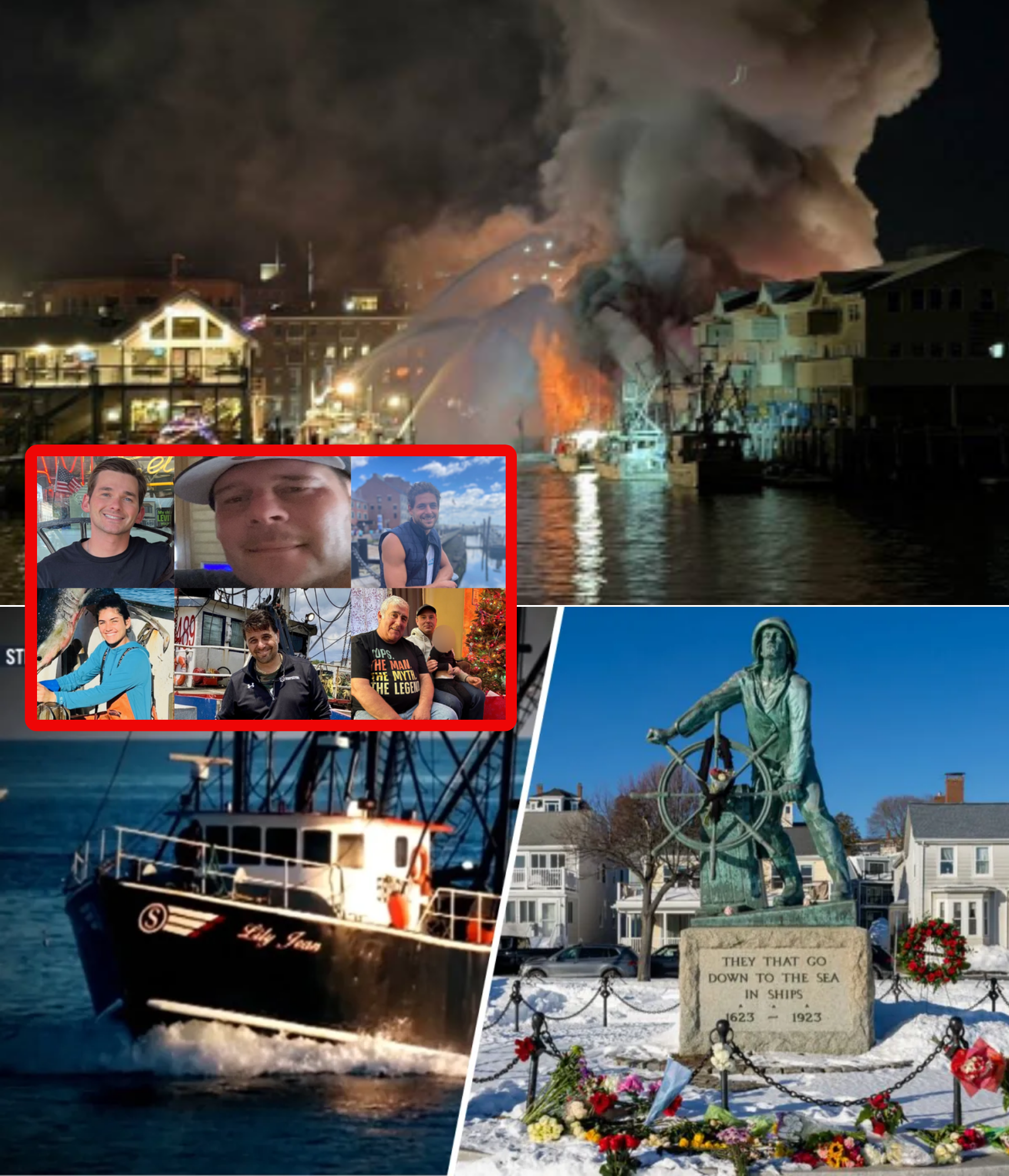
The commercial fishing vessel Lily Jean, a 72-foot workhorse out of Gloucester, Massachusetts, met a tragic end on the morning of January 30, 2026, claiming the lives of all seven people aboard. What makes this incident particularly haunting is the speed of the disaster: the boat sank so rapidly that no human-initiated distress signal was ever sent. Instead, the only alert came from the vessel’s emergency position-indicating radio beacon (EPIRB), which activates automatically upon contact with water. Authorities received the signal at approximately 6:50 a.m., but by the time Coast Guard responders reached the scene 25 miles off Cape Ann, the Lily Jean had already disappeared beneath the surface, leaving only scattered debris and one unoccupied life raft.
The absence of a Mayday call or any radio communication points to an extraordinarily sudden event. In maritime emergencies, crews typically have time to issue a distress signal if the sinking is gradual—such as from flooding or hull damage. Here, the total loss of communications and the immediate activation of the EPIRB suggest the vessel likely suffered a rapid capsize or catastrophic flooding. Possible causes include severe stability issues, perhaps from shifting cargo, ice accumulation in freezing temperatures (air and water hovering near or below 40°F), or a rogue wave striking the boat at an vulnerable angle. Fishing vessels like the Lily Jean, designed for heavy loads of groundfish, can become dangerously top-heavy if not properly managed, especially in rough winter seas off New England.
The Lily Jean was no stranger to the spotlight. The boat and its crew had appeared in a 2012 episode of the History Channel series “Nor’Easter Men,” showcasing the harsh realities of commercial fishing in the region. Captain Accursio “Gus” Sanfilippo, a respected and experienced skipper described by friends and local officials as skilled, wise, and spirited, led the vessel. He had spoken with a fellow fisherman just hours before the tragedy, with no indication of trouble. On board were crew members Paul Beals Sr. and his son Paul Beals Jr., along with John Rousanidis, Freeman Short, Sean Therrien, and 22-year-old Jada Samitt, a NOAA fisheries observer dedicated to sustainable practices. Samitt’s family released a statement praising her commitment: she saw her role not just as observation but as active participation in protecting seas and fisheries.
When the EPIRB alert reached Coast Guard watchstanders in Boston, response was swift. An MH-60 Jayhawk helicopter from Air Station Cape Cod, a small boat from Station Gloucester, and the Cutter Thunder Bay were dispatched. They located a debris field near the signal’s position, recovered one unresponsive body from the water, and found the vessel’s life raft—empty. No survivors were located despite an exhaustive 24-hour search covering more than 1,000 square miles. The operation was suspended on January 31, with officials citing the extreme cold, time elapsed, and lack of additional signs of life.
Rear Adm. Michael Platt, commander of the Coast Guard’s Northeast District, immediately launched a formal district-level investigation, assisted by the National Transportation Safety Board (NTSB). Such probes aim to uncover facts, identify safety improvements, and prevent future incidents rather than assign blame. Early reports noted no obvious clues at the scene, but investigators will examine factors like weather conditions, vessel maintenance records, stability calculations, and potential mechanical failures. The Lily Jean was returning from a fishing trip, possibly loaded, which could have contributed to instability if not balanced properly.
This tragedy reverberated through Gloucester, a tight-knit fishing community where such losses strike at the heart. State Sen. Bruce Tarr, who grew up with Captain Sanfilippo, expressed disbelief: “This was a good vessel, this was a good skipper… It makes it really hard to fathom when you lose a boat 22 miles from shore under those circumstances.” Residents gathered at the city’s fishermen’s statue to mourn, and the broader fishing fleet honored the lost by lighting up the harbor in a poignant tribute.
The incident underscores persistent risks in commercial fishing—one of the world’s most dangerous professions. Rapid sinkings without warning have occurred before, often due to downflooding through open hatches, free surface effect from liquid in holds, or sudden weather shifts. In cold waters, survival time drops dramatically; even with immersion suits, hypothermia sets in quickly. The unoccupied life raft suggests crew had no opportunity to deploy or board it, reinforcing the suddenness.
As the investigation continues over months, the focus will likely turn to broader lessons: enhanced stability training, mandatory EPIRB registration and testing, improved weather monitoring for small vessels, and perhaps new technologies like real-time stability alerts. For now, the story of the Lily Jean serves as a somber reminder of the ocean’s unforgiving power and the bravery of those who work its waters daily to bring seafood to tables.
The seven lives lost—Gus Sanfilippo, Paul Beals Sr., Paul Beals Jr., John Rousanidis, Freeman Short, Sean Therrien, and Jada Samitt—will be remembered not just for how they died, but for how they lived: dedicated, resilient, and tied to the sea.
News
The Black Bag in the Ravine: Chilling Discovery in the Death of American Airlines Flight Attendant Eric Gutierrez.
The tragic case of 32-year-old American Airlines flight attendant Eric Fernando Gutierrez Molina took an even darker turn as investigators in Colombia recovered a black bag linked to the missing…
The Secret Weekend Pattern: How the FBI’s Latest Breakthrough May Finally Trap Nancy Guthrie’s Abductor.
As March 2026 draws to a close, the disappearance of 84-year-old Nancy Guthrie from her home in Tucson’s Catalina Foothills has entered its 55th day with no arrest and no…
The Insider Who May Have Opened the Door: FBI Hunts for the Person Who Knew Nancy Guthrie’s Home Too Well.
In the affluent Catalina Foothills neighborhood of Tucson, Arizona, where residents often leave garage doors open and security feels routine, the abduction of 84-year-old Nancy Guthrie on the night of…
The Vacant House Perch: SWAT Commander Reveals How the Kidnapper Likely Staged Nancy Guthrie’s Abduction.
In the upscale Catalina Foothills of Tucson, Arizona, where million-dollar homes boast layered security and residents pride themselves on knowing every face and vehicle, the disappearance of 84-year-old Nancy Guthrie…
The Empty House Next Door: Chilling Clues FBI Uncovered in Nancy Guthrie’s Kidnapping.
In the exclusive Catalina Foothills neighborhood of Tucson, Arizona, where seven-figure mansions sit behind layered security gates and vigilant residents know every vehicle and routine, an unthinkable crime shattered the…
The Hidden Daughter Who Inherited the Entire Guthrie Ranch – The Will No One Saw Coming.
In the rugged hills near Billings, Montana, the Guthrie family ranch stood as a symbol of American grit for decades. What began as a modest 30-acre lease in the 1940s…
End of content
No more pages to load