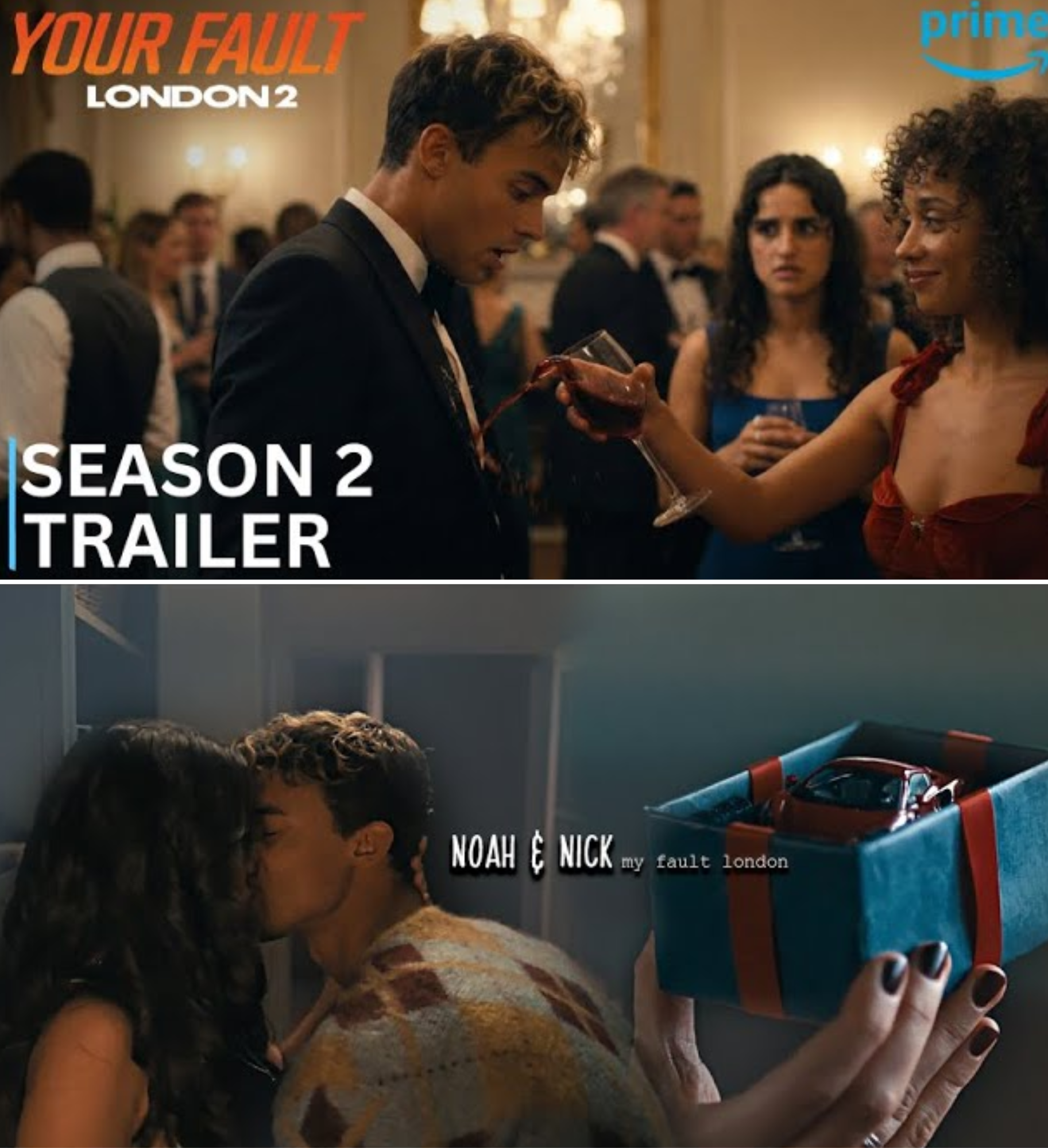
Prime Video has unveiled the official trailer for Your Fault: London, the highly anticipated 2026 continuation of the steamy, turbulent romance franchise adapted from Mercedes Ron’s bestselling Culpables series. Clocking in at just over two minutes, the teaser wastes no time plunging viewers into a darker, more claustrophobic evolution of Noah and Nick’s relationship. What began as forbidden passion in the original Spanish Culpa Mía and its sequels now relocates to the bustling, rain-slicked streets of London, where university life promises independence but delivers surveillance instead.
The trailer opens on Noah stepping off a train at King’s Cross, backpack slung over one shoulder, eyes bright with cautious optimism. She’s starting fresh—new city, new campus, new chances to define herself beyond the chaos of her past with Nick. The voiceover, delivered in a low, intimate whisper that feels too close, sets the tone: “Love doesn’t get scary all at once. It gets tight first.” Cut to quick, disorienting flashes: Nick’s hand on her wrist a little too firmly during a late-night walk, his phone lighting up with her location shared “just in case,” unannounced appearances at her dorm with coffee she never asked for. Each gesture starts sweet, then sours under scrutiny.
Nick’s character arc takes center stage in this installment. Previously portrayed as the brooding, protective stepbrother whose intensity was part of the allure, he now embodies a more insidious possessiveness. The trailer shows him scrolling through Noah’s social media in the dark, jaw clenched at a photo of her laughing with classmates. “I’m just worried about you,” he says in one scene, voice soft but eyes hard. Noah’s response—hesitant smile fading—signals the shift: she’s beginning to recognize the pattern. The most chilling line lands midway: “The most dangerous relationships aren’t loud. They’re the ones that convince you control is care.” It’s delivered over a montage of increasingly invasive moments—Nick “accidentally” bumping into her study group, questioning her late nights, deciding what parties are “safe” for her.
The London setting amplifies the tension. Gone are the sun-drenched Spanish villas and luxury cars of earlier films; here, the city feels alive yet isolating. Narrow streets, crowded pubs, foggy Thames walks—all become backdrops for private battles. One standout sequence unfolds at a university party: strobe lights pulse, bass thumps, bodies press close. Noah dances freely for the first time in the series, uninhibited. Across the room, Nick watches—not with anger, but with a quiet, calculating stillness. The camera lingers on his face as jealousy flickers, then hardens. “Jealousy has a witness,” the title card declares, implying that every toxic moment now has an audience—friends noticing, Noah herself finally seeing.
Noah’s growth forms the emotional core. Anna Cathcart’s performance conveys a young woman reclaiming agency. She confronts Nick in a rain-soaked alley: “I’m not yours to protect anymore.” His reply—“You’ll always be mine to worry about”—lands like a threat wrapped in devotion. The trailer hints at her pushing boundaries: applying for a semester abroad, forming new friendships that don’t include him, even flirting lightly with someone else in a library scene. These acts of independence provoke Nick’s spiral, turning his protectiveness into outright control.
The supporting cast adds depth to the relational web. Friends who once cheered the romance now express concern. One roommate pulls Noah aside: “He’s always there. Even when he’s not.” Family dynamics, complicated by the step-sibling history, resurface through tense phone calls and surprise visits. The trailer teases a potential ally in a new character—a confident, no-nonsense professor or mentor—who encourages Noah to prioritize her own voice.
Visually, the trailer marks a tonal departure. Cinematography leans into cooler tones—steel grays, muted blues, harsh fluorescents in dorms and lecture halls. Lighting often traps characters in shadows or half-light, symbolizing obscured truths. The score blends pulsing electronic beats with haunting strings, building unease rather than swoon-worthy romance. Quick cuts and disorienting angles during confrontations mimic the psychological fog of gaslighting.
Fan anticipation runs high following the massive success of the original trilogy. The Spanish films amassed hundreds of millions of views on Prime Video, spawning a global fandom drawn to the high-stakes, forbidden-love trope. This London iteration aims to mature the narrative, moving beyond escapist fantasy into a more grounded examination of red flags. Showrunners have emphasized in interviews that the story explores how healthy devotion can morph into danger when boundaries erode. It refuses to romanticize toxicity, instead forcing viewers to question their own comfort with certain behaviors.
Social media buzz exploded immediately after the drop. Hashtags like #YourFaultLondon, #NoahBreakFree, and #NickRedFlags trended within hours. TikTok duets overlay the trailer’s dialogue on real-life relationship advice videos, while Twitter threads dissect every micro-expression. Some fans defend Nick’s actions as “intense love,” others call for Noah to run. The divide mirrors broader cultural conversations about possessiveness versus passion.
The trailer ends on a gut-punch cliffhanger: Noah alone in her room, staring at her phone as Nick’s text appears—“Where are you?”—followed by the sound of a key turning in the lock. She freezes. The screen fades to black with the tagline: “Some betrayals don’t need words.” It promises a season that challenges viewers to decide whether love can survive when trust becomes surveillance.
Your Fault: London positions itself as more than another romance sequel. By relocating the story and deepening the psychological stakes, it invites audiences to confront uncomfortable realities. Passion is intoxicating, but control disguised as care can be lethal. As Noah stands at the threshold of self-discovery, the question lingers: will she stay in the cage, or finally walk out?
News
“It’s All Because She Changed Her Will”: Savannah Guthrie’s Emotional Confession Shakes Up the Nancy Guthrie Disappearance Case.
The disappearance of Nancy Guthrie has gripped the public since January 31, 2026, when the 68-year-old retired public affairs worker from the University of Arizona vanished from her home in…
Ordinary Dad Turns Hero: One Father’s Instinct Saved Lives After Deadly Tennessee School Bus Crash.
On a Friday afternoon that started with excitement and laughter, a routine field trip for Kenwood Middle School students in Clarksville, Tennessee, turned into a scene of devastation that no…
Two Empty Seats at Kenwood Middle School as Students Return After Fatal Bus Crash – Sisters Hold Solidarity Sign.
Two empty seats will greet students and staff at Kenwood Middle School in Clarksville, Tennessee, when classes resume on Monday morning following the devastating school bus crash on Friday, March…
Kenwood Bus Dashcam Footage Raises Unanswered Question: Why the Slow Drift Across Highway 70 With No Braking?
A quiet morning field trip turned into tragedy on March 27, 2026, when a Montgomery County Schools bus from Kenwood Middle School in Clarksville, Tennessee, collided head-on with a Tennessee…
Possible Shoe Print in Blood? 3 Shocking Expert Theories on Nancy Guthrie Porch Evidence – Day 62 Update.
The disappearance of 84-year-old Nancy Guthrie has gripped the nation for 62 days, with her daughter, NBC News anchor Savannah Guthrie, publicly pleading for answers while the investigation continues to…
Outlander Season 8 Episode 4 Sneak Peek: Claire’s Resurrection Power Changes Everything as War Looms.
Outlander Season 8 continues to deliver the high-stakes drama, time-travel romance, and historical intensity that has defined the series since its beginning. With Episode 3 still fresh in fans’ minds,…
End of content
No more pages to load