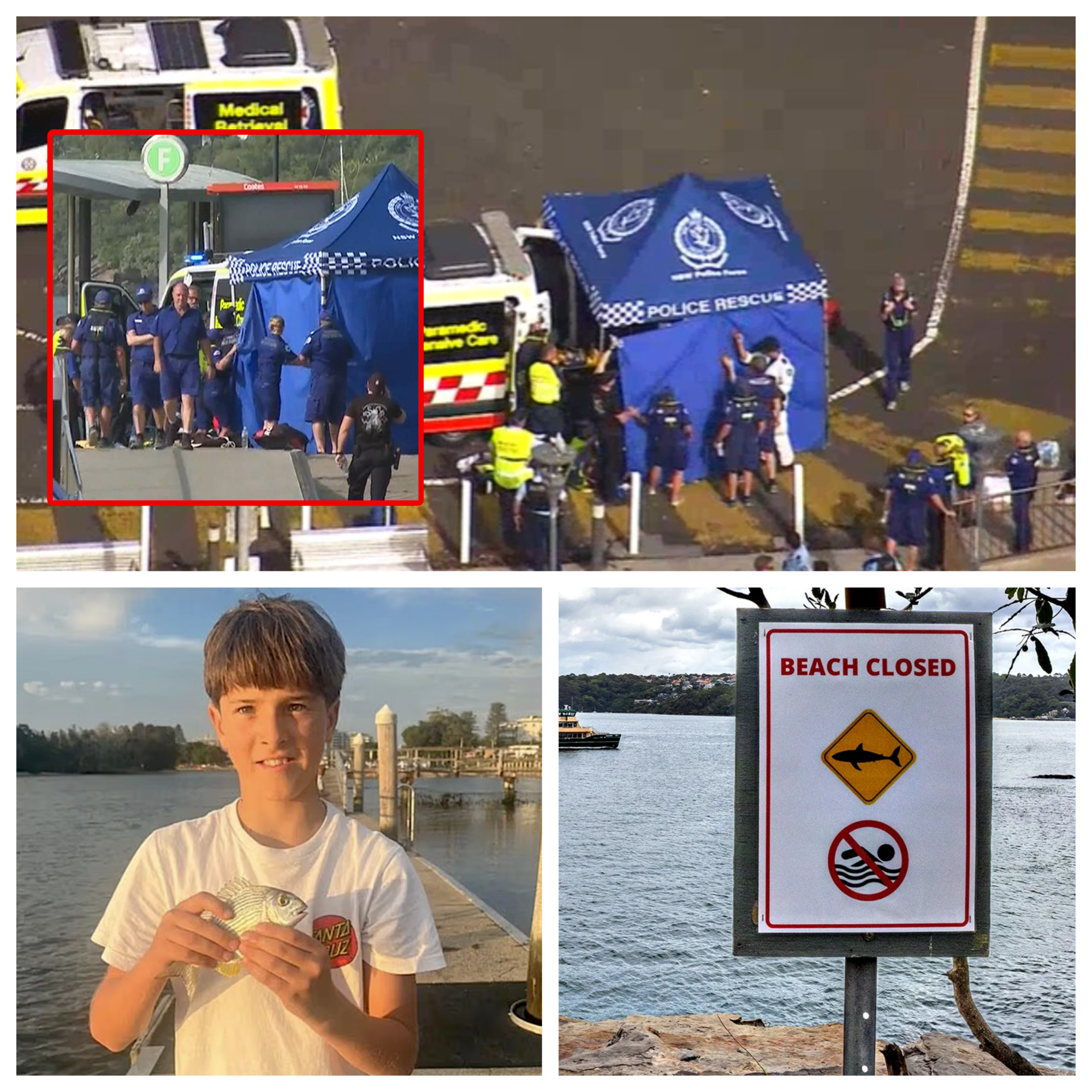
A 12-year-old boy named Nico de Bruyn has become the latest tragic victim of a shark attack in Sydney Harbour, dying from catastrophic injuries after being bitten while swimming near a popular jetty on the afternoon of January 19, 2026. The attack, witnessed by several bystanders and captured partially on mobile phones, has sent shockwaves through the local community and reignited fierce debate over shark management in one of Australia’s most iconic and heavily used waterways.
Nico, a Year 7 student at a prestigious Sydney private school and a promising junior surfer and swimmer in the Manly Warringah district, had been enjoying the summer holidays with friends and family at a sheltered cove near the Balmoral area. Witnesses said the water was calm and clear—typical conditions that usually feel safe for families. Around 3:40 p.m., Nico was swimming approximately 30 meters from the jetty when a large shark—believed to be a bull shark measuring between 2.5 and 3 meters—struck without warning. The force of the initial bite knocked him underwater; he resurfaced briefly screaming before being pulled down again. Friends and nearby adults rushed to his aid, dragging him to the jetty steps where CPR was immediately performed by off-duty paramedics who happened to be present.
Despite heroic efforts by bystanders and emergency services, Nico suffered massive blood loss and traumatic injuries to his torso and legs. He was airlifted to Sydney Children’s Hospital in critical condition but was pronounced deceased shortly after arrival. A family member who was present at the scene later spoke to reporters outside the hospital in a voice barely above a whisper: “He’s just asleep… but he will never wake up.” The words, raw and unfiltered, have since circulated widely online, encapsulating the unbearable grief of a family that lost a child in an instant.
Nico was remembered by schoolmates, coaches, and neighbors as an exceptionally bright and kind boy. His swim coach described him as “a natural in the water—fearless but always respectful of the ocean.” He had recently won a regional junior surf lifesaving competition and was preparing for state-level trials. Teachers noted his infectious smile and his habit of helping younger students during training sessions. “Nico was the kid who made everyone feel included,” one classmate posted online. “He was always cracking jokes, always lifting people up. Now the whole school feels empty.”
The attack has stunned Sydney, a city long accustomed to sharing its harbour with marine life but rarely confronted with such a high-profile fatality in sheltered waters. Bull sharks are known to enter the harbour via the Parramatta River system, especially during summer when water temperatures rise and baitfish congregate. Marine experts note that juvenile and sub-adult bull sharks often use the harbour as a nursery area, feeding on schools of mullet and bream. While fatal attacks remain extremely rare—only the fourth in Sydney Harbour in the past 100 years—the incident has prompted immediate calls for action.
NSW Police and the Department of Primary Industries (DPI) deployed drumlines and shark nets at nearby beaches within hours. A targeted shark catch-and-kill operation was authorized under the state’s shark management policy, resulting in the capture and euthanasia of two large bull sharks in the vicinity over the following 48 hours. Drone surveillance and acoustic tagging programs have been expanded, but critics argue these measures are reactive rather than preventive.
Animal welfare groups and marine biologists have voiced opposition to lethal culling, arguing that bull sharks are simply occupying natural habitat and that education, better signage, and temporary area closures during high-risk periods would be more effective and humane. Surfers and ocean users are divided: some demand permanent nets across harbour entrances, while others insist that living alongside sharks is part of Australia’s coastal identity and that overreaction risks demonizing an apex predator essential to ecosystem balance.
Nico’s family has asked for privacy as they grieve, but they released a short statement through a family friend: “Nico was a talented young athlete who was always making people smile. He loved the water more than anything. We are heartbroken beyond words and ask that people respect our need for space while we try to understand this unimaginable loss.” A memorial service is planned for early February at his school, where classmates have created a tribute wall covered in drawings, surfboard stickers, and messages of love.
The tragedy has also reignited political debate. State Opposition Leader Mark Speakman called for an urgent review of shark hazard management, while Premier Chris Minns defended current strategies as “evidence-based” and promised additional funding for research and beach safety patrols. Surf Life Saving Australia issued a reminder that the risk of shark attack remains statistically lower than many other everyday activities, yet urged swimmers to avoid areas near river mouths and to swim in groups.
For the de Bruyn family, statistics offer no comfort. A boy who dreamed of competing at national level, who laughed easily and loved fiercely, was taken in seconds. His story joins a short but devastating list of fatal shark encounters in Sydney’s urban waters—reminders that even in the heart of a major city, nature can be sudden and unforgiving.
As vigils are held along Balmoral Beach and flowers pile up at the jetty, Nico’s smile lives on in photographs shared by friends and teammates. His family clings to memories of a child who found joy in the very element that claimed him. The harbour continues to shimmer under summer sun, but for those who loved Nico, the water will never feel the same again.