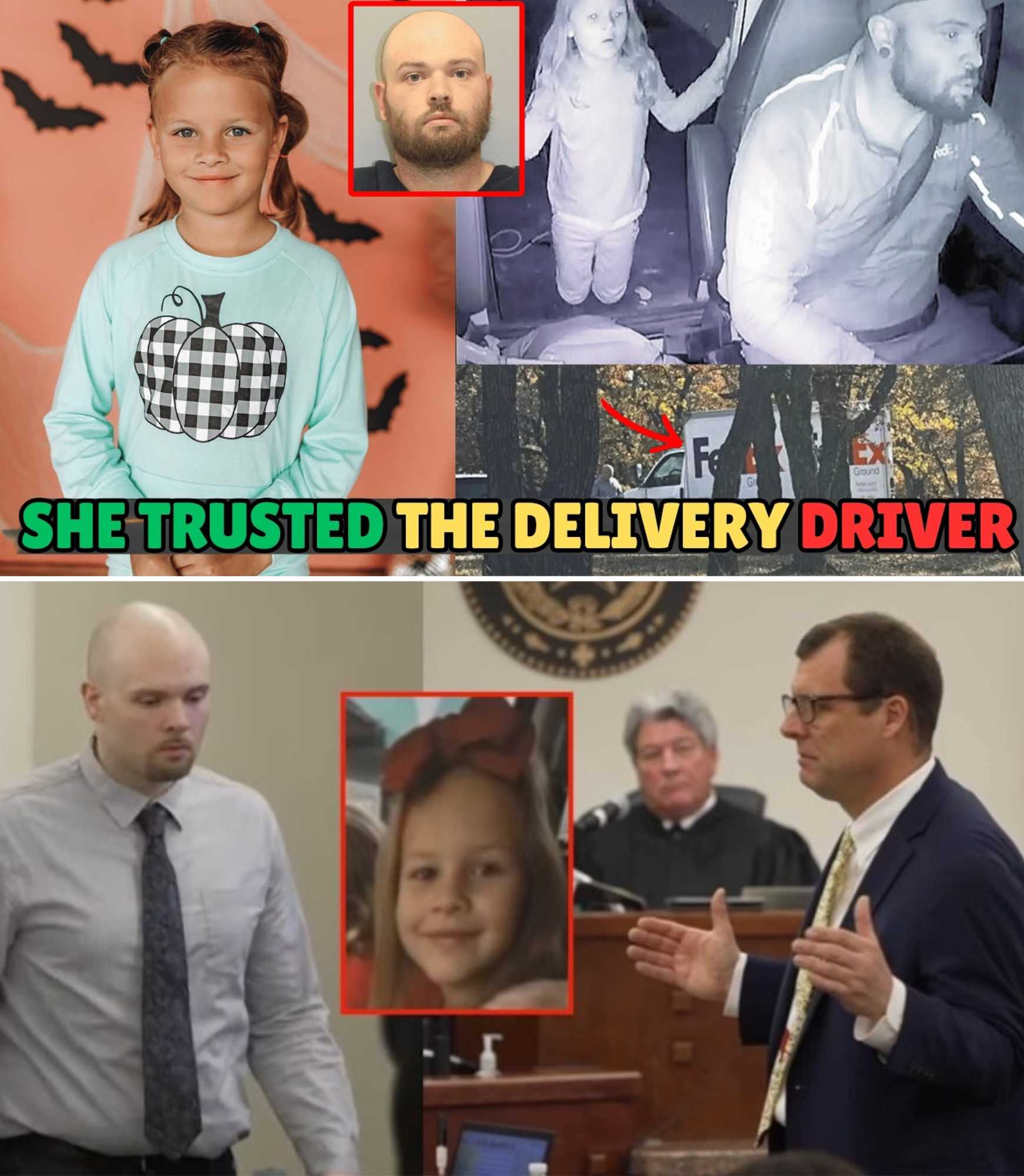
On November 30, 2022, in the quiet small town of Paradise, Texas, 7-year-old Athena Strand was doing what any typical little girl might do on a crisp fall afternoon — playing outside her family home while her stepmother cooked inside. Her father was away on a hunting trip, leaving the house peaceful and routine. No one could have imagined that a routine FedEx delivery would shatter that peace forever.
Athena was described by her teacher as a “free spirit” who loved drawing, writing, coloring, dressing up, and showing up to school with stickers on her hands. She was the kind of child who lit up every room — a “true gem” full of life and curiosity. That day, her stepmother had ordered a special Christmas gift: a Barbie “You Can Be Anything” doll set. The package arrived via contract FedEx driver Tanner Her, a 34-year-old man making deliveries on the same road.
What happened next unfolded in a nightmare that would consume the community for 72 hours and eventually lead to a capital murder trial filled with shocking evidence and emotional testimony.
According to prosecutors, Tanner Her had scoped out the area the day before, passing Athena’s house and making another delivery nearby — a detail they argued showed premeditation rather than coincidence. On the day of the disappearance, Her pulled up to deliver the Barbie set. Athena, being the outgoing child she was, opened the door or approached the truck. What should have been a quick handoff turned deadly.
Her initially told investigators a story of accident: he claimed he accidentally struck the little girl while backing out of the driveway, panicked that she might tell her father, placed her in the FedEx truck, and then strangled her because he “couldn’t think of another way out.” That narrative quickly crumbled under the weight of cold, hard evidence.
A photo captured by the truck’s internal camera system showed Athena standing upright, alert, and completely uninjured in the back of the vehicle. Prosecutors pointed out that Her had threatened her with the chilling words: “Don’t scream or I’ll hurt you.” Audio evidence later revealed banging and screaming from inside the truck, with Athena fighting back against a man more than three times her size. Prosecutors described the tiny girl as a “warrior” who fought with the strength of “100 men.”
An Amber Alert was issued almost immediately, triggering a massive community search involving law enforcement and hundreds of volunteers. For 72 agonizing hours, the town held its breath. Athena’s body was eventually found two days later in Boyd, Texas, roughly seven miles from her home. She had been strangled and dumped in a field. The Barbie dolls remained part of the delivery process, a heartbreaking symbol of the innocence stolen that day.
The courtroom phase brought even more devastating details. Her’s defense attempted to paint a picture of panic and poor impulse control, presenting 19 experts who cited his autism diagnosis, childhood exposure to toxic lead levels (reportedly 24 times the normal limit), and mental health history to argue for life without parole instead of the death penalty. Prosecutors, however, dismantled his story as “lie upon lie upon lie,” emphasizing that the only truthful part was his admission that he killed her. They highlighted his lack of remorse and the deliberate choices he made after the initial encounter.
In a surprise courtroom moment, Her pleaded guilty to capital murder and aggravated kidnapping before full testimony could begin. The case moved directly to the sentencing phase, where the jury deliberated between death and life in prison. At the time of reporting, that decision was still pending.
Athena’s mother, Maitland Gandhi, spoke powerfully in interviews and victim impact statements. She expressed that if the incident had truly been a tragic accident, the family might have found a way to forgive. But the choice to kill instead of seeking help was unforgivable. “He is nothing,” she said of Her, “but Athena is absolutely everything.” At the funeral, she closed her daughter’s casket herself, kissing Athena and whispering an apology for not being able to protect her.
The case also sparked a civil lawsuit filed by Athena’s father against FedEx, alleging the company failed to properly vet and supervise contract drivers like Her. Additional unconfirmed allegations surfaced online claiming prior sexual assault by Her, though no charges were filed in those matters.
Athena Strand’s story is a painful reminder of how quickly innocence can be taken and how one seemingly ordinary delivery turned into an unimaginable tragedy. The small-town community of Paradise rallied together in grief and search efforts, but the loss left a permanent scar. Prosecutors urged the jury to remember Athena’s fight and the terror she endured in those final moments.
As the sentencing deliberations continue, the focus remains on justice for a little girl who simply opened the door for a package that should have brought joy, not horror. Her love of stickers, drawings, and dress-up lives on in the memories of everyone who knew her, while the legal system now decides the ultimate punishment for the man who took her away.
This case highlights broader questions about delivery driver screening, community safety, and the devastating ripple effects of violent crime on families and small towns. Athena’s warrior spirit and the strength she showed in her final moments have become a rallying cry for those demanding accountability.
In the end, no verdict can bring Athena back, but her story ensures she will never be forgotten. The Barbie that never made it under the Christmas tree remains a symbol of everything that was stolen that November day in Paradise, Texas.
News
“She Still Writes to Her Every Year”: Athena Strand’s Little Sister’s Heartbreaking Ritual Since FedEx Driver Murdered Her Big Sister.
The abduction and murder of 7-year-old Athena Strand in November 2022 shocked the nation, leaving a family forever changed and a community demanding justice. What has emerged in the years…
Parents Break Silence After Family Pit Bull Kills 7-Month-Old Elizah Turner.
On the morning of April 9, 2025, in a home on the 3700 block of South Champion Avenue in south Columbus, Ohio, a routine day turned into every parent’s worst…
SWAT Storms Annie Guthrie’s Backyard: Why Hostage Rescue Teams Won’t Leave in the Nancy Guthrie Investigation.
Armored vehicles rolled up. Tactical officers in full gear surrounded the property. Hours passed, and law enforcement showed no signs of leaving. In a dramatic new development in the disappearance…
Desert Drop Shocks Investigators: Brian Entin’s Chilling Find in Nancy Guthrie Case Points to Calculated Abduction.
In the vast, unforgiving Sonoran Desert near Tucson, Arizona, a single discovery has sent ripples through the ongoing investigation into the disappearance of 84-year-old Nancy Guthrie. Journalist Brian Entin, who…
FBI Makes Second Arrest in Nancy Guthrie Kidnapping: Tunnel Discovery and DNA Evidence Point to Coordinated Plot.
Federal agents executed a high-profile SWAT operation on April 10, 2026, detaining a second suspect in the disappearance of Nancy Guthrie — a convicted felon whose residence placed him in…
After the Verdict: How Ginny & Georgia Season 4 Turns Acquittal Into a New Kind of Hell for the Miller Family.
The courtroom doors swing shut. Georgia Miller walks free after being acquitted for the murder of Tom Fuller, but freedom has never felt more dangerous. Netflix’s addictive mother-daughter drama Ginny…
End of content
No more pages to load