Ejected and Alive: The Flight Attendant’s Miraculous Survival in LaGuardia’s Deadly Runway Collision.
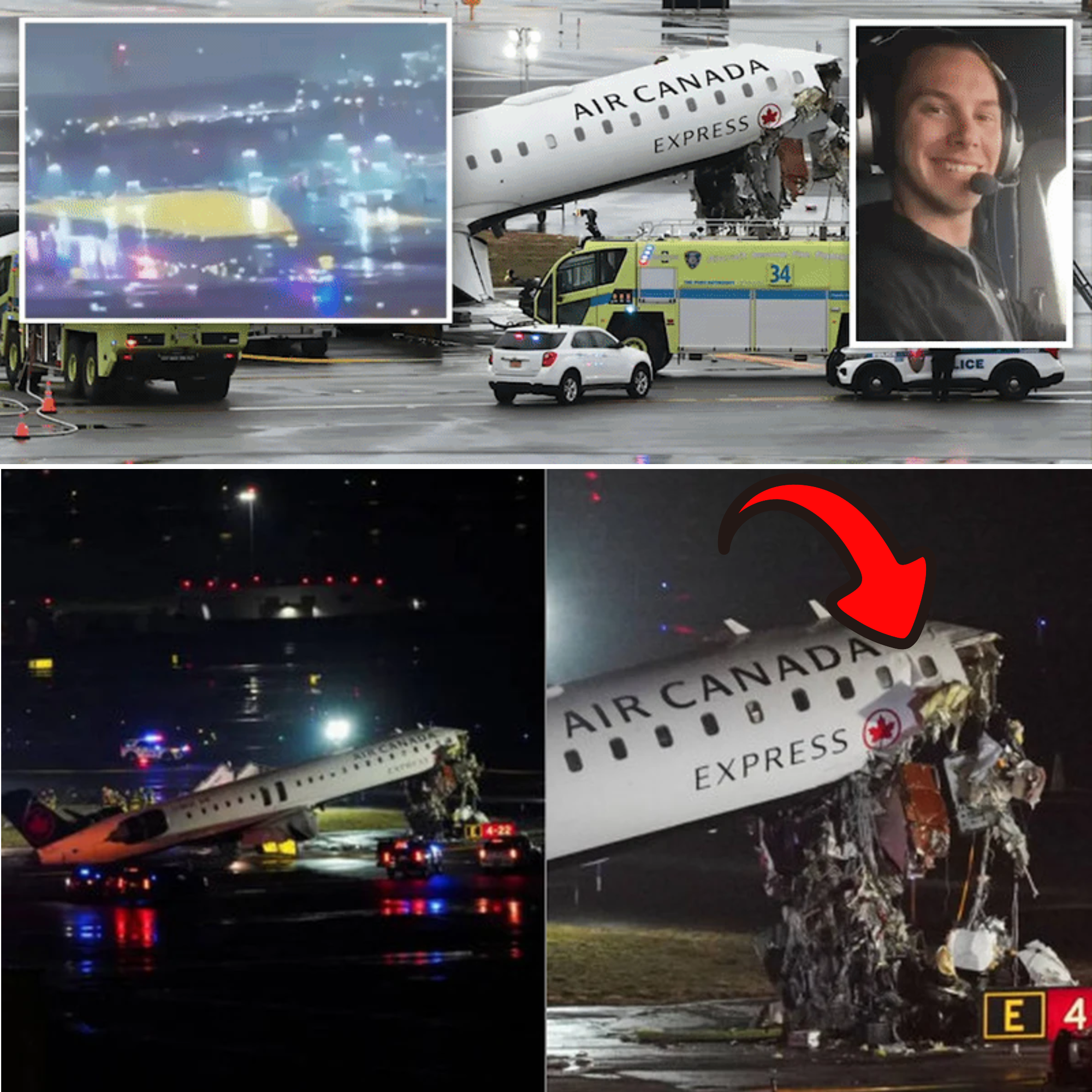
A female flight attendant aboard the ill-fated Air Canada Express Flight AC8646 has emerged as one of the most extraordinary survivors of the March 22, 2026, runway collision at LaGuardia Airport. Solange Tremblay, a veteran crew member from Quebec, was thrown more than 100 meters from the aircraft while still strapped into her forward jumpseat when the Bombardier CRJ-900 slammed into a Port Authority fire truck. Despite severe injuries, including damage to her leg requiring surgery, Tremblay’s survival has been hailed as nothing short of miraculous given the catastrophic destruction to the cockpit area.
The flight, operated by Jazz Aviation on behalf of Air Canada, originated in Montreal and carried 72 passengers and four crew members. It touched down on Runway 4 shortly before midnight under clear conditions. The collision occurred seconds after landing when the jet struck the fire truck crossing the runway to respond to an unrelated odor emergency on a United Airlines aircraft. The impact sheared away the forward fuselage, killing both pilots instantly from massive blunt force trauma. Forty-one passengers and crew sustained injuries, with several in critical condition initially, though most have since stabilized or been released.
Tremblay, positioned in the forward jumpseat near the cockpit for landing and takeoff duties, bore the brunt of the forward section’s destruction. Sources briefed on the incident, including reports from NBC News and CNN, confirmed that Port Authority police discovered her outside the wreckage, still secured in the ejected seat. The jumpseat, designed for crew during critical phases, detached under the extreme forces of the collision. Tremblay was rushed to hospital where she underwent surgery for leg injuries. Her daughter, Sarah Lépine, spoke to Quebec broadcaster TVA Nouvelles, describing the scene: “Her seat was ejected more than a hundred meters from the plane. It’s a miracle she is even alive. She had a guardian angel watching over her.”
Lépine, in a Facebook message to National Post, reiterated the shock and gratitude: “I haven’t spoken to her since this morning. She was being transferred to a different hospital for surgery on her leg.” Tremblay’s survival defies expectations for occupants in the forward cabin during high-impact ground collisions. Aviation safety experts note that the cockpit and immediate adjacent areas often suffer the worst deformation in such events, with survivability rates near zero in comparable past incidents. The fact that Tremblay remained strapped in likely prevented further ejection trauma and tumbling, while the seat’s detachment may have absorbed some energy that would otherwise have been transferred directly to her body.
The jumpseat’s design played a crucial role. Modern aircraft seats incorporate energy-absorbing features and secure harnesses to protect crew during emergencies. In this case, the harness kept Tremblay restrained as the seat separated from the disintegrating structure, potentially reducing the risk of secondary impacts. First responders arriving on scene found the engines off, allowing safer access to rear exits for passenger evacuation. Passengers described chaos in the cabin—screams, forward jolts, and rapid deployment of emergency slides—but the rear and mid-cabin sections remained largely intact, enabling efficient egress.
The incident has spotlighted the razor-thin margins in ground operations at congested airports like LaGuardia. The fire truck’s crossing stemmed from standard protocol for the United flight’s cabin odor issue, yet timing overlapped fatally with the Air Canada landing. Air traffic control recordings captured desperate repeated commands—”Stop, stop, stop, Truck 1, stop”—but the warnings arrived too late. Preliminary reviews suggest clearances were issued for both the landing and the vehicle movement, with human factors—tower workload, communication clarity, and split-second decision-making—under intense scrutiny.
The National Transportation Safety Board leads the investigation with support from the FAA, Transport Canada, and the Canadian Transportation Safety Board. Flight data and cockpit voice recorders, along with tower tapes and radar tracks, will reconstruct the sequence. Key questions include whether enhanced surface detection systems flagged the conflict promptly, staffing adequacy during the late-night shift, and potential for automated alerts or physical barriers on active runways during arrivals.
Air Canada and Jazz Aviation expressed profound sorrow for the pilots’ loss and activated comprehensive support for families, passengers, and crew. Counseling services address the psychological impact, particularly for survivors like Tremblay who endured direct exposure to the violence. The airline emphasized cooperation with investigators and reaffirmed safety as its core priority.
Tremblay’s story resonates deeply in the aviation community, where crew members routinely place themselves in forward positions to ensure passenger safety. Her ejection and survival underscore both the perils of such roles and the effectiveness of safety equipment under extreme conditions. Lépine’s words capture the emotional weight: a mother’s life preserved against impossible odds, attributed to divine protection amid mechanical failure.
As recovery continues for the injured and the airport gradually resumes operations, Tremblay’s ordeal serves as a poignant reminder of human resilience. The forward jumpseat, once a routine workplace, became an improbable lifesaver. Investigations will likely yield recommendations to further mitigate runway incursion risks—stricter protocols for emergency vehicle movements, improved real-time alerting, or technological redundancies—but for now, the focus remains on those who endured the night.
Solange Tremblay’s survival transcends statistics. It represents hope amid tragedy: a woman thrown from disaster still secured in her seat, found alive on the tarmac, and now fighting toward recovery. In the shadow of lost pilots and injured passengers, her miracle escape offers a thread of light—proof that even in the darkest moments of aviation’s unforgiving physics, survival can defy the odds.