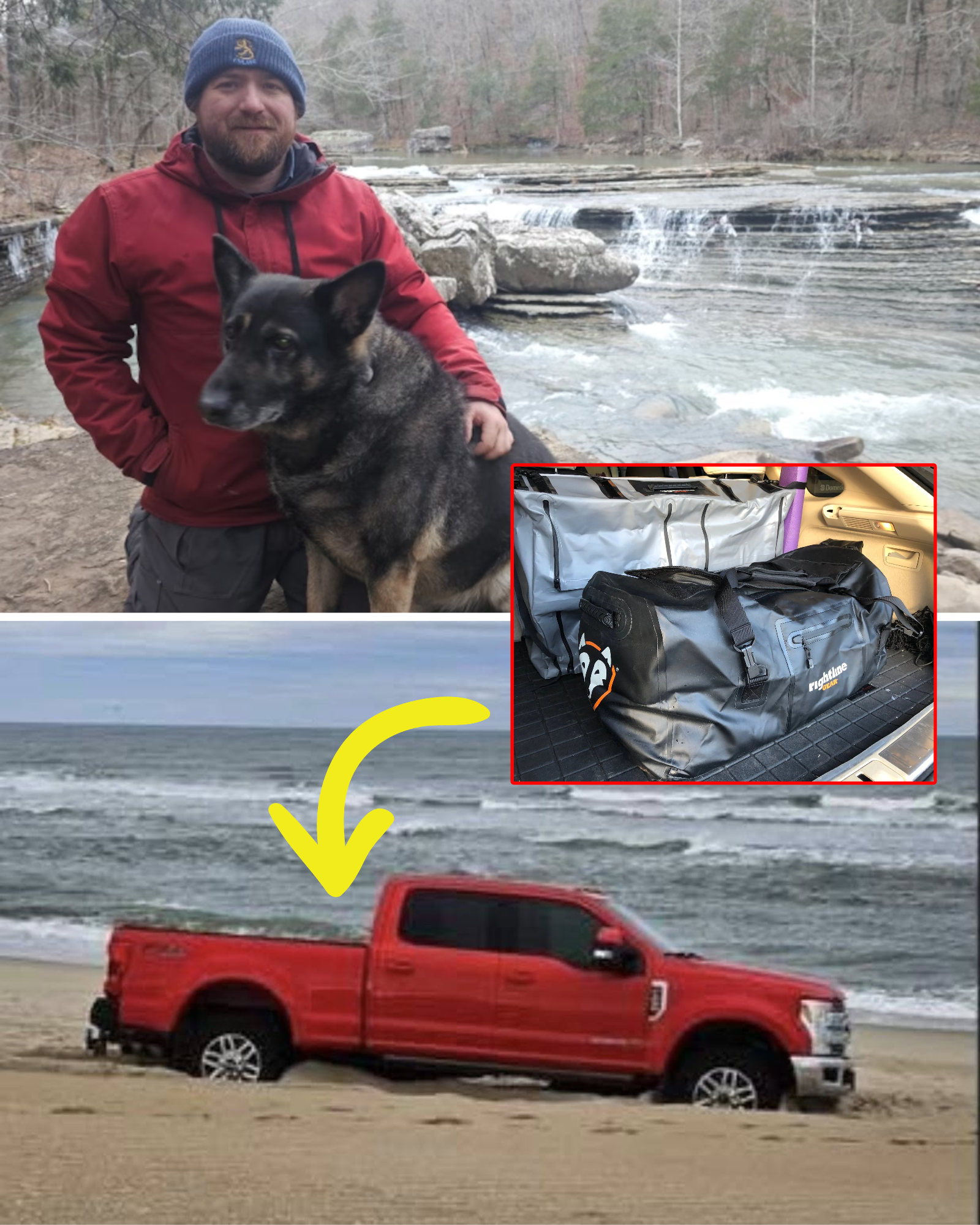
The investigation into the disappearance of 39-year-old Chris Palmer has veered into deeply troubling territory following the discovery of a black duffel bag containing a jacket bearing DNA that does not belong to him. The red 2017 Ford F-250, stuck on a remote stretch of sand at Cape Hatteras National Seashore near Buxton, North Carolina, since January 12, 2026, has become the focal point of an increasingly complex case that no longer appears to be a straightforward missing person incident.
Palmer, a seasoned outdoorsman from Arkansas with a military past, level-5 whitewater rafting certification, and an unbreakable bond with his German Shepherd mix Zoey, had been documenting his solo camping journey meticulously. He began in the Smoky Mountains on December 8, 2025, moved to Boone Fork through late December, spent Christmas reporting plans to reach George Washington National Forest in Virginia, and by January 4 confirmed he would extend his stay there. His final communication on January 9 outlined a shift to Monongahela National Forest in West Virginia, complete with a brief video of rough terrain and a note about unreliable cell service. Family members later described an element in that message as cryptic or “difficult to understand,” a detail that now feels ominous in light of subsequent findings.
The truck’s discovery between Ramp 43 and Cape Point—an isolated, four-wheel-drive-only beach—immediately raised red flags. Inside were Palmer’s shotgun, safe, and most camping equipment, yet critical personal belongings had vanished: his clothing, coat, and Zoey’s food and water bowls. A kayak previously visible strapped to the roof in arrival footage was gone, suggesting possible water travel toward nearby islands or inlets.
During a detailed forensic sweep, investigators located the black duffel bag tucked in the cab or bed area. Among its contents was a jacket that underwent immediate DNA testing. Results confirmed the biological material—skin cells, hair, or sweat—did not match Palmer’s genetic profile. Authorities have withheld specifics about the sample’s quality or possible contributors, but the mismatch has prompted urgent database comparisons and expanded inquiries into anyone Palmer might have encountered during his travels.
This revelation reframes earlier anomalies. A local witness reported spotting a dark-colored kayak—consistent with Palmer’s—drifting close to an island shoreline at dawn, accompanied by distant barking that could have come from Zoey. Separately, CCTV from a private dock recorded 90 seconds of the vessel’s movement before the feed cut out, with the last frame capturing a second figure emerging into view. Whether these sightings connect to the foreign DNA remains under active review, but they collectively suggest interaction with at least one other individual.
National Park Service teams, supported by volunteers including the United Cajun Navy (contacted by Palmer’s father, Bren), have intensified searches across beaches, marshes, and offshore waters. Infrared drones scan for heat signatures at night, boats patrol inlets, and ground crews comb dunes and remote access points. Harsh January weather—strong winds, rough surf, and cold temperatures—continues to hinder progress, yet officials stress that Palmer and Zoey could still be alive in the region.
Palmer is described as Caucasian, 5 feet 6 inches to 5 feet 9 inches tall, with blue eyes and strawberry-blonde hair. He is known for exceptional survival skills, responsible communication habits, and no documented history of mental health issues, financial troubles, or interpersonal conflicts. The sudden cessation of contact, combined with the illogical detour hundreds of miles off course, has puzzled even seasoned investigators.
The presence of foreign DNA has ignited widespread speculation. Online communities dedicated to the case debate scenarios: an altercation leading to foul play, an encounter with a stranger that turned violent, or a staged disappearance involving accomplices. Some point to the missing personal items as evidence of removal under duress, while others wonder if the jacket belonged to someone who assisted Palmer only to leave traces behind.
Family statements continue to circulate, emphasizing Palmer’s reliability and devotion to Zoey. Bren Palmer has publicly reiterated that his son would never abandon his dog or fail to check in without cause. The cryptic nuance in the January 9 message now looms larger—perhaps a veiled reference to an approaching person, an unexpected change forced upon him, or a subtle distress signal lost in translation.
As of January 22, 2026, the black duffel bag and its contents represent the strongest physical evidence of third-party involvement yet uncovered. Prosecutors and federal agents are involved, treating the case with heightened scrutiny typical of potential criminal disappearances on national park land. Tips continue to pour in via the NPS hotline (888-653-0009), with authorities asking anyone who visited Cape Hatteras between January 9 and 12—especially near Cape Point—to examine personal photos, videos, or memories for anything unusual: the red truck, a man walking with a German Shepherd, suspicious vehicles, or activity on the water.
The Outer Banks, with its treacherous currents, shifting barrier islands, and history of maritime vanishings, has once again become the backdrop for a haunting unsolved mystery. Yet the discovery of foreign DNA injects fresh urgency and dread. It transforms what might have been an accidental tragedy into a question of human intent. Was Chris Palmer targeted? Did he cross paths with danger? Or does the jacket hold the key to locating him and Zoey alive?
Searchers press forward, driven by every new lead and the family’s unwavering hope. The black duffel bag sits in evidence storage, its contents silent witnesses to whatever transpired after that final, puzzling message. In the vast Atlantic expanse and endless dunes, the truth waits—perhaps closer than anyone realizes, hidden in plain sight among the waves and wind.