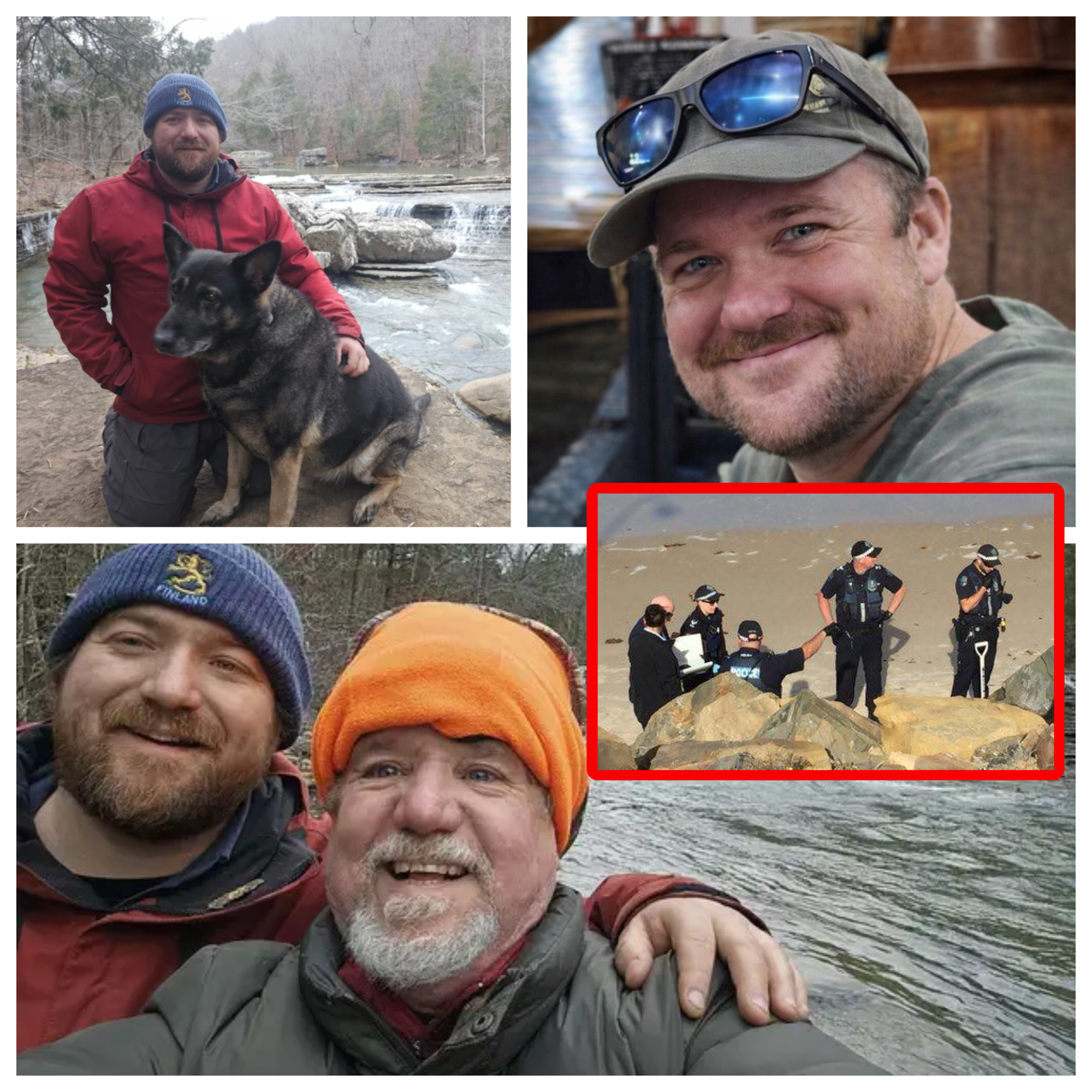
The family of Chris Palmer has formally requested authorities to suspend all active search operations for the 39-year-old man who disappeared from North Carolina’s Outer Banks in mid-January 2026. In a raw, emotional public statement posted across social media platforms, Chris’s father, Bren Palmer, revealed the devastating reason behind the decision: his son had been secretly living with a terminal cancer diagnosis for the past 18 months. The announcement has not only brought painful closure to a weeks-long mystery but has also ignited intense speculation about the true nature of Chris’s final days and the puzzling absence of any medical documentation in his abandoned vehicle.
Chris Palmer vanished after his truck was found bogged down in sand on a secluded stretch of beach near Buxton, within Cape Hatteras National Seashore, on January 12, 2026. Inside the vehicle were personal effects, clothing, and supplies consistent with an extended outdoor trip, yet the blue-and-white kayak visible in surveillance footage from the previous day was gone. Cell phone data placed Chris near Avon on January 10 and Cape Point in Buxton on January 11. When he failed to return home to Arkansas, a massive search involving the U.S. Coast Guard, National Park Service rangers, local sheriff’s deputies, and volunteer groups was launched. Helicopters scanned the coastline, boats patrolled offshore, and teams combed dunes and marshes. Despite exhaustive efforts, neither Chris nor his 11-year-old German shepherd, Zoey, was located.
The turning point came when the family received confirmation of Chris’s long-concealed illness. Bren Palmer’s statement read in part: “With the heaviest hearts imaginable, we have asked that the search for our beloved son be ended. We have learned that Christopher was privately battling terminal cancer for approximately 18 months. This knowledge has helped us make sense of the path he chose.” He described Chris as a fiercely independent soul who cherished freedom above all—freedom that aggressive medical treatments would have stolen away. The family believes Chris intentionally entered the ocean during his final night, choosing a swift and solitary end in the place that had always brought him peace.
What continues to unsettle investigators is the complete lack of medical records, prescriptions, doctor’s notes, or even a single pill bottle related to his condition inside the truck. Chris had driven hundreds of miles from Arkansas to the Outer Banks—a journey that would almost certainly involve carrying documentation for ongoing treatment, pain management, or emergency contacts. Yet nothing of the sort was recovered. This glaring omission has led many to wonder: Did Chris deliberately purge any trace of his illness before embarking on the trip? Was the absence of paperwork part of a conscious effort to leave no trail that could lead back to hospitals, appointments, or the reality he had kept hidden from everyone?
The story of Zoey adds another layer of sorrow. Bren Palmer later shared that the aging German shepherd suffered from advanced hip dysplasia and required multiple daily medications. The family now believes Chris spent his last days deep in the woods, quietly accompanying Zoey through her final hours before making his way to the water. “Our son likely stayed with her in the forest during her last moments,” Bren wrote. “He would never have left her alone.” This image—of a man cradling his dying companion before facing his own mortality—has resonated deeply with the public, turning Chris’s disappearance into a symbol of profound loyalty and quiet dignity.
Chris Palmer was remembered by friends and coworkers as a gentle, outdoors-loving individual who found joy in solitude and the rhythm of nature. He rarely spoke of personal struggles, preferring to project strength and calm. Those close to him now reflect on subtle signs in the preceding months: longer silences, more frequent solo trips, a quiet intensity when discussing the future. In retrospect, these were likely the quiet signals of someone carrying an unbearable weight alone.
The Outer Banks held special significance for Chris. Its wild, windswept beaches and untamed Atlantic had long been a place of refuge. The family believes he chose this location deliberately—not as a random vacation spot, but as the backdrop for his farewell. The missing kayak, the abandoned truck, the lack of medical traces—all align with someone who planned to disappear without burdening others with the aftermath.
Authorities have respected the family’s wishes and scaled back operations, though the case remains open pending any new evidence. No body, no kayak, and no definitive proof of what transpired that night have been recovered. The absence of closure in the traditional sense has left room for speculation: Was the kayaking outing a carefully chosen method to ensure he would not be found? Did Chris intend for the sea to claim him completely, sparing his family the prolonged grief of watching him fade?
The Palmer family has asked for privacy while expressing deep gratitude to the countless strangers who followed the search, sent messages of support, and offered prayers. They hope Chris’s story prompts greater awareness of the emotional isolation many face when diagnosed with terminal illness and encourages open conversations about end-of-life wishes.
As the investigation winds down and winter waves continue to crash against the same shores where Chris was last seen, his legacy endures not as a mystery unsolved, but as a testament to the lengths one man went to protect those he loved—from the pain of watching him suffer, and from the burden of saying goodbye. In choosing silence and solitude, Chris Palmer left behind more questions than answers, but also a powerful reminder of the quiet courage that can exist in the face of inevitable loss.
News
Driver Breaks Silence on Deep River Crash — Claims “Short Argument” with Rico Montes Caused the Truck to Flip.
The driver of the black pickup truck involved in the fatal Deep River crash has finally spoken publicly for the first time since the March 2026 incident that claimed the…
Phone Recovered from Deep River Still Trying to Send Final Location — The Last Desperate Act of Rodrigo “Rico” Montes.
In the early hours of March 23, 2026, 18-year-old high school senior Rodrigo “Rico” Montes made one final, heartbreaking attempt to reach his family. As police divers searched the murky…
“Mom, I’m Riding Home With a Friend, See You Soon” — The Final Text Before Rodrigo “Rico” Montes Was Found in the Overturned Truck in Deep River.
On a quiet Sunday night in March 2026, 18-year-old Rodrigo “Rico” Montes sent his mother a simple, reassuring text that would become the last words she ever received from her…
The Black Bag in the Ravine: Chilling Discovery in the Death of American Airlines Flight Attendant Eric Gutierrez.
The tragic case of 32-year-old American Airlines flight attendant Eric Fernando Gutierrez Molina took an even darker turn as investigators in Colombia recovered a black bag linked to the missing…
The Secret Weekend Pattern: How the FBI’s Latest Breakthrough May Finally Trap Nancy Guthrie’s Abductor.
As March 2026 draws to a close, the disappearance of 84-year-old Nancy Guthrie from her home in Tucson’s Catalina Foothills has entered its 55th day with no arrest and no…
The Insider Who May Have Opened the Door: FBI Hunts for the Person Who Knew Nancy Guthrie’s Home Too Well.
In the affluent Catalina Foothills neighborhood of Tucson, Arizona, where residents often leave garage doors open and security feels routine, the abduction of 84-year-old Nancy Guthrie on the night of…
End of content
No more pages to load