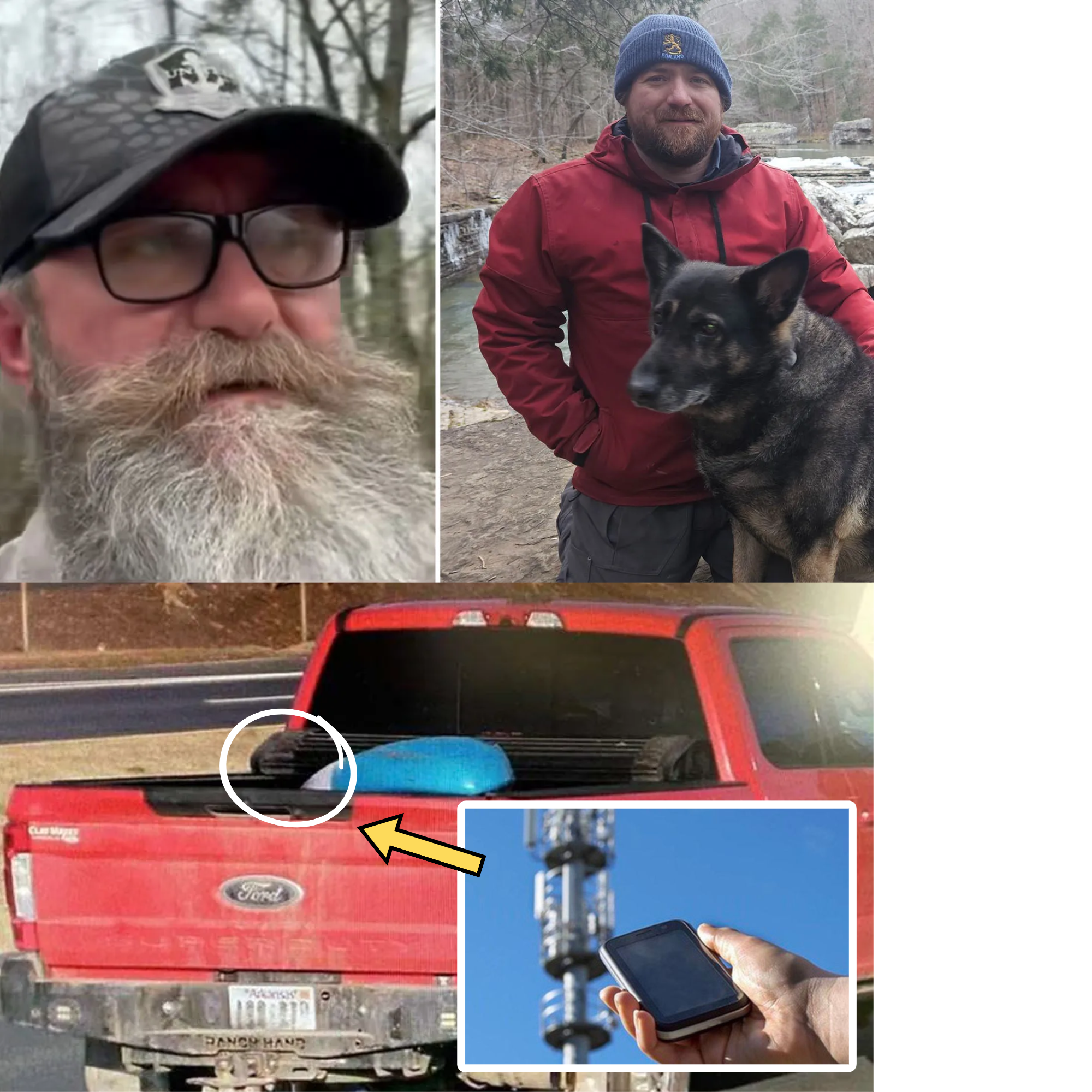
New cell tower data obtained by investigators has cast serious doubt on Chris Palmer’s final communication with his family, showing that his phone was nowhere near the location he claimed to be heading toward on January 9, 2026. According to records reviewed by the National Park Service and Arkansas authorities, the last ping from Palmer’s device placed it in Dare County, North Carolina — near Avon on the Outer Banks — at a time when he had explicitly told relatives he was traveling north toward Monongahela National Forest in West Virginia. The discrepancy, spanning hundreds of miles in the opposite direction, has intensified speculation that the 39-year-old experienced camper may have deliberately misled his family — or that something far more troubling occurred after that message was sent.
Palmer, an experienced solo adventurer from Arkansas, had been documenting a multi-week camping journey through national forests since early December 2025. His route was methodical: Smoky Mountains, Boone Fork, George Washington National Forest in Virginia, with plans to continue north to Monongahela. He maintained regular contact, sending text updates and short terrain videos whenever signal allowed. On January 9, his final message to family stated clearly: “Heading to Monongahela next — terrain looking good.” Attached was a brief clip of rugged woodland consistent with his stated path. That was the last anyone heard from him directly.
Yet cell tower triangulation data tells a starkly different story. Records show his phone connected to a tower near Avon, North Carolina, late on the evening of January 9 and again near Cape Point on January 10 and 11. These locations are on Hatteras Island, part of Cape Hatteras National Seashore — roughly 400 miles southeast of where he claimed to be going. The route deviation is not minor; it represents a complete reversal of direction, crossing multiple states and taking him to one of the most isolated stretches of the Atlantic coast.
Investigators have not yet determined why Palmer’s phone was so far off course. Several scenarios are being considered:
- Voluntary change of plans: He may have decided on impulse to detour to the Outer Banks, perhaps for a spontaneous beach camp or to explore the barrier islands. However, this contradicts his meticulous planning style — he had always shared route changes in advance and never deviated without notice.
- Device manipulation or theft: Someone else could have been in possession of his phone after January 9, explaining the southward movement. This theory gains traction when paired with the fact that Palmer himself was never seen again after that date.
- Coercion or foul play: The most troubling possibility is that Palmer was forced or lured off his intended route. The presence of his truck mired in remote sand, the missing kayak, Zoey stranded on a cliff, and now the mismatched cell data all point toward an event that interrupted his journey — potentially involving another party.
The truck was discovered on January 12, stuck between Ramp 43 and Cape Point, with keys in the ignition, shotgun, locked safe, and most camping gear intact. Missing were Palmer’s coat, some clothing, Zoey’s bowls, and the kayak seen in earlier traffic camera footage. Zoey was later rescued dehydrated but alive from a bluff overlooking the Atlantic on January 22. Her survival suggests she became separated from Palmer under duress or during an attempt to flee danger.
Earlier leads now appear more ominous in light of the cell data. A witness reported seeing Palmer carrying the kayak toward the shore with Zoey. Surveillance from a private dock captured a drifting kayak at dawn accompanied by distant barking. CCTV from the same dock showed a second shadowy figure in the final frame before signal loss. And now, the phone’s location directly contradicts Palmer’s last known statement. Taken together, these elements paint a picture not of a man who simply got lost, but of someone whose plans were abruptly and possibly violently altered.
Family members, led by father Bren Palmer, have reacted with a mix of shock and renewed determination. “He always told us exactly where he was going,” Bren posted on social media. “If the phone was hundreds of miles south when he said he was heading north, then someone or something changed that plan. We need answers.” The family has urged anyone with information about unusual activity near Cape Point between January 9 and 12 to contact authorities.
National Park Service officials have confirmed the cell data is authentic and is now central to the investigation. Search efforts have been re-focused on the forested areas behind the beach where the second figure was seen, as well as nearby inlets where the kayak may have been abandoned or hidden. Marine patrols continue to scan shallow waters, while cadaver dogs have been deployed along potential escape routes through the dunes and maritime scrub.
The Outer Banks’ extreme isolation — vast undeveloped coastline, shifting sands, strong currents, and limited cell coverage — makes disappearance tragically plausible. Yet the combination of deliberate southward travel, an abandoned truck, a stranded dog, missing personal items, a drifting kayak, a mysterious watcher in the trees, and now conflicting cell tower data strongly suggests human involvement rather than pure accident.
As winter storms threaten to erase what little physical evidence remains, time is running out. The phone’s location does not lie. Chris Palmer told his family he was heading north. His phone tells a very different story. Somewhere between that final message and the silent dunes of Hatteras Island lies the truth — and the hope that it will lead rescuers to a living man, or at least to answers for a family that refuses to stop searching.