Chilling 16-Second Video: The Deadly Runway Collision at LaGuardia That Killed Two Pilots.
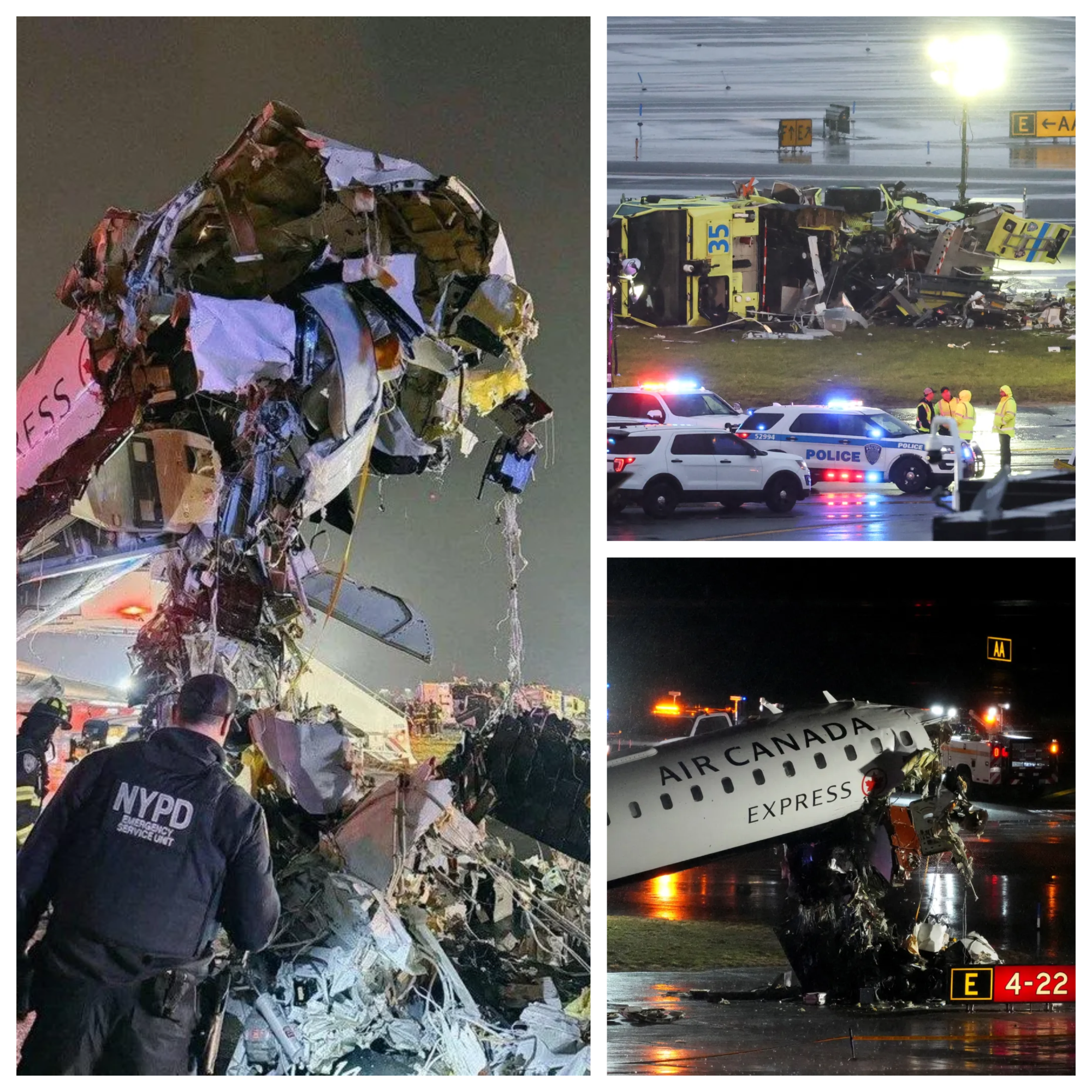
A horrifying collision unfolded late Sunday night at New York’s LaGuardia Airport when an Air Canada Express regional jet struck a Port Authority fire truck on the runway moments after landing. The incident, captured in a brief 16-second surveillance video circulating widely online, shows the CRJ-900 aircraft, traveling at an estimated 93 to 105 miles per hour, slamming into the emergency vehicle with devastating force. The impact sheared off much of the cockpit, tilted the plane backward, and resulted in the immediate deaths of both the pilot and co-pilot. Forty-one passengers and crew members sustained injuries, some serious, while two Port Authority firefighters in the truck were also hurt.
The flight, designated AC8646 and operated by Jazz Aviation on behalf of Air Canada, originated from Montreal and carried 72 passengers along with four crew members. It touched down on Runway 4 shortly before midnight local time. According to preliminary reports from the Port Authority of New York and New Jersey, the fire truck was crossing the runway in response to a separate incident involving a United Airlines aircraft that had reported an odor issue on board. Air traffic control audio recordings, now under intense scrutiny, reveal a sequence of communications that appear to show confusion in the tower.
In the released audio, a controller initially grants clearance for “Truck 1” to cross Runway 4 at taxiway Delta. Seconds later, as the incoming Air Canada jet approaches, urgent commands ring out: “Stop, stop, stop, Truck 1, stop!” The warnings came too late to prevent the collision. One controller reportedly later said, “I messed up,” highlighting potential human error amid the high-pressure environment of nighttime operations at a busy airport. The fire truck had paused earlier to confirm clearance before proceeding, but the timing overlapped fatally with the landing aircraft.
Eyewitness accounts and photos from the scene depict a grim picture: the jet’s nose crushed inward, debris scattered across the tarmac, and emergency responders rushing to evacuate survivors. Passengers described hearing a massive bang followed by chaos as the plane lurched to a halt. Flight attendants acted swiftly to guide people down emergency slides, with many reporting shock and minor to moderate injuries from the abrupt stop and impact forces. The aircraft sustained severe damage to the forward section, including the loss of Engine 2 and parts of the landing gear, yet remained structurally intact enough for a successful rapid evacuation.
LaGuardia Airport, one of the three major hubs serving New York City, was immediately shut down following the crash. All flights were canceled or diverted, stranding thousands of travelers and causing widespread disruptions across the Northeast. The facility remained closed into Monday morning as investigators from the National Transportation Safety Board (NTSB), Federal Aviation Administration (FAA), and Canadian authorities arrived on site. Canadian investigators joined the probe given the flight’s origin and airline involvement. Early focus centers on air traffic control communications, runway incursion protocols, and visibility conditions that night.
Runway incursions—unauthorized vehicles or aircraft on active runways—remain a persistent safety concern in aviation. The FAA has implemented measures like enhanced ground radar and stricter clearance procedures, yet incidents persist, especially at congested airports like LaGuardia with its complex layout and limited space. This collision echoes past tragedies, such as the 1991 runway crash at Detroit Metropolitan Airport that killed eight, underscoring the razor-thin margins in ground operations.
The victims include the two pilots, whose identities have not yet been publicly released pending family notifications. Their deaths mark a tragic loss in the aviation community, where cockpit crews often face immense responsibility in split-second decisions. The injured passengers, transported to nearby hospitals, included individuals with fractures, concussions, and lacerations from the violent jolt. Medical teams praised the crew’s composure during the evacuation, which likely prevented further fatalities.
Air Canada issued a statement expressing profound sorrow and full cooperation with the investigation. “The safety of our passengers and crew is our top priority,” the airline said, confirming support for affected families and travelers. Jazz Aviation echoed similar sentiments, emphasizing their commitment to safety protocols.
As the NTSB reconstructs the event using flight data recorders, cockpit voice recordings, and witness statements, questions mount about how clearance was granted and then rescinded in such a short window. Night operations, combined with the fire truck’s urgent response to the United flight, created a perfect storm of misaligned timing. Experts note that controllers manage multiple aircraft and vehicles simultaneously, and fatigue or distraction can play roles in rare but catastrophic errors.
The 16-second video, sourced from airport surveillance and quickly shared on social media, has amplified public horror. It shows the jet’s lights approaching rapidly before the sudden, explosive impact—flames briefly visible as parts collide. The clip’s brevity intensifies its impact, capturing raw terror without graphic excess. Viewers describe it as “chilling” and “unreal,” with many calling for immediate reforms to prevent runway crossings during active landings.
This tragedy has reignited debates over airport infrastructure. LaGuardia, long criticized for outdated facilities, underwent major redevelopment in recent years, yet runway operations remain challenging due to geographic constraints. Advocates argue for advanced surface detection systems and automated alerts to flag potential incursions in real time.
In the aftermath, tributes have poured in for the pilots and injured. Political leaders, including New York Governor Kathy Hochul, expressed condolences and pledged support for the investigation. Aviation unions urged patience while facts emerge, cautioning against premature blame.
The incident serves as a stark reminder of aviation’s inherent risks, even on the ground. While air travel remains statistically safe, ground collisions expose vulnerabilities in coordination between air and surface operations. As recovery efforts continue and LaGuardia gradually reopens, the focus shifts to learning from this disaster to safeguard future flights.
The collision’s echoes will linger long after the runway clears— a haunting 16 seconds that claimed lives and shattered assumptions of routine safety.