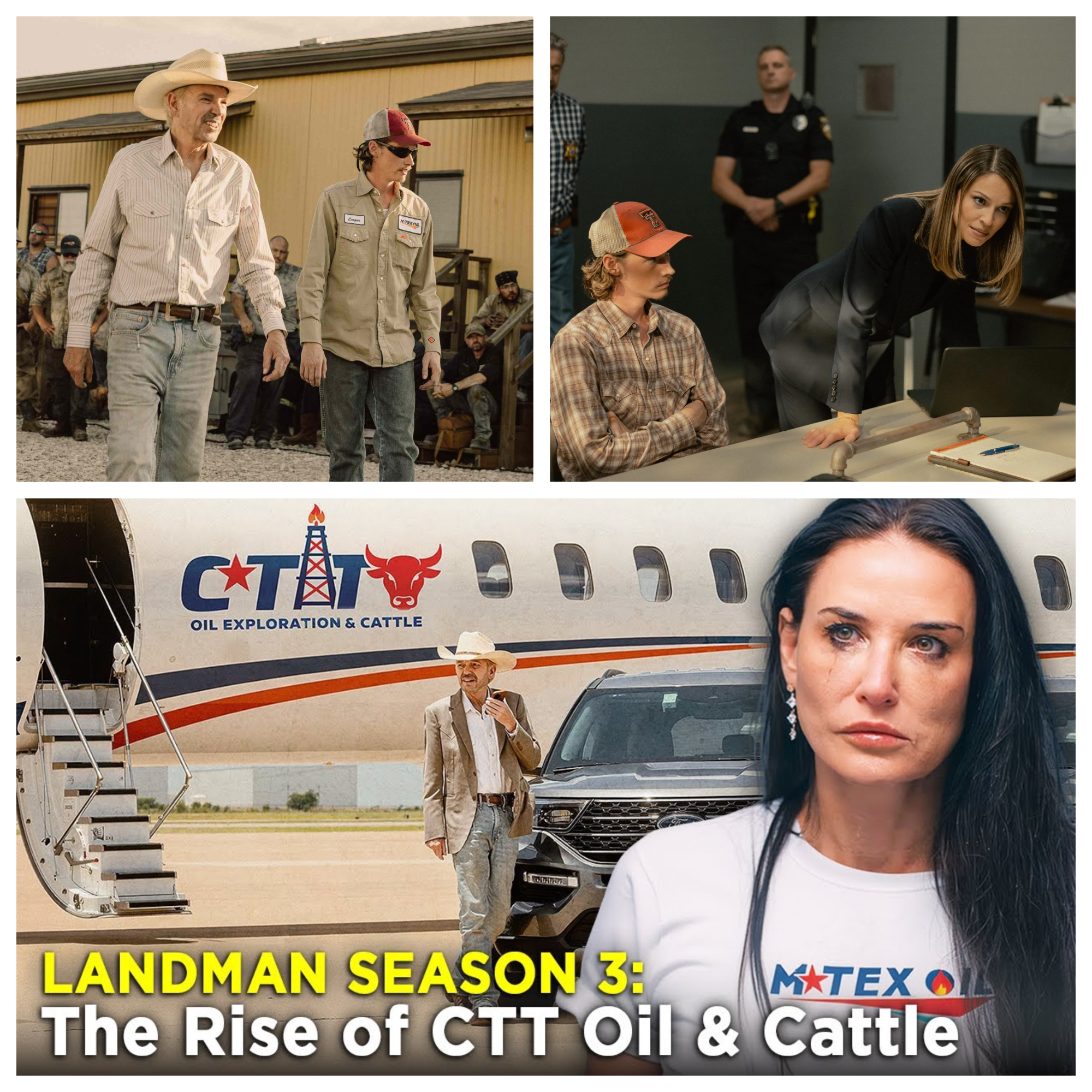
Cami Miller enters Season 3 of LANDMAN convinced she has finally seized control of M-Tex Oil and the chaotic West Texas energy world her late husband Monty once dominated. After orchestrating Tommy Norris’s ouster in the Season 2 finale, she steps fully into the spotlight as the company’s undisputed leader, delivering a ruthless luncheon speech that warns executives her reign will be meaner and more unforgiving than Monty’s ever was. To many observers, this moment feels like the culmination of her long game—transforming from grieving widow to iron-fisted CEO. Yet a growing body of fan theories and close analysis suggests her most decisive action may have been her gravest error: indirectly forcing the birth of CTT Oil Exploration and Cattle, the new family-run venture Tommy launches with cartel backing from Gallino.
The revenge theory posits that Cami’s decision to fire Tommy wasn’t just corporate pruning—it was personal retaliation wrapped in business logic. Tommy had long served as Monty’s trusted right hand, the steady operator who kept M-Tex profitable even as Monty chased bigger risks. When Cami assumes control, she sees Tommy’s cautious approach as a threat to her vision of aggressive expansion and tighter personal grip on power. By removing him, she eliminates the last vestige of Monty’s influence and any internal challenge to her authority. What she fails to anticipate is how that dismissal ignites Tommy’s own survival instinct. Refusing Chevron’s safe buyout offer, Tommy instead secures financing from his old ally Gallino and forms CTT—named for Cooper, Tommy, and T.L.—a lean, family-operated company focused on the very wells and leases M-Tex once controlled. In one stroke, Cami has not neutralized a rival; she has created a direct, agile competitor unburdened by corporate bureaucracy and fueled by personal vendetta.
CTT’s emergence reshapes the power dynamics in ways Cami cannot fully foresee. As a smaller entity, CTT operates with speed and ruthlessness M-Tex’s larger structure cannot match. Tommy, now free from boardroom oversight, can pursue high-risk, high-reward plays that Gallino’s resources quietly amplify. The cartel connection—long a shadow over the series—gains tangible leverage here. Gallino’s investment isn’t mere charity; it’s strategic. He gains a foothold in legitimate oil operations while positioning Tommy as a proxy in the basin’s escalating turf wars. Theories suggest CTT’s early successes—snatching key leases, outmaneuvering regulators, and undercutting M-Tex on contracts—stem directly from this unholy alliance. What Cami dismissed as a disgruntled ex-employee walking away becomes a guerrilla force chipping away at her empire from the edges.
The theory gains traction when examining Cami’s psychological blind spots. Throughout Seasons 1 and 2, she positions herself as the wronged wife reclaiming what is hers. Yet her actions increasingly mirror the very ruthlessness she once condemned in Monty. Firing Tommy is framed as protecting the company’s future, but it carries unmistakable personal venom—he represents the old guard that tolerated Monty’s excesses while she endured them. By cutting him loose without a parachute, she underestimates the depth of loyalty he commands among roughnecks, engineers, and even some M-Tex veterans who quietly follow him to CTT. This exodus drains talent and institutional knowledge from M-Tex at the worst possible moment, as the company faces mounting regulatory scrutiny and environmental pushback.
Rebecca’s aggressive enforcement in Season 3 further amplifies the theory. Her high-profile raid on a suspected illegal dumping site—widely believed to be tied to M-Tex subcontractors—comes suspiciously soon after CTT gains traction. While the operation targets a low-level operator, the timing and visibility suggest a broader message. Rebecca, long skeptical of the industry’s influence over local law enforcement, may be using the arrest to signal that protections once afforded to M-Tex no longer apply. If Cami’s consolidation of power alienated key allies—including those who once turned a blind eye—Rebecca’s move could represent the first crack in the armor. Theories propose the raid serves dual purposes: legitimate enforcement against environmental crimes and a warning to Cami that her aggressive tactics have drawn unwanted federal attention, attention that CTT, operating under the radar, has so far avoided.
Cami’s miscalculation compounds as CTT begins to thrive. Tommy’s family dynamic—Cooper’s raw ambition, T.L.’s old-school wisdom—creates a resilient core that M-Tex’s corporate structure lacks. Early wins for CTT, such as securing Gallino-backed financing for high-yield wildcat wells, erode M-Tex’s market share. The company’s smaller footprint allows quicker adaptation to fluctuating oil prices and regulatory shifts. Meanwhile, Cami’s meaner leadership style breeds resentment internally. Employees whisper about her paranoia, her tendency to micromanage, and her willingness to sacrifice long-term relationships for short-term gains. The creation of CTT doesn’t just split the workforce; it splits loyalties. Those who stay with M-Tex do so out of fear or inertia, not inspiration, creating a morale crisis that manifests in leaks, sabotage rumors, and declining productivity.
The revenge angle sharpens when considering Gallino’s role. His funding of CTT isn’t altruistic—it’s payback for years of perceived slights from Monty and, by extension, M-Tex. Cami’s firing of Tommy hands Gallino the perfect proxy to wage economic warfare without direct exposure. Theories suggest his endgame involves using CTT to siphon leases, contracts, and talent from M-Tex until the larger company buckles under debt and scandal. If Cami believes she has won by consolidating power, she overlooks how that consolidation has made M-Tex a bigger, slower target. CTT, lean and hungry, exploits every vulnerability she creates.
As Season 3 unfolds, the theory predicts a cascading backfire. Regulatory investigations intensify, fueled by tips from disgruntled ex-employees now at CTT. Political allies once loyal to Monty drift toward the rising star Tommy represents. Cami’s personal life frays under the strain—isolated from family, distrusted by peers, haunted by Monty’s ghost. The ultimate irony: in trying to erase Tommy’s influence, she amplifies it. CTT doesn’t just survive; it threatens to eclipse M-Tex entirely.
LANDMAN has always explored how power corrupts and how the quest for control breeds its own destruction. Cami’s arc in Season 3 embodies this theme perfectly. What she sees as her greatest triumph—seizing M-Tex and banishing Tommy—may prove her fatal flaw. By creating CTT, she doesn’t eliminate a threat; she births a monster tailored to exploit her weaknesses. The revenge isn’t Tommy’s alone—it’s the industry’s unforgiving logic turning against her. As alliances shift and bodies pile up, the question isn’t whether Cami can win. It’s whether she can survive the fire she herself ignited.
News
“It’s All Because She Changed Her Will”: Savannah Guthrie’s Emotional Confession Shakes Up the Nancy Guthrie Disappearance Case.
The disappearance of Nancy Guthrie has gripped the public since January 31, 2026, when the 68-year-old retired public affairs worker from the University of Arizona vanished from her home in…
Ordinary Dad Turns Hero: One Father’s Instinct Saved Lives After Deadly Tennessee School Bus Crash.
On a Friday afternoon that started with excitement and laughter, a routine field trip for Kenwood Middle School students in Clarksville, Tennessee, turned into a scene of devastation that no…
Two Empty Seats at Kenwood Middle School as Students Return After Fatal Bus Crash – Sisters Hold Solidarity Sign.
Two empty seats will greet students and staff at Kenwood Middle School in Clarksville, Tennessee, when classes resume on Monday morning following the devastating school bus crash on Friday, March…
Kenwood Bus Dashcam Footage Raises Unanswered Question: Why the Slow Drift Across Highway 70 With No Braking?
A quiet morning field trip turned into tragedy on March 27, 2026, when a Montgomery County Schools bus from Kenwood Middle School in Clarksville, Tennessee, collided head-on with a Tennessee…
Possible Shoe Print in Blood? 3 Shocking Expert Theories on Nancy Guthrie Porch Evidence – Day 62 Update.
The disappearance of 84-year-old Nancy Guthrie has gripped the nation for 62 days, with her daughter, NBC News anchor Savannah Guthrie, publicly pleading for answers while the investigation continues to…
Outlander Season 8 Episode 4 Sneak Peek: Claire’s Resurrection Power Changes Everything as War Looms.
Outlander Season 8 continues to deliver the high-stakes drama, time-travel romance, and historical intensity that has defined the series since its beginning. With Episode 3 still fresh in fans’ minds,…
End of content
No more pages to load