Bleeding Before the Impact: The Witness Who Saw Blake Seers Fleeing His Home With a Slashed Throat.
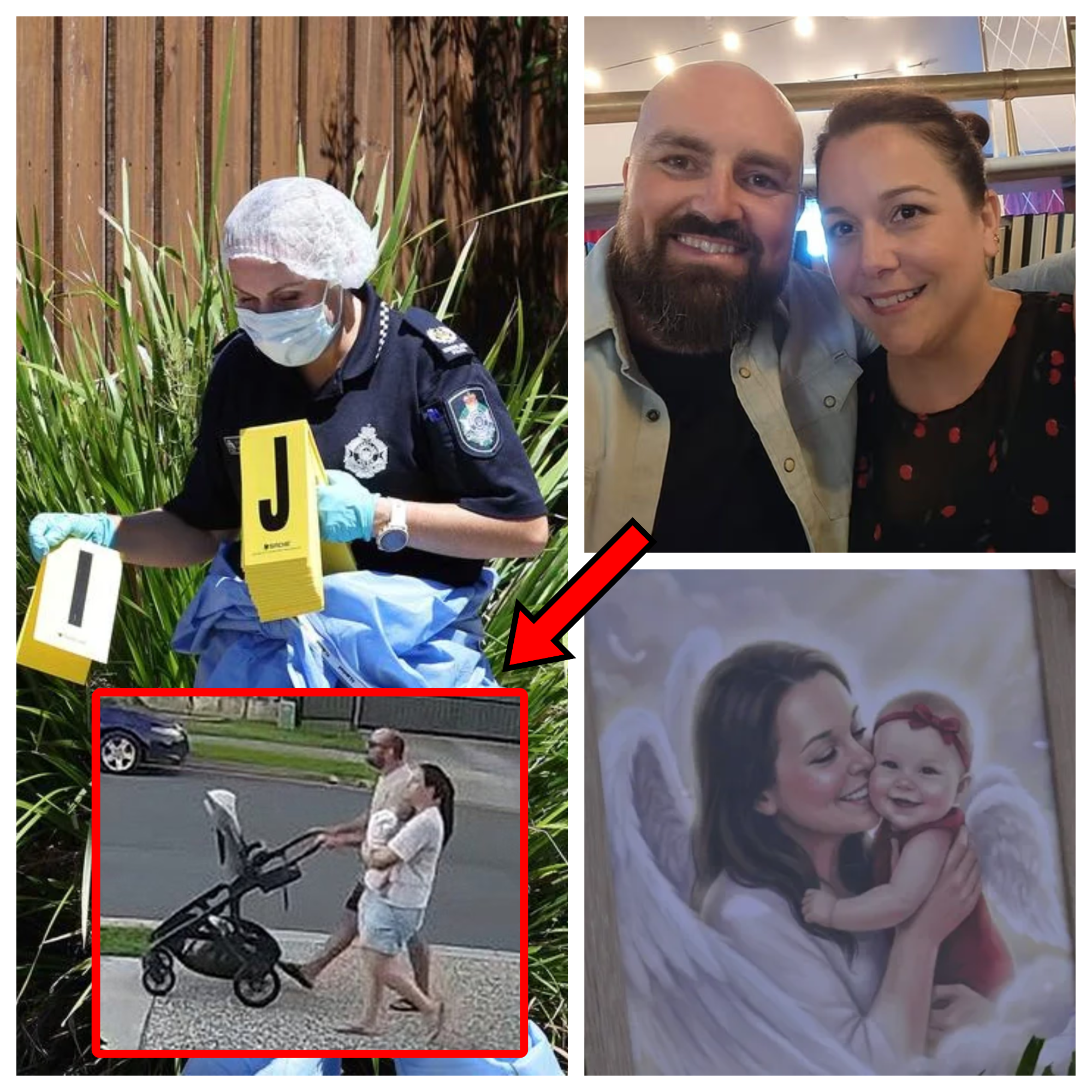
A single eyewitness account delivered to Queensland Police on March 14, 2026, has upended the investigation into the brutal stabbing deaths of 38-year-old primary school teacher Kate Paterson and her one-year-old daughter April. The witness—a long-haul truck driver traveling the Mount Lindesay Highway at approximately 5:40 a.m. on March 12—told investigators he observed a man staggering along the roadside shoulder, both hands pressed tightly against his neck. Blood was streaming visibly between the fingers and down the front of his shirt. The man, positively identified as Dr. Blake Seers, was waving frantically with one arm in an attempt to flag down passing vehicles. The driver slowed but continued forward due to poor visibility and heavy oncoming traffic. Seconds later, a white utility vehicle traveling at highway speed struck Seers as he lurched partially into the lane. He was thrown several meters and lay motionless until emergency responders arrived.
The truck driver’s description was precise: Seers appeared conscious but in severe distress, his movements jerky and uncoordinated, consistent with massive blood loss from an arterial neck wound. Paramedics who treated him at the scene documented an 8–10 cm transverse laceration across the anterior neck, deep enough to nick the trachea and cause significant hemorrhage. Emergency surgery at Princess Alexandra Hospital repaired damage to the airway and several major vessels; Seers remains intubated and sedated in the ICU under constant police guard. Medical staff report he is intermittently responsive but physically unable to speak.
This testimony directly contradicts earlier assumptions that Seers’ throat injury resulted from the vehicle impact itself. Instead, it places the laceration before the collision—meaning the wound was inflicted inside or immediately outside the family residence on Belivah Road, likely during or shortly after the fatal attack on Kate and April. A small but critical blood trail discovered during a second sweep of the property supports the account: droplets leading from the front door, down the driveway, and along the footpath for roughly 150 meters before they abruptly stop. Forensic analysis indicates the pattern is consistent with arterial spurting under pressure, not simple drip from a secondary injury.
The last known images of Kate and April alive come from a neighbor’s CCTV captured at 6:05 p.m. on March 11. Kate walks calmly along the footpath, gently pushing April’s pram. She appears relaxed, occasionally looking down at her daughter with affection. The pair had likely returned from a short evening outing to a nearby playground or shop—routine for the family in the quiet Logan suburb. They re-entered the house shortly after; lights were extinguished around 9:30 p.m., aligning with the household’s normal schedule.
Police now estimate the homicides occurred between midnight and 4:00 a.m. Kate sustained multiple stab wounds to the chest, neck, and abdomen, with defensive injuries to her forearms and palms indicating a fierce struggle. April was found in her nursery crib with precise, deep stab wounds to the chest and throat—described by pathologists as “targeted and efficient.” The suspected weapon—a bloodied kitchen knife recovered from the laundry sink—matched the wound profiles on all three victims. No forced entry was evident; investigators believe the perpetrator either possessed a key, was voluntarily admitted, or exploited an unlocked point of access.
The new witness evidence has sharpened focus on two primary scenarios. In the first, Seers was attacked inside the home during the same incident that killed Kate and April. He managed to flee the residence, ran toward the highway in search of help, and was subsequently struck by the passing vehicle. The blood trail, the timing of his appearance on the road, and the severity of the neck wound before impact lend weight to this version. The second scenario—now receiving serious consideration—is that Seers inflicted the fatal injuries on his partner and child before self-inflicting the throat wound and attempting to end his life by stepping into traffic. This theory is supported by the absence of clear third-party DNA at the scene, the lack of defensive wounds on Seers beyond those from the collision, and the fact that no signs of a struggle involving an intruder were immediately apparent.
Investigators have not formally named Seers a suspect, but sources confirm he is the central figure of interest. His mobile phone, recovered from the crash site, showed no outgoing communications between 11:00 p.m. on March 11 and the time of the incident. Cell-site data places the device inside the Belivah Road property until minutes before he appeared on the highway. A search of the home uncovered additional blood evidence on clothing belonging to Seers, though forensic results are pending.
The double homicide has devastated the Logan community. Windaroo State School, where Kate taught Year 5, remains closed as staff and students process the loss. A growing memorial of flowers, soft toys, candles, and children’s drawings covers the school entrance and spills onto the footpath. Colleagues recall Kate’s boundless energy, her innovative lessons blending art and science, and her habit of remembering every student’s birthday. Parents describe her as the teacher who made children feel truly valued. April, just weeks shy of her first birthday, was remembered in tributes as a joyful, curious toddler who loved being pushed in her pram and waving at neighbors.
Police continue to canvass the neighborhood, review additional private CCTV, and request dashcam footage from the Mount Lindesay Highway between 5:00 and 6:00 a.m. on March 12. Forensic teams have returned to the residence multiple times, searching for trace evidence that could identify—or definitively exclude—a third party. Detectives have also appealed for anyone who saw unusual activity around Belivah Road overnight to contact Crime Stoppers.
If Blake Seers survives and regains the ability to communicate, his version of events will be decisive. Until then, the truck driver’s sighting of a blood-soaked man desperately clutching his throat stands as one of the most pivotal pieces of evidence yet: a father either fleeing a massacre—or carrying the guilt of one. The peaceful CCTV stroll of a mother and her baby now serves as a heartbreaking prelude to violence that shattered a family and left an entire suburb searching for answers in the dark.