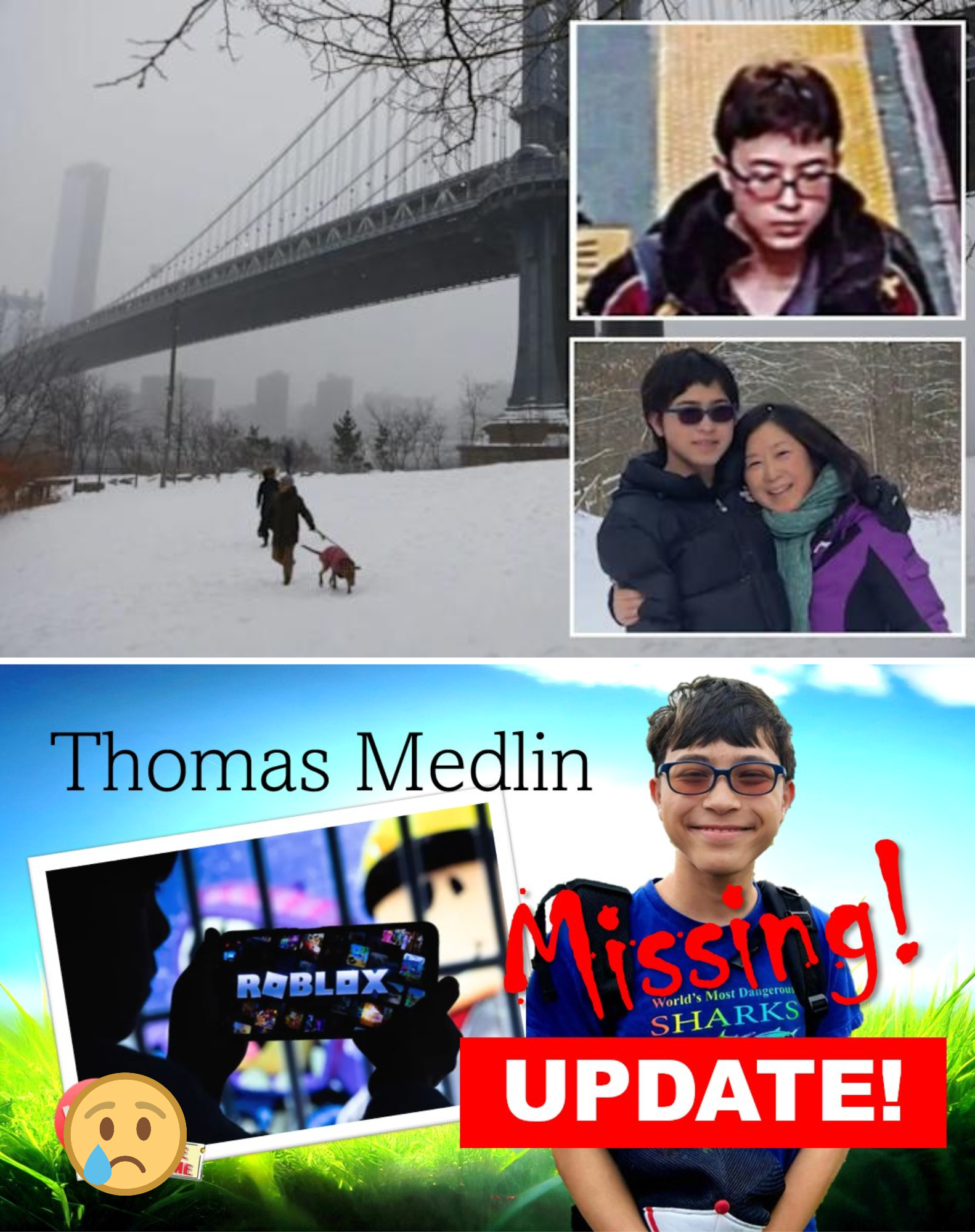
Suffolk County Police have released a pivotal update in the disappearance of 15-year-old Thomas Medlin from Saint James, Long Island, revealing that the teen was last captured on surveillance footage on the pedestrian walkway of the Manhattan Bridge on January 9 at approximately 7:06 p.m. The new details, stemming from an exhaustive review of video surveillance and digital evidence, paint a haunting picture of the final known movements of the missing boy, who left his school that afternoon and traveled alone into New York City.
Thomas departed the Stony Brook School around 3:30 p.m., heading straight to the nearby Long Island Rail Road station. He boarded a train to Manhattan, where he was first spotted on security cameras at Grand Central Terminal around 5:30 p.m. From there, the trail led to the Manhattan Bridge, a structure spanning the East River between Lower Manhattan and Brooklyn. Detectives determined his presence on the pedestrian path at 7:06 p.m., marking what authorities now describe as his last confirmed location.
The footage shows Thomas stopping near the railing for 36 seconds—a duration that investigators emphasize as potentially the most critical piece of evidence in the entire case. During this brief pause, he appears to linger in a spot overlooking the water before continuing out of the camera’s frame. No subsequent video from bridge exits captures him leaving the structure on foot. His cellphone registered its final activity at 7:09 p.m., just three minutes after the observed pause. One minute later, at 7:10 p.m., a nearby surveillance camera recorded a distinct splash in the East River below the bridge.
Police have stressed that Thomas was never seen departing via any pedestrian path exits, raising urgent questions about what transpired in those intervening moments. The absence of exit footage, combined with the timing of the phone inactivity and the water disturbance, has shifted the focus of the investigation toward the possibility of an accidental fall or intentional act into the icy river. Authorities have not ruled out foul play but noted in their statement that there is currently no indication of criminality involved. The East River’s strong currents and cold January conditions complicate any recovery efforts, yet search operations—including divers, boats, and aerial support—continue along the waterway and surrounding areas.
The case first drew public attention when Thomas was reported missing shortly after leaving school. Initial reports suggested he may have traveled to Manhattan to meet someone he connected with online through the gaming platform Roblox, though police have not confirmed this as a factor in the bridge sighting. Family members have expressed frustration with early speculation, urging focus on finding Thomas rather than unverified theories. His mother previously described him as a kind, quiet teen who loved video games and spending time with friends, making his sudden solo trip to the city all the more out of character.
The Manhattan Bridge, with its pedestrian walkway offering stunning views but also isolation at dusk, has become the epicenter of the search. The 36-second stop has gripped public imagination and fueled widespread concern. In similar past cases involving bridges, brief pauses near railings have sometimes indicated hesitation, distress, or a moment of decision. Investigators are analyzing the angle and quality of the footage to determine if Thomas showed any signs of interaction with others, appeared distressed, or made any gestures that could provide further insight. Enhanced versions of the clip, if released, could prompt witnesses—drivers on the bridge, pedestrians, or those nearby—to come forward with dashcam video or personal observations.
Community response has been overwhelming. Vigils have been held on Long Island, with classmates, teachers, and neighbors sharing photos of Thomas wearing his signature black jacket with red stripes, dark sweatpants, glasses, and backpack. Tips have flooded the Suffolk County Police tip line, including possible sightings in Manhattan that were later ruled out. Online, hashtags like #FindThomasMedlin and #BringThomasHome trend regularly, with users sharing the police updates and pleading for information.
The psychological toll on the family is evident. Thomas’s loved ones have publicly thanked the community for support while asking for privacy amid the emotional strain. Police continue to review additional digital evidence, including potential social media activity or messages from January 9, to build a fuller timeline. Divers have conducted multiple sweeps of the East River near the bridge’s midpoint, where the splash was captured, though challenging visibility, depth, and currents have hindered progress.
This development underscores the fragility of missing-persons cases, where a single piece of footage can redirect an entire investigation. The 36 seconds Thomas spent near the railing stand as a silent, agonizing pause in a story that remains unresolved. Every detail—from the exact camera perspective to the environmental conditions that evening—is under scrutiny. Authorities urge anyone with information, no matter how small, to contact them immediately. In the meantime, the search persists, driven by hope that Thomas will be found safe or that closure will come for those who love him.
As winter grips the region, the East River continues to flow beneath the bridge, holding its secrets. The moment frozen on CCTV may indeed prove decisive—whether it leads to answers, recovery, or a heartbreaking confirmation. Until then, the 36 seconds linger as a reminder of how quickly lives can change and how desperately families cling to every clue.
News
Driver Breaks Silence on Deep River Crash — Claims “Short Argument” with Rico Montes Caused the Truck to Flip.
The driver of the black pickup truck involved in the fatal Deep River crash has finally spoken publicly for the first time since the March 2026 incident that claimed the…
Phone Recovered from Deep River Still Trying to Send Final Location — The Last Desperate Act of Rodrigo “Rico” Montes.
In the early hours of March 23, 2026, 18-year-old high school senior Rodrigo “Rico” Montes made one final, heartbreaking attempt to reach his family. As police divers searched the murky…
“Mom, I’m Riding Home With a Friend, See You Soon” — The Final Text Before Rodrigo “Rico” Montes Was Found in the Overturned Truck in Deep River.
On a quiet Sunday night in March 2026, 18-year-old Rodrigo “Rico” Montes sent his mother a simple, reassuring text that would become the last words she ever received from her…
The Black Bag in the Ravine: Chilling Discovery in the Death of American Airlines Flight Attendant Eric Gutierrez.
The tragic case of 32-year-old American Airlines flight attendant Eric Fernando Gutierrez Molina took an even darker turn as investigators in Colombia recovered a black bag linked to the missing…
The Secret Weekend Pattern: How the FBI’s Latest Breakthrough May Finally Trap Nancy Guthrie’s Abductor.
As March 2026 draws to a close, the disappearance of 84-year-old Nancy Guthrie from her home in Tucson’s Catalina Foothills has entered its 55th day with no arrest and no…
The Insider Who May Have Opened the Door: FBI Hunts for the Person Who Knew Nancy Guthrie’s Home Too Well.
In the affluent Catalina Foothills neighborhood of Tucson, Arizona, where residents often leave garage doors open and security feels routine, the abduction of 84-year-old Nancy Guthrie on the night of…
End of content
No more pages to load