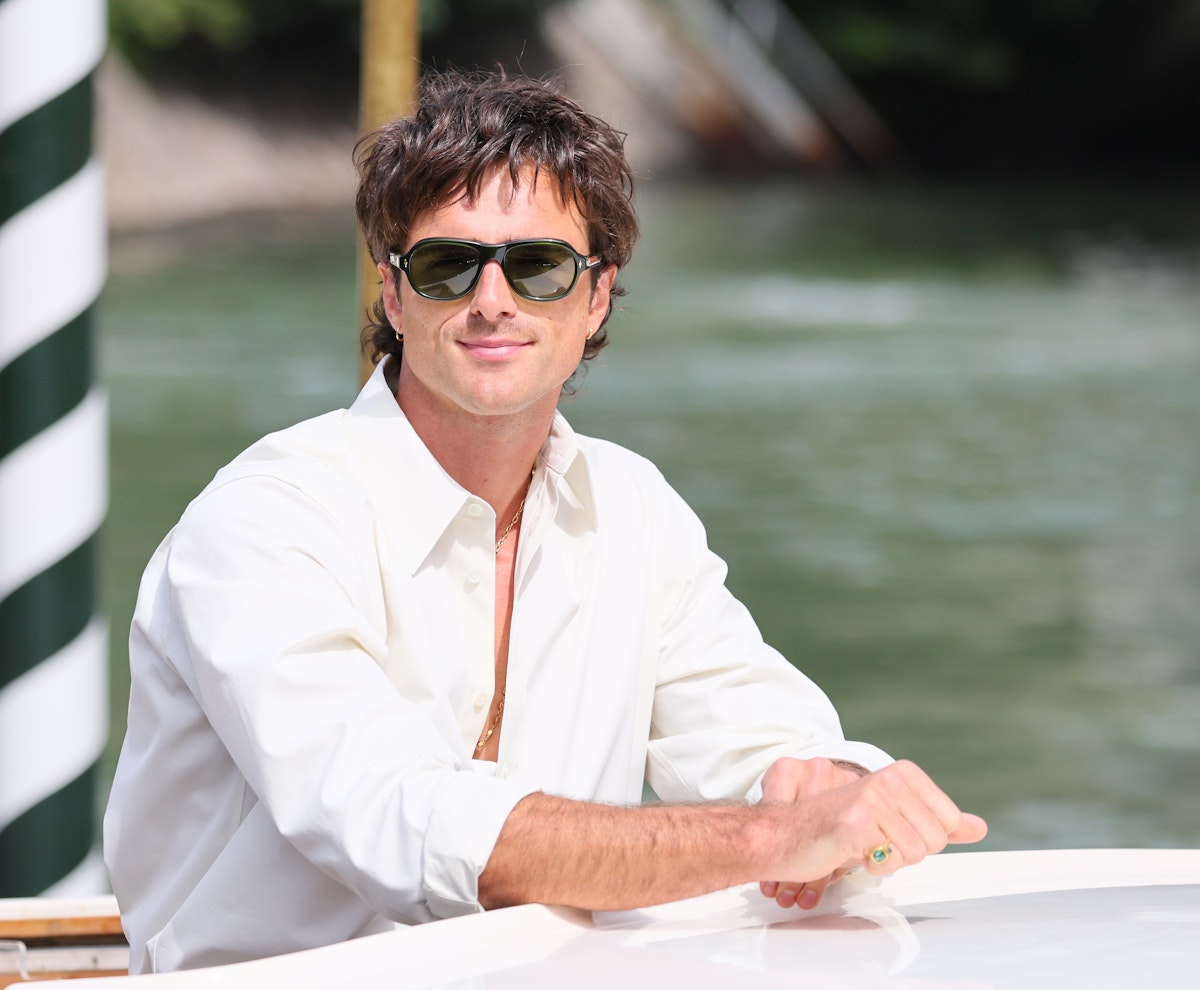
The canals of Venice shimmered under the late August sun like veins of liquid gold, the ancient city’s labyrinthine charm amplified by the frenetic pulse of the 82nd Venice International Film Festival. It was August 30, 2025—a day etched into cinematic history not just for the world premiere of Guillermo del Toro’s long-awaited Frankenstein, but for the arrival of Jacob Elordi, the 28-year-old Australian heartthrob whose sartorial sleight-of-hand turned heads faster than a plot twist in a del Toro fever dream. Stepping off a water taxi at the historic Excelsior Hotel’s private dock, Elordi emerged in a vision of all-white elegance: a custom Bottega Veneta ensemble that draped his 6-foot-5 frame like a modern-day Fellini apparition. Crisp pleated trousers cascaded to polished black loafers, a tailored button-down shirt billowed softly in the lagoon breeze, and perched atop it all, a pair of oversized Jacques Marie Mage sunglasses—those enigmatic, amber-tinted shields that have become his red-carpet armor. The look was monastic yet magnetic, a blank canvas whispering promises of the gothic grandeur to come. Photographers swarmed like seagulls, their shutters clicking in a staccato symphony, capturing the actor’s languid stride: hands thrust deep into pockets, a subtle smirk playing beneath the shades, exuding the effortless nonchalance of a man who knows the monster within is his greatest role yet.
By evening, as the festival’s grand Sala Grande theater glowed like a Renaissance jewel under the Lido’s twilight sky, Elordi underwent a metamorphosis worthy of his on-screen counterpart. The all-white prelude gave way to a classic black tuxedo—another Bottega Veneta masterpiece, double-breasted with softly structured shoulders, wide-leg trousers pooling elegantly at the ankles, and a crisp white shirt accented by a silk bow tie from Saint Laurent. Gone were the oversized sunglasses, replaced by a direct gaze that pierced the flashbulbs, his dark curls tousled just so, evoking a brooding Heathcliff reimagined for the streaming age. Flanked by co-stars Oscar Isaac (as the tormented Victor Frankenstein) and Mia Goth (the ethereal Elizabeth), Elordi paused on the crimson carpet, offering a rare, boyish grin to the roaring crowd. It was a pivot from purity to potency, innocence to intensity—a stylistic sleight that mirrored the film’s thematic core: creation, destruction, and the blurred line between man and myth. As Frankenstein unspooled to a thunderous 13-minute standing ovation, Elordi’s dual looks didn’t just dominate the dispatches from La Biennale; they redefined red-carpet alchemy, proving that in the hands of a stylist like Wendi Ferreira and Nicole DeJulio—the sister duo behind his Venice wardrobe—fashion isn’t attire; it’s narrative.
The 82nd Venice International Film Festival, held from August 27 to September 6, 2025, was a glittering requiem for cinema’s soul in an AI-saturated era. Curated by artistic director Alberto Barbera, the lineup blended auteur reverence with populist punch: Pedro Almodóvar’s The Room Next Door snagged the Golden Lion, while Frankenstein—del Toro’s magnum opus, a Netflix behemoth budgeted at $120 million—anchored the competition slate. Mary Shelley’s 1818 novel, reimagined through del Toro’s lens of body horror and existential empathy, stars Elordi as the Creature: a hulking, eloquent behemoth forged from scavenged flesh, his porcelain skin scarred by lightning and longing. No bolts in the neck here; del Toro’s monster is a tragic Adonis, his frame a canvas of sutures and sorrow, voiced with a rumbling baritone that channels Elordi’s innate vulnerability. Co-starring Isaac’s feverish inventor, Goth’s luminous bride-to-be, and Christoph Waltz as the enigmatic mentor, the film clocks in at 142 minutes of stop-motion splendor and practical effects wizardry—del Toro’s love letter to Hammer Horror, Universal classics, and his own Pan’s Labyrinth melancholy. Critics who caught the premiere hailed it as “a grotesque ballet of the human heart,” with Variety praising Elordi’s “towering physicality masking a poet’s fragility.” Streaming November 7 after a limited theatrical run starting October 17, Frankenstein positions Netflix as awards bait, with whispers of Oscar nods for del Toro’s direction, Isaac’s lead, and Elordi’s breakout supporting turn.
Elordi’s journey to this Venetian pinnacle is a tale of Brisbane grit and Hollywood alchemy. Born Jacob Elordi on June 26, 1997, in the sun-drenched suburbs of Melbourne’s east, he grew up the eldest of four in a close-knit Catholic family—his father, a property developer of Spanish descent, and his mother, a freelance writer of New Zealander roots. Tall even as a teen (he hit 6’5″ by 16), Jacob was the lanky kid channeling his awkwardness into rugby league, captaining his high school team while secretly auditioning for local theater. “I was that gangly bloke who tripped over his own feet,” he quipped in a 2023 GQ Australia profile, “but give me a script, and suddenly I’m striding.” Drama school at the Victorian College of the Arts was his crucible, where he honed a chameleon craft: the brooding intensity of Romeo + Juliet‘s Mercutio, the sly charm of The Great Gatsby‘s Nick Carraway. Post-graduation in 2015, he hustled bit parts in Aussie soaps like Neighbours before the Euphoria siren call.
HBO’s Euphoria (2019) was his American baptism: as Nate Jacobs, the golden-boy bully with a powder-keg psyche, Elordi exploded into cultural consciousness. His scenes—raw, ripped from the headlines of toxic masculinity—earned him a Critics’ Choice nod and a legion of TikTok theorists dissecting his “smolder stare.” The show’s Zendaya-led vortex propelled him to The Kissing Booth trilogy (2018-2021), Netflix’s guilty-pleasure rom-coms where he played the floppy-haired bad boy opposite Joey King, amassing 300 million hours viewed. But Elordi craved depth over dimples. 2022’s Saltburn—Emerald Fennell’s razor-sharp class satire—saw him as Felix Catton, the aristocratic idyll whose posh privilege masked predatory play. Clad in candy-striped polos and barefoot romps through Oxford quads, his chemistry with Barry Keoghan’s feral Oliver Quick ignited midnight scrolls and “hot priest” memes. Priscilla (2023), Sofia Coppola’s velvet-gloved Elvis biopic, cast him as the King himself—a towering, tender Presley whose pompadour and pelvis thrust humanized the icon, earning The New York Times acclaim as “a revelation in sideburns.” By 2025, Elordi’s slate was stacked: He Went That Way with Bryce Dallas Howard, a mockumentary A Complete Unknown as Bob Dylan sidekick, and Fennell’s Wuthering Heights where he’ll embody the storm-swept Heathcliff opposite Reneé Rapp’s Cathy. Yet Frankenstein marks his pivot to prestige horror, a role del Toro handpicked after spotting Elordi’s Euphoria reel: “Jacob has the body of a god and the eyes of a damned soul,” the director gushed in a Deadline dispatch.
:max_bytes(150000):strip_icc():focal(999x0:1001x2)/_Jacob-Elordi-083025-2-84661952c60747de881e74739bacadc9.jpg)
No dissection of Elordi’s Venice virtuoso would be complete without crediting the sartorial sorceresses: sisters Wendi Ferreira and Nicole DeJulio, the dynamic duo whose eponymous styling firm has redrawn the map of men’s red-carpet real estate. Hailing from Los Angeles’ fashion underbelly—Wendi with credits on The Ellen DeGeneres Show, Nicole touring with Sheryl Crow—the pair founded their atelier in 2018, spotting a void in menswear’s monochrome monotony. “Black tux, rinse, repeat? Nah,” Wendi told V Man post-Venice. “We wanted romance, risk—suits that tell stories.” Their ethos: oversized silhouettes with architectural precision, blending heritage houses like Bottega Veneta (Elordi’s house ambassador since 2024) with indie edge. For Venice, they curated a trilogy of looks, each a chapter in Elordi’s Frankenstein fable. The all-white arrival? A “creation dawn”—high-waisted trousers in fluid linen, a shirt unbuttoned to hint at the scars beneath, those JMM sunglasses veiling the monster’s nascent gaze. “It’s purity before the storm,” Nicole explained, “Jacob stepping into Victor’s lab, untainted.” The premiere tuxedo? A “reanimated requiem”—double-breasted wool with fanged lapels evoking del Toro’s sutures, wide legs whispering of the Creature’s lumbering grace. Between, the photocall: a checked shirt tucked into beige trousers, sleeves rolled for rogueish reveal. “We dressed the duality,” Wendi added. “Angel and beast, in one wardrobe.” Elordi’s trust in them is total: “These women see the subtext in my silence,” he shared in a rare Esquire confessional. Their Venice coup—echoing past triumphs like David Oyelowo’s crimson Oscars suit or Nicholas Hoult’s sash-ed Dior—catapulted Elordi to “best-dressed man of the fest,” per GQ Italia, outshining Timothée Chalamet’s Dune sequins and Barry Keoghan’s Beatles biopic whimsy.
The sunglasses saga deserves its own spotlight—these aren’t mere accessories; they’re Elordi’s enigmatic exoskeleton. Jacques Marie Mage, the Phoenix-based atelier crafting limited-run frames (under 500 pairs per style), has become his talisman. The Venice pair? Custom amber aviators, $1,200 apiece, with hand-engraved temples nodding to del Toro’s lore. “They shield the vulnerability,” Elordi told Variety‘s shopping desk, “let me observe without being observed—like the Creature peeking from the shadows.” His red-carpet optics chronicle reads like a style syllabus: Cannes 2025’s aviator JMMs with a Bottega tux; the Governors Awards’ tortoiseshell shades framing a thigh-grazing dinner jacket; even Saltburn‘s press tour, where square Chanels veiled his post-Felix funk. Affordable dupes abound—Ray-Ban Wayfarers at $150, Quay Australia’s oversized ovals for $60—but Elordi’s originals, blending heritage hardware with bespoke flair, underscore his ascent: from Kissing Booth teen to Bottega’s brooding beau. “Sunglasses are my script notes,” he quipped at a festival Q&A, prompting laughs from del Toro and Isaac. In Venice’s blinding Adriatic glare, they were indispensable—fashion’s fog machine for a star who’s all too aware of the spotlight’s scorch.
Venice’s red carpet wasn’t Elordi’s solo; it was a constellation of co-stars illuminating Frankenstein‘s fever. Oscar Isaac, 46 and radiating Renaissance polymath, arrived in a custom ERL tuxedo—artisan wool with a cummerbund echoing his Moon Knight mysticism, paired with a bow tie that nodded to Victor’s Victorian vanity. “Jacob’s the body; I’m the brain,” Isaac joked to Deadline photogs, his arm slung around Elordi’s shoulder in brotherly bonhomie. Mia Goth, 32, channeled Shelleyan siren in an archival Trussardi gown from 1996—ivory silk with a corseted bodice and train that trailed like a bridal shroud, Damiani jewels glinting like laboratory vials. Styled by Jessica Paster, her look fused fragility with ferocity, mirroring Elizabeth’s tragic arc. Christoph Waltz, 68, brought Teutonic gravitas in a Louis Vuitton three-piece, his pocket square a splash of crimson against charcoal— a subtle scar to the ensemble’s suture theme. The carpet crackled with their chemistry: del Toro, bearded and beaming in a velvet smoking jacket, herded his cast like a proud Prometheus, while Paris Jackson (in another Trussardi archival) and Rosie Huntington-Whiteley (Armani Privé SS24 homage) added glamour gravitas. Backstage, the ovation’s roar—13 minutes of unbridled acclaim—sealed the night’s triumph, with Elordi wiping a discreet tear, his tuxedo jacket slung over one shoulder like a discarded skin.
Beyond the velvet ropes, Elordi’s Venice vogue ignited a menswear maelstrom. The Gentleman’s Journal dubbed it “the tuxedo’s romantic revival,” crediting his Bottega breadth for breathing life into staid silhouettes. Social scrolls surged: #ElordiVenice trended with 2.5 million posts on X by September 1, fans dissecting the white-to-black binary as “monster makeup in Milanese marble.” TikTok tailors recreated the looks on a budget—white linen from Zara, aviators from Amazon—while WWD pondered his Bottega bond: since inking as the house’s face in 2024, Elordi’s campaigns (Intrecciato totes, woven loafers) have spiked sales 22% in menswear. Critics like Pitchfork‘s fashion arm lauded the “deliberate dishevel”—trousers grazing ankles, shirts untucked just enough to tease. Yet Elordi’s ethos transcends threads: “Clothes are costumes for the character you’re playing that day,” he told HELLO! in a September sit-down, “whether it’s Heathcliff on the moors or the Creature in the lab.” His stylists echo: Ferreira and DeJulio, who’ve dressed him since Priscilla, infuse narrative nuance—Venice’s white for “pre-stitch purity,” black for “post-lightning legacy.”
As Frankenstein barrels toward its bow, Elordi’s orbit expands: Wuthering Heights lenses in Yorkshire fog come spring 2026, pitting him against Rapp in Fennell’s windswept psychodrama; a Dune: Messiah whisper casts him as a Fremen lieutenant; and unconfirmed Euphoria S3 rumors tease Nate’s nadir. Off-screen, his personal palette paints a portrait of quiet complexity: a Brisbane homecoming with family barbecues, poetry slams at L.A.’s Hammer Museum (he’s a Rilke devotee), and a low-key romance with Olivia Rodrigo that fizzled amicably in 2024, per People. Philanthropy threads through: Elordi’s advocacy for Australian bushfire relief (donating Euphoria residuals) and Indigenous youth arts via his Elordi Foundation. Venice, then, wasn’t mere millinery; it was manifesto—a declaration that at 28, Jacob Elordi is no longer the brooding beau; he’s the blueprint.
In the lagoon’s lingering echo, as gondolas ghost through the night, Elordi’s dual looks linger like a half-remembered dream: white as the page before the pen, black as the ink that bleeds eternal. From oversized shades shielding secrets to a tuxedo tailored for tragedy, his Venice vignette reminds us: true style isn’t seen—it’s stitched into the soul, one masterful metamorphosis at a time.