“Try Not To Cry, Princess” — They Mocked Her, Until She Became A Navy SEAL And Took Down 8 Marines.
The sun hadn’t cleared the Pacific yet, but Coronado was already awake.
At 5:15 a.m., the air tasted like salt and old sweat, the kind that lived in concrete walls and never fully washed out. Lieutenant Roxan “Roxy” Jet finished her three-hundredth burpee without drama. No flourish. No pause to let anyone see what it cost.
Down. Up. Jump.
Down. Up. Jump.
Around her, twenty-eight SEALs matched the cadence, a synchronized grind that sounded like boots and breath and stubbornness. The instructors didn’t need to shout. The work spoke for itself. This place didn’t care about speeches. It cared about repetitions.
Roxy rose on the last one like a machine, then stood still with her hands on her thighs, eyes forward, refusing to fold in half the way her lungs begged her to. She knew the feeling well—burning chest, buzzing arms, legs so tight they felt bolted to bone. She’d lived in that edge since she was a teenager, back when the idea of a woman in the Teams was still something people said with a laugh.
Now she was here, one year, eight months, and nine days into wearing a trident on her chest.
And every morning she made sure nobody forgot what it had taken to earn it.
“Recovery stretch, move,” Commander James Torres called, voice crisp in the dawn.
Torres wasn’t the kind of leader who performed. He didn’t need to. He’d been in the Teams longer than Roxy had been alive, and the lines around his eyes looked like they’d been carved by wind and bad sleep. When he said move, people moved—not because he was loud, but because he was right.
Roxy dropped into a stretch, smooth and controlled. No tremor. No wince. She’d learned that if you showed pain, some people treated it like an invitation. Doubt was contagious out here. Disrespect was worse.
This was her family now—men who’d watched her crawl through Hell Week, who’d seen her shake and puke and keep going anyway. It hadn’t made everyone love her. It had made them accept a simple fact: she belonged.
The gate at the edge of the training ground rattled. Engines rolled in low and heavy.
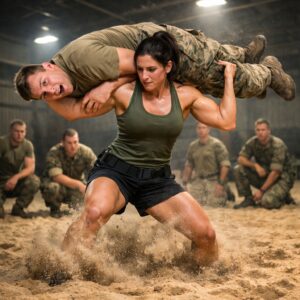
Three matte-green Humvees rolled through the morning like they owned it, each door stamped with UNITED STATES MARINE CORPS. The rumble cut through the quiet in a way that made heads lift and shoulders tighten.
SEALs and Marines had a relationship that shifted with context. Sometimes it was pure respect, the kind you only give another person who’s lived in the same hard places. Sometimes it was rivalry wrapped in jokes that carried teeth. Both sides thought they were the sharper blade.
The Humvees stopped. Doors opened.
Eight Marines stepped out, all male, all built like they’d been assembled from spare parts labeled aggression and confidence. Their posture had that Force Recon swagger—loose, but ready. Like the world was a door and they’d been born to kick it in.
Roxy recognized the type instantly. She’d grown up around it.
Her brother had been one, too, before he’d joined the Navy and disappeared into the quiet, dangerous world that didn’t make recruiting posters.
The lead Marine moved first. Tall—six-three, maybe more—with shoulders like a linebacker and a jaw that looked chiseled from frustration. Staff Sergeant chevrons rode his sleeve. The name tape read HAYES.
Torres stepped forward, hand out. “Commander James Torres. Welcome to Coronado.”
Hayes shook with a firm, deliberate grip, eyes sweeping the assembled SEALs like he was counting them. His gaze landed on Roxy and stayed there just a touch too long.
Three seconds.
His mouth twitched like he’d smelled something sour.
Torres didn’t miss it. Neither did Roxy.
“This is a joint training detachment,” Torres said, voice even. “Two weeks. Advanced close-quarters, hostage rescue, extraction, the whole package. We do this clean. We do it professional.”
“Crystal, Commander,” Hayes said.
The words were respectful. The tone carried something else. Like he was agreeing out loud while disagreeing in his head.
The first week passed in a blur of controlled violence.
Live-fire drills at 0400. CQB house runs at 0600. Breaching drills with flash-bangs that left ears ringing until lunch. Roxy moved like she had been born inside the kill house—smooth entries, perfect pie slices around corners, weapon transitions so fast they looked lazy. She never spoke unless spoken to. She never smiled unless it was earned.
The Marines noticed.
They noticed the way she cleared rooms faster than half their team. They noticed how she never asked for help reloading mags or adjusting gear. They noticed that when the instructors called “fail,” she was never the one walking back to the start line.
So they started small.
A muttered “princess” when she passed the chow line.
A low whistle when she racked a 225-pound deadlift like it weighed nothing.
A joke about “how cute it is when girls play soldier.”
Roxy heard every word. She filed every one away the way a sniper files wind speed and distance. She didn’t react. Not yet.
On day nine came the crucible: a full-contact, no-holds-barred force-on-force scenario. Two teams—eight SEALs and eight Marines—tasked with capturing a mock high-value target inside a condemned barracks complex. Rules were simple: simunition rounds only, no eye-pro removal, fight until one side controls the objective.
Torres paired Roxy with the assault element.
Hayes smirked when he saw the lineup. “You sure you want her up front, Commander? We don’t want anyone getting hurt.”
Torres looked at Hayes the way a parent looks at a child who just asked if the stove is hot.
“She’s not here to be protected,” he said. “She’s here to win.”
The whistle blew.
The Marines moved fast—stacked, aggressive, shouting suppressed commands. They breached the south door and poured inside like water through a broken dam.
Roxy’s team went in from the east.
She was first through the breach.
The hallway was dark, smoke thick from earlier pyrotechnics. She pie’d the corner, weapon up, finger indexed. Two Marines appeared at the end of the corridor—Hayes and another sergeant. They opened fire.
Roxy dropped, rolled left, came up behind a rusted filing cabinet. Simunition cracked against metal. She returned two controlled pairs—center mass on both. Both men dropped, cursing and laughing at the same time.
“Two down,” she said into comms, voice calm.
She moved.
Third Marine rounded the stairwell. She sidestepped, used his momentum against him, drove an elbow into his throat, swept his leg, finished with a knee to the ribs as he hit the floor. He wheezed “out” before he even realized he’d lost his rifle.
Fourth came from behind.
She felt the air shift, spun, caught his wrist mid-strike, twisted, forced him face-first into the wall. Plastic clacked against concrete. He tapped twice. Out.
Five and six tried to flank from the adjacent room.
Roxy didn’t wait. She low-crawled under a desk, popped up between them, double-tapped one in the chest, then pivoted and put three rounds into the other’s plate carrier. Both raised hands. Done.
Seven and eight were waiting at the objective room.
They had barricaded the door with a heavy table.
Roxy didn’t hesitate.
She charged the door shoulder-first, splintered the wood, rolled inside, came up shooting. One Marine caught a sim round to the helmet and swore loudly. The other tried to grapple.
Big mistake.
Roxy used his weight against him, dropped low, hooked his ankle, flipped him over her hip. He landed hard. She mounted, pinned his arms with her knees, pressed the muzzle of her training rifle against his throat.
“Yield,” she said quietly.
He stared up at her for a long second.
Then tapped the floor three times.
The whistle blew again.
Objective secured.
Seven minutes and forty-one seconds.
Eight Marines down.
Zero SEALs.
The room went quiet.
Hayes pushed himself up off the mat, rubbing his chest where the simunition had left a red welt. He looked at Roxy for a long moment—really looked at her this time. Not as a woman in the Teams. Not as “princess.” Just as the person who had just dismantled his entire squad without breaking a sweat.
He walked over slowly.
Extended a hand.
Roxy took it.
“Good work, Lieutenant,” he said. No sarcasm. No edge. Just respect.
She shook once. Firm.
“You too, Staff Sergeant.”
Later that evening, in the team room, the Marines bought the first round.
Hayes raised his bottle toward Roxy.
“To the princess,” he said, and this time the word carried no mockery.
“To the princess,” the others echoed.
Roxy lifted her water bottle in return.
She didn’t smile.
She didn’t need to.
The room understood.
She had earned the silence that followed.
And in the Teams, silence is the loudest form of respect there is.