The Wrong Table. The Viper Was Never the One They Feared.
The Wrong Table. The Viper Was Never the One They Feared.
The first thing Sergeant Caleb “Hawk” Donovan noticed was not the woman’s face, or the orange in her hands, or the way the entire corner of the mess hall seemed to bend around her silence. It was the table. Table Seven. For three years, that table had belonged to him. Not officially. Nothing at Camp Pendleton belonged to anyone except the Corps, the government, and the dust that settled into every boot seam by sundown. But some things were understood.
The coffee pot nearest the back wall was for Staff Sergeant Briggs. The busted vending machine was cursed. And Table Seven was Hawk’s territory. So when Caleb walked in with six Marines behind him, sweat still drying under their collars after morning drills, and saw a woman sitting there alone, peeling an orange like she had all the time in the world, something hot and stupid ignited behind his ribs. She was small compared to the men around her, maybe five-six, with dark hair pulled tight against her skull and a face so still it looked carved from winter.
Her uniform was regulation, but her jacket was plain. No flashy patches. No visible rank on the angle Caleb could see. No nervous glance, no apology, no instinct to move. That annoyed him most. The mess hall noise throbbed around her: trays clattering, chairs scraping, laughter sharp as broken glass. Yet she sat in the center of it like the eye of a storm, carefully separating the orange peel in one long spiral. Her fingers moved with clean, patient precision. Caleb dropped his tray on the table hard enough to rattle her spoon.
“Hey, sweetheart,” he said, leaning over her. “You’re in the wrong zip code.”
The laughter behind him came instantly. Too instantly. His men knew the script. He barked, someone flinched, they laughed, order returned. But the woman did not flinch. She didn’t even look up. “I’m eating, Sergeant,” she said. Her voice was quiet. Level. Not afraid. Not angry. That should have warned him. Caleb smiled, but there was no humor in it. “And I’m telling you to move.”
The orange peel continued to curl. Across the hall, a few Marines began to look over. Someone lowered a fork. Someone else stopped laughing mid-breath. Caleb felt the room watching, and because he felt it, he could not back down. Men like him were built out of witnesses. Without an audience, his cruelty had no shape. He bent closer.
“You deaf?” Her thumb slid beneath the peel. “No.” “Then stand up.” “No.” The word landed softly, but Caleb felt it like a slap. His squad shifted behind him. One of them, Private Lewis, muttered, “Hawk, maybe—” Caleb shot him a look that shut him up. He reached down, fast and casual, and hooked his fingers into the tight knot of hair at the back of her head. The mess hall changed. Not loudly. Not dramatically.
But something in the air tightened. Conversations died in uneven patches. A tray stopped halfway to the dish return. Somewhere behind Caleb, a chair leg squealed once and then went still. He tugged. Not hard enough to injure. Just enough to humiliate. The woman’s hand stopped mid-peel. For the first time, she looked up. Her eyes were gray-green, cold and clear, without a drop of panic in them. Caleb expected fury. He expected fear. He expected the kind of wounded pride he knew how to crush. Instead, she looked at him like she was reading a weather report.
“Let go,” she said. Caleb leaned closer, lowering his voice. “Or what?” Her gaze moved from his face to his hand, then back again. “Last warning.” He laughed. “You hear that, boys? She’s warning me.” His fingers tightened in her hair. A second later, Caleb Donovan screamed.
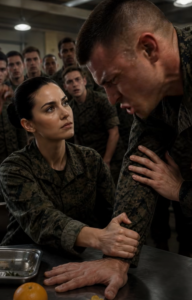
It happened too fast for most people to understand. Her left hand came up, caught his wrist, and twisted inward with a crisp, brutal economy. Her elbow pinned his forearm. Her shoulder turned. His grip opened before his brain knew he had lost control. Then she drove his hand down onto the metal table. The impact cracked through the mess hall like a rifle shot. His tray jumped.
The orange rolled once, bumped his sleeve, and stopped. Caleb’s knees hit the bench. His breath went out in a wet grunt. Pain flashed white behind his eyes. He tried to pull back, but she held him there with one hand, still seated, still calm, still barely breathing hard. The woman leaned just close enough for him to hear. “Then don’t touch me.”
Every Marine in the hall stared. Caleb’s face burned hotter than his wrist. Pain was nothing. Pain he understood. Humiliation was worse. Humiliation made monsters out of men who had already mistaken cruelty for strength. “You have no idea who you just put hands on,” he hissed. She released him. He stumbled back, clutching his wrist. His squad did not laugh now. Nobody did.
The woman picked up the orange, tore away another strip of peel, and said, “Neither do you.” That was when the door at the far end opened. Three officers entered. The first was a captain Caleb recognized. The second was a colonel he had seen only from a distance. The third was a civilian-looking man in a black suit, walking with the soft authority of someone who did not need a uniform to ruin lives.
The colonel’s eyes swept the room and stopped at Table Seven. His expression changed. Not surprise. Recognition. He walked straight toward the woman. Caleb felt something unfamiliar crawl up his spine.
The colonel stopped beside her table and said, “Major Voss.” The room inhaled. Caleb’s mouth went dry. Major. The woman wiped juice from her thumb with a napkin, then finally stood. She was not tall, but the room seemed to shrink around her. “Colonel,” she said.
The colonel looked at Caleb’s red wrist, the fallen tray, the watching Marines. “Is there a problem here?” Major Elena Voss glanced once at Caleb. For the first time, something like emotion crossed her face. Not anger. Disappointment. “No, sir,” she said. “Just a misunderstanding at the wrong table.” But Caleb knew, in the sudden hollow beneath his ribs, that it was not over. It had just begun…
The room inhaled. Caleb’s mouth went dry.
Major.
The woman wiped juice from her thumb with a napkin, then finally stood. She was not tall, but the room seemed to shrink around her.
“Colonel,” she said.
The colonel looked at Caleb’s red wrist, the fallen tray, the watching Marines. “Is there a problem here?”
Major Elena Voss glanced once at Caleb. For the first time, something like emotion crossed her face. Not anger. Disappointment.
“No, sir,” she said. “Just a misunderstanding at the wrong table.”
But Caleb knew, in the sudden hollow beneath his ribs, that it was not over. It had just begun.
Colonel Reyes — no relation, but the name still sent a chill through the old hands — nodded once, then turned to the entire mess hall. His voice carried without effort.
“Marines, listen up. This is Major Elena Voss, Task Force Serpent. She’s not here on vacation. She’s running a classified assessment of unit discipline, close-quarters readiness, and leadership culture across Pendleton. Her word carries the same weight as mine — sometimes more.”
A stunned silence thickened the air. Someone’s tray clattered to the floor.
Elena Voss looked at Caleb. Her gray-green eyes were calm again, almost gentle in their finality.
“You wanted the table, Sergeant Donovan. It’s yours.” She gathered the remains of her orange, placed the peel neatly on the tray, and stepped aside. “But understand this — ownership isn’t taken with noise and hands. It’s earned with respect. You just taught every Marine in this hall what happens when you forget that.”
Caleb stood frozen, wrist throbbing, pride in ruins. His squad wouldn’t meet his eyes. Private Lewis stared at the floor like it might swallow him.
Colonel Reyes continued. “Effective immediately, Sergeant Donovan and his fire team will report to Major Voss for remedial training. Full syllabus. Two weeks. No excuses.” He paused, letting the weight settle. “And every platoon leader in this mess hall will ensure this incident is discussed in tonight’s after-action reviews. We don’t haze our own. We don’t break discipline for ego. Not on my watch.”
As the officers turned to leave, Elena paused beside Caleb one last time. She spoke so quietly only he could hear.
“I’ve been the small woman in the corner more times than you can count. In places where men like you didn’t survive long enough to learn. Next time you see someone quiet, ask yourself why they feel safe enough to stay that way.”
She rolled up her sleeve just enough for him — and the closest Marines — to see the ink: the coiled serpent around the dagger, crimson eyes sharp even under mess hall lights. The mark of Task Force Serpent. The ghost unit whose operators wrote the manuals everyone else trained by.
Caleb swallowed. For the first time in years, the Hawk had nothing to say.
Over the next two weeks, Caleb Donovan learned humility in the hardest classroom on base. Major Voss didn’t yell. She didn’t need to. She dismantled him on the mats again and again with that same terrifying calm, then rebuilt him piece by piece. His fire team trained beside him, soaked in sweat and silent respect. By the end, they moved differently — sharper, quieter, more dangerous.
On the final day, after Caleb successfully countered one of her signature wrist traps for the first time, Elena Voss offered him her hand. He took it without hesitation.
“You’re good, Hawk,” she said. “You just forgot that strength without control is weakness wearing a loud mouth.”
Caleb nodded, throat tight. “Table Seven is yours whenever you want it, Major. Hell… the whole damn mess hall is.”
She gave the smallest smile. “Keep it. I prefer the corner now. Easier to watch.”
When Major Elena Voss left Camp Pendleton a month later, she did so as quietly as she had arrived. But the story remained. Marines who had once laughed at the small woman peeling an orange now told the tale with something close to reverence. Table Seven stayed empty for weeks, a silent monument.
And Sergeant Caleb “Hawk” Donovan? He never again claimed a table with force.
He earned his space the way she taught him — with discipline, with respect, and with the quiet understanding that the most dangerous person in any room is often the one who needs no audience to prove it.
The Viper had never been the one they feared.
She was the one they learned to respect.